🧁 Baking Powder Sodium Calculator
Estimate sodium from baking powder by teaspoons, grams, label sodium, recipe type, servings, flour amount, batch multiplier, substitution ratio, and leavening strength.
Choose flour-ratio mode when drafting a recipe from flour. Choose direct amount mode when a recipe already lists baking powder teaspoons or grams.
| Label Profile | Sodium Per Tsp | Sodium Per Gram | Calculator Use |
|---|---|---|---|
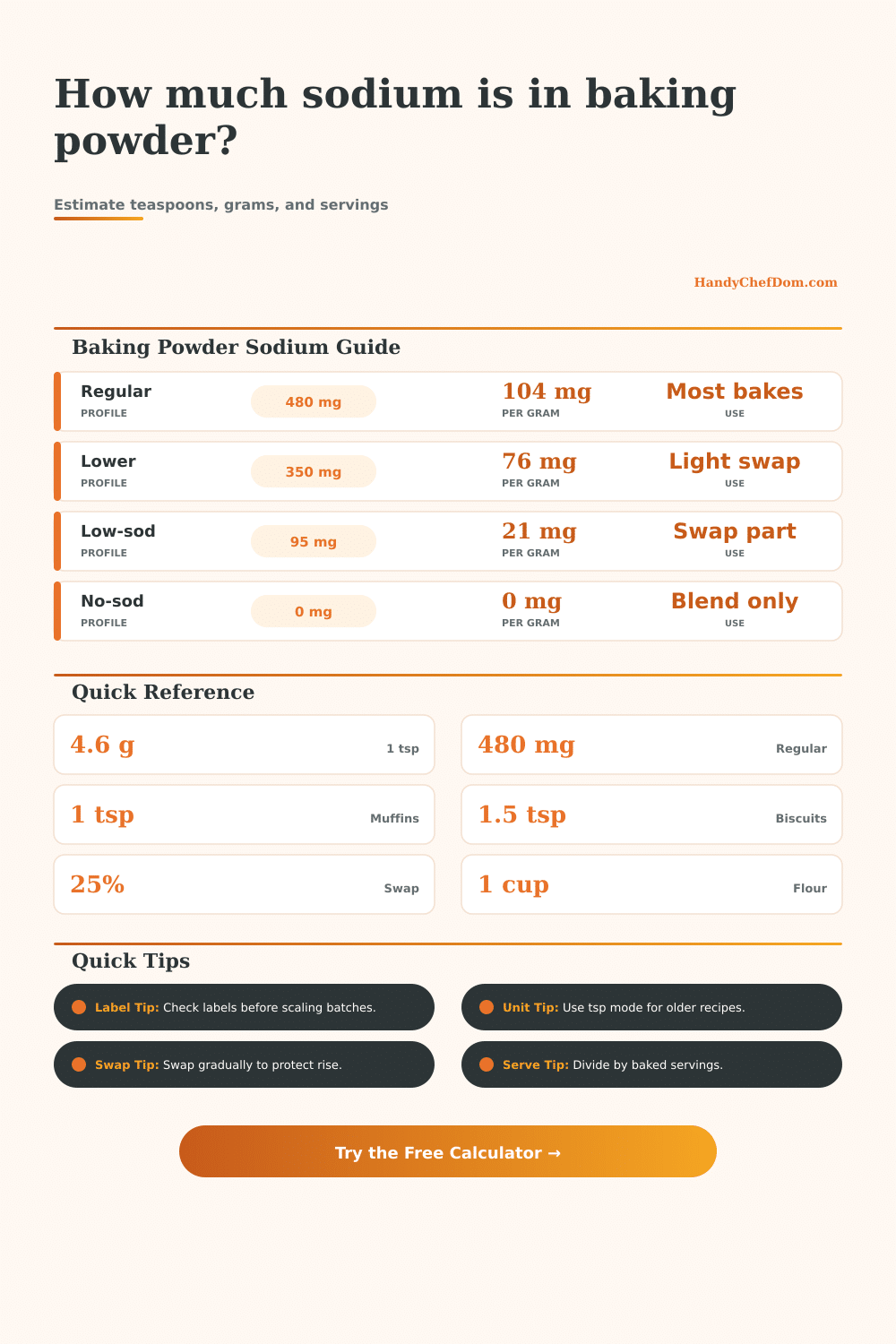
| Regular double-acting powder | 480 mg | 104 mg/g | Use for typical recipes unless your label says otherwise. |
| Lower-sodium style powder | 350 mg | 76 mg/g | Use when the label is lower than regular but not reduced-sodium. |
| Aluminum-free style powder | 520 mg | 113 mg/g | Use label data because sodium can still be high. |
| Store-label style powder | 450 mg | 98 mg/g | Good placeholder for generic pantry calculations. |
| High-sodium label powder | 600 mg | 130 mg/g | Use when a nutrition label lists a higher sodium level. |
| Reduced-sodium blend | 180 mg | 39 mg/g | Use for packaged reduced-sodium baking powder. |
| Very low-sodium blend | 95 mg | 21 mg/g | Use when a label or homemade blend is clearly low sodium. |
| Sodium-free blend | 0 mg | 0 mg/g | Use for sodium-free substitutes entered at zero sodium. |
| Recipe Type | Typical Baking Powder | Flour Basis | Planning Note |
|---|---|---|---|
| Layer cake or snack cake | 1 tsp per cup flour | 120 g flour | Balanced lift for tender cake batters. |
| Muffins | 1 tsp per cup flour | 120 g flour | Common starting point for quick muffin batters. |
| Pancakes or waffles | 1.25 tsp per cup flour | 120 g flour | Higher lift for fast griddle batters. |
| Baking powder biscuits | 1.5 tsp per cup flour | 120 g flour | Higher amount for a taller, lighter crumb. |
| Quick bread loaf | 0.75 tsp per cup flour | 120 g flour | Dense batters often use a moderate amount. |
| Cornbread | 1.25 tsp per cup dry mix | 120 g dry mix | Use flour-cup equivalent for the dry base. |
| Scones | 1.25 tsp per cup flour | 120 g flour | Uses extra lift for thick cut dough. |
| Soft cookies | 0.5 tsp per cup flour | 120 g flour | Smaller amount supports spread control. |
| Baking Powder Amount | Approx Grams | Sodium at 480 mg/tsp | Sodium at 180 mg/tsp |
|---|---|---|---|
| 1/4 tsp | 1.15 g | 120 mg | 45 mg |
| 1/2 tsp | 2.3 g | 240 mg | 90 mg |
| 1 tsp | 4.6 g | 480 mg | 180 mg |
| 1 1/2 tsp | 6.9 g | 720 mg | 270 mg |
| 2 tsp | 9.2 g | 960 mg | 360 mg |
| 1 tbsp | 13.8 g | 1440 mg | 540 mg |
| 4 tsp | 18.4 g | 1920 mg | 720 mg |
| 2 tbsp | 27.6 g | 2880 mg | 1080 mg |
| Substitution Ratio | Regular Powder | Substitute Powder | Effect on Sodium |
|---|---|---|---|
| 0% substituted | 100% | 0% | No sodium reduction from the baking powder. |
| 25% substituted | 75% | 25% | Modest reduction with less change to lift. |
| 50% substituted | 50% | 50% | Large reduction, best tested before serving. |
| 75% substituted | 25% | 75% | Very low sodium if the substitute is sodium-free. |
| 100% substituted | 0% | 100% | Lowest sodium, but leavening behavior may differ. |
| Weak powder adjustment | More total tsp | Same ratio | Sodium rises if extra regular powder is needed. |
If you’re feeding a large family (or yourself) who needs to watch their salt intake, baking powder’s got a ton of sodium in a tiny little canister and it realy adds up fast. When you’re thinking about making cakes and muffins tender and rising high, you probably aren’t thinking about how much sodium is hiding out in there. But with a few simple entries from you into the calculator above, it’ll do the math for you. Once you know why those numbers change when you adjust ingredients, you’ll be able to bake smarter.
On average, between four hundred and five hundred milligrams of sodium per teaspoon is what most regular double-acting baking powder contain. It’s a lot, yes, when you think of it as a pinch of leavening agent, but keep in mind: how much of this stuff do you use in any given recipe? If you’re making a typical cake batter, you’ll be using one teaspoon per cup of flour. A two layer cake with three cups of flour will require three teaspoons of powder. There are one thousand four hundred milligrams of sodium in your cake batter before adding any salt at all, and all of it is hidden, chemically bound up in the very thing most home bakers don’t even think about.
Why Baking Powder Has So Much Salt
Because brands differ so much, the tool also includes options for various types of labels (some store brands are a bit less; some have no aluminum, which may mean more sodium than regular ones). The only way to know is to check your own bottle. The calculator converts that information into grams for you. This helps because most nutrition labels shows sodium per serving but don’t say how many grams are in a teaspoon. In case you’re wondering: A teaspoon weighs approximately four and a half grams.
If you halve a batch, you halve the sodium. If you double a recipe, you double the sodium. Simple math. It is easy to overlook when you are mixing things together. You should of also consider trying a sodium-free or low-sodium mix. The calculator has spaces to enter substitution ratios, that way, you know precisely how many milligrams of sodium you’ll avoid when you use half of your normal powder and substitute the other half with no-sodium kind.
Know that these replacements will be a bit different in the oven; some won’t rise as well, others will change the flavor somewhat. So it’s good to test a mini-batch before committing. That is covered nicely on the reference table. The table explains how various substitutions affects the final sodium count but have a minimal impact on rising.
How Powder Strength Affects Sodium Content
Another thing to consider: how strong is your powder? Baking powder does lose its strength with age, and if your powder’s can has been in the cupboard for half a year or longer, it may only contain eighty percent of its initial strength as a rising agent. If this sounds like you, you’re likely tempted to add more to make up for it… Adding more sodium in the process. To account for the strength of your powder, the calculator lets you input that value into the calculation, so it provides you with a more realistic estimate of the amount you’re actualy ingesting. It’s a little thing, sure. But if you’re trying to nail down an exact nutritional target, every little bit counts.
When baking we strive for balance. We aim for our baked goods to be delicious, fluffy, and fitting our diet. Sodium is an ingredient worth knowing about when baking. Keeping track of how much sodium comes from your leavening agent helps show you exactly what you are consuming. Remember, it’s not all or nothing. It’s about knowing where your sodium is coming from.
Next time you open up that box, just give the back of package a quick glance. You may be surprised by how much sodium can be packed into something so small. Using a few simple tools and a little bit of planning will allow you to achieve a light and airy bake without any more sodium than you’d like. Small change in the kitchen leads to a healthier habit at the table.