🍕 Leftover Pizza Shelf Life Calculator
Estimate a conservative leftover pizza storage window from topping type, storage temperature, time left out, wrap, slice stack depth, reheats, sauce load, freezing plans, and your planned eat date.
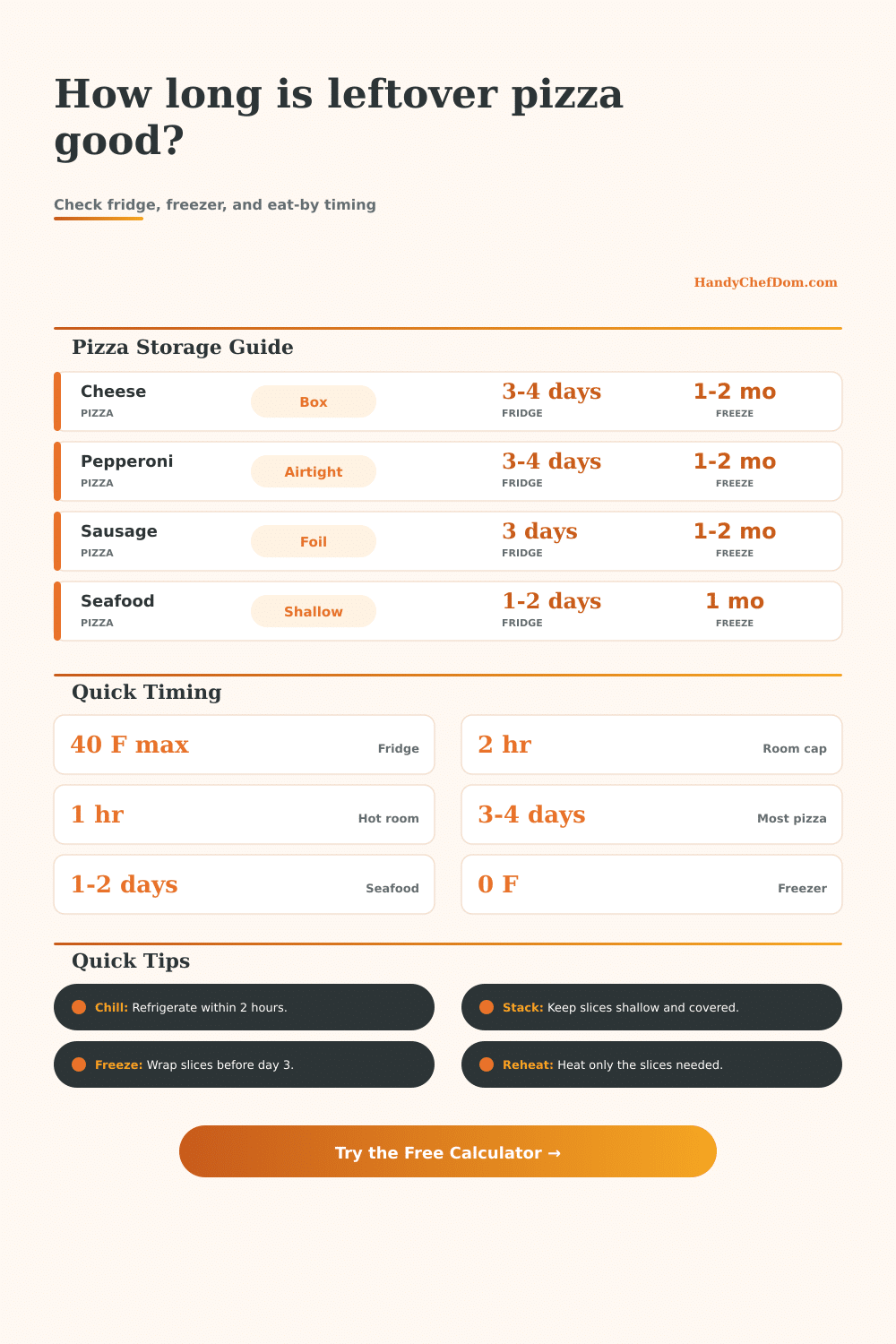
Use a conservative home-kitchen estimate based on USDA and FoodSafety-style leftover guidance: refrigerate perishable pizza within 2 hours, within 1 hour above 90°F, keep the fridge at 40°F or below, and discard food that exceeded the safe time limit.
| Topping Type | Conservative Fridge Window | Freezer Quality | Storage Note |
|---|---|---|---|
| Plain cheese pizza | 3 to 4 days | 1 to 2 months | Store covered and shallow; quality is best early |
| Pepperoni or cured meat | 3 to 4 days | 1 to 2 months | Treat as a cooked perishable leftover |
| Vegetable pizza | 3 to 4 days | 1 to 2 months | Watery vegetables can soften crust and shorten quality |
| Sausage or meat lovers | 3 days | 1 to 2 months | Use the shorter side for ground meat and mixed meats |
| Chicken or turkey pizza | 3 days | 1 to 2 months | Reheat only the slices being served |
| Ricotta or extra-cheese white pizza | 2 to 3 days | 1 month | High dairy and moisture reduce quality hold |
| Seafood pizza | 1 to 2 days | 1 month | Use quickly and discard if mishandled |
| Loaded mixed toppings | 3 days | 1 to 2 months | Use the most perishable topping as the guide |
| Container or Wrap | Cooling and Drying | Best Use | Calculator Treatment |
|---|---|---|---|
| Airtight shallow container | Best balance of cover and shallow cooling | Meal prep slices and next-day lunches | Small quality boost |
| Foil or plastic wrap on plate | Good cover, moderate drying risk | Short fridge holds | Neutral treatment |
| Original pizza box | Bulky, dries fast, cools uneven stacks | Temporary storage only | Shortens window |
| Loose cover or gap in wrap | More exposure and faster quality loss | Eat soon | Shortens window |
| Open or poorly covered | Fast drying and contamination exposure | Avoid for leftovers | Strong reduction |
| Vacuum sealed freezer pack | Best freezer quality protection | Flat frozen slice packs | Freezer quality boost |
| Timing Grid | Room Temperature | Action | Calculator Treatment |
|---|---|---|---|
| 0 to 1 hour left out | Up to 90°F | Refrigerate in shallow covered storage | Best case timing |
| 1 to 2 hours left out | Up to 90°F | Refrigerate now and use the shorter side | Small reduction |
| Over 2 hours left out | Up to 90°F | Discard perishable leftover pizza | Discard verdict |
| 0 to 1 hour left out | Above 90°F | Chill immediately | Shorter side |
| Over 1 hour left out | Above 90°F | Discard perishable leftover pizza | Discard verdict |
| Fridge above 40°F too long | Unsafe storage range | Use official outage guidance and discard when in doubt | Zero or reduced remaining time |
| Slice Stack and Reheat Choice | Storage Effect | Use-By Impact | Recommended Handling |
|---|---|---|---|
| Single layer slices | Fastest cooling | Uses full adjusted window | Separate with parchment or use shallow boxes |
| 1 to 2 inch stack | Normal home storage | Neutral treatment | Cover tightly and keep cold |
| 2 to 3 inch stack | Slower center cooling | Use shorter side | Split stacks before refrigerating |
| Deep dish or over 3 inches | Slowest cooling | Strong reduction | Store individual portions |
| One reheat | Quality and handling loss | Use within 1 to 2 days | Reheat only what will be eaten |
| Two or more reheats | Repeated warm-cool cycling | Use same day or discard | Avoid saving reheated slices again |
Is it safety or risk? If your leftover pizza sits on the counter, it’s one thing; if it’s in the back of the fridge, that’s another. Should you eat it now, or save it for breakfast tomorrow?
On the one hand, you don’t want to waste food. But on the other, you don’t want to get sick either. Typically decision between stomach ache vs. Choosing a tasty meal is more about when you eat it then what you eat. To most people, it comes down to sniffing: Does it smell off? Unfortunately, bacteria don’t always gives off an unpleasant scent until they’ve done too much damage.
Tips for Storing Leftover Pizza
You also have some influence over storage temperature. Running your refrigerator warmer than forty degrees (which many do, particularly when frequently opened or stuffed with food) will shorten the safe-eating period beyond what standard guidelines indicates. The refrigerator-temperature calculator linked above lets you take into account this factor; rather than assume ideal storage conditions, you can plug in the real world scenario of your own fridge’s temperature. It’s not a huge adjustment, but an improvement.
Three days is assumption of cool and consistent conditions; raise the temp by five degrees and you may be cutting off a day and a half from the safe range. When planning out meals, that’s significant.
Also, certain toppings makes the pizza spoil quicker. Cured meats (such as pepperoni) aren’t as risky than seafood, and seafood will go bad more quickly because it spoils easy. This calculator takes that into account, adjusting the expiration date accordingly for pies containing seafood.
Plain cheese slices are easy; properly kept in a air-tight container, they’ll last up to three or four days before anything really goes wrong. But add fresh veggies, white sauce, or ricotta, and you’re creating an environment ripe for bacterial growth (thanks to increased moisture). For that reason, don’t just focus on the crust: keep in mind what’s on top of it when using the tool, since it shortens the time frame for higher-moisture pizzas to match.
Wrap it up: Most people don’t realize that how you wrap the pizza matters more then they think. If you have an old school pizza box (the original kind), it’s not good to store it since it traps heat when stacked, is bulky, and lets air in. It’s best to transfer each slice into a shallow container that can be closed. This protects against contamination and slows drying.
The calculator considers open boxes or loose wrapping a major risk. Invest a couple minutes and put your slices into a container that’s airtight and shallow. Don’t stack them too deep, because a thick pile will cool slowly and leave the middle in a dangerous temperature range for longer. Keep in mind, though, that a shallow container cools quickly; the whole slice will be okay.
You should also consider whether you will reheat. Each time a slice gets warmed up and cooled down, it degrade in quality, and the safety margin shrinks too. That’s why the calculator takes into account how many times you’ve reheated a slice; each additional heating makes it less safe than when eaten cold or just warmed once. It’s a conservative stance, but it covers your ass.
Don’t mess with it: you want to eat the stuff you intend to eat, not subject it to your fridge’s patience. If you’re not sure, pop the leftover slices into the freezer on the first day. Freezing completely stops the clock and retains texture more effective than prolonged storage in the fridge. Thaw in the fridge (not at room temperature on the counter).
Remember: The precise number of hours is never what this is really about. Two days? Soft. Discard? Don’t fight it… The price of a wrong move here is more expensive then the price of a fresh slice. When you store it, keep it simple: Wrap it tightly, keep it cool, eat it quickly.
Counter-slice? That’s a gamble. Container-slice? That’s a plan.