🧊 Ice Cubes per Whiskey Calculator
Estimate cubes per glass and total ice by pour volume, glass style, cube size, dilution target, temperature, sip time, and guest count.
Choose the serving style, pour size, cube format, target dilution, sip time, temperatures, and guest count. The calculator estimates melt water and rounds cubes up for service.
| Glass Style | Typical Pour | Ice Choice | Dilution Target |
|---|---|---|---|
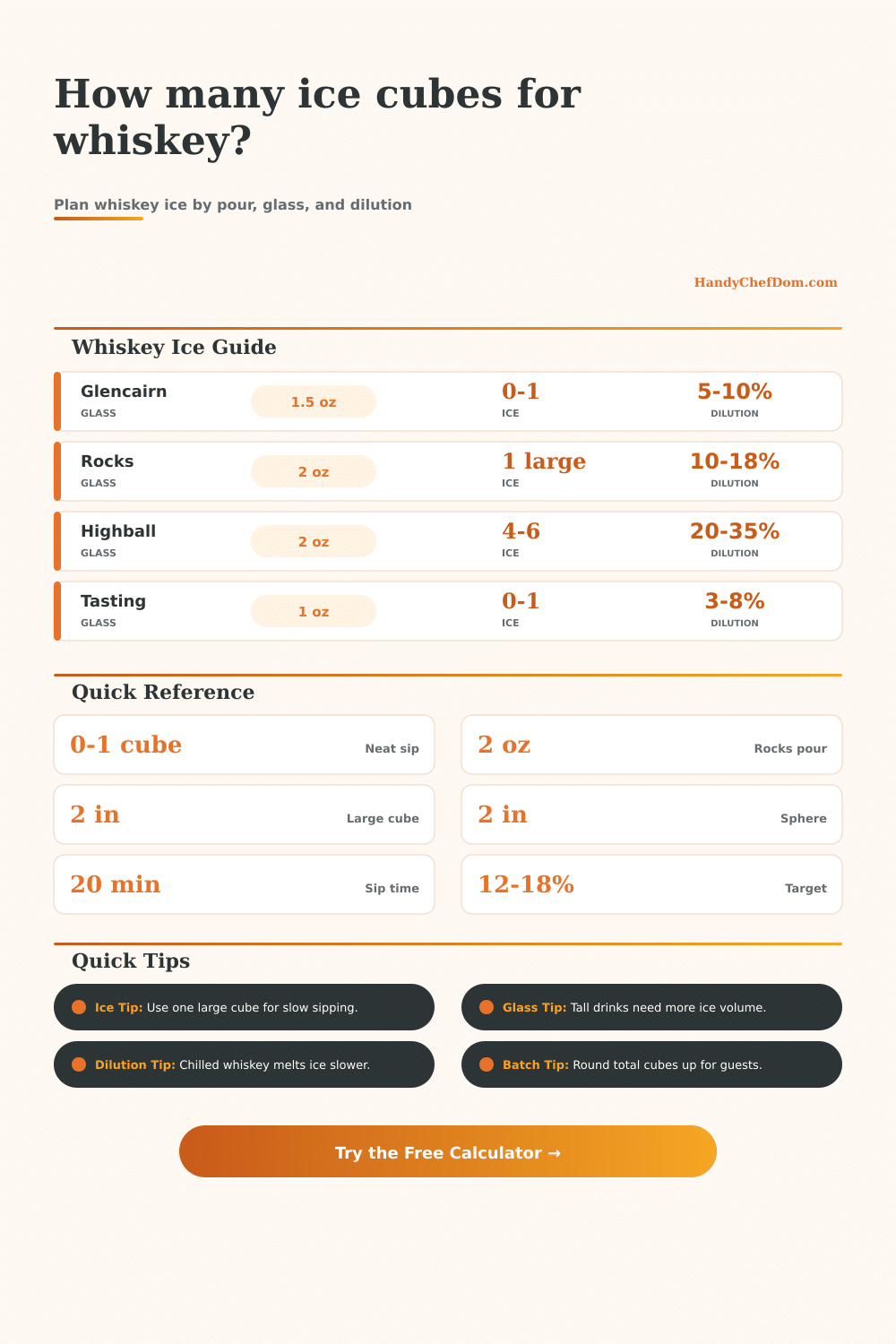
| Glencairn or nosing glass | 1 to 1.5 oz | None or one small cube | 3 to 10% |
| Rocks glass | 1.5 to 2.5 oz | One large or two standard cubes | 10 to 18% |
| Double rocks glass | 2 to 3 oz | Large cube or sphere | 12 to 22% |
| Highball glass | 1.5 to 2 oz | Spear, stack, or many cubes | 20 to 35% |
| Coupe or Nick and Nora | 1.5 to 2 oz | Usually shaken or stirred ice | 10 to 20% |
| Tasting copita | 0.5 to 1 oz | None or chip ice | 0 to 8% |
| Ice Shape | Size Reference | Approx Weight | Melt Behavior |
|---|---|---|---|
| Small freezer cube | 0.8 inch | 8 to 12 g | Fast melt, quick chill |
| Standard cube | 1 to 1.25 inch | 16 to 32 g | Balanced for rocks pours |
| Large cube | 1.75 to 2 inch | 85 to 130 g | Slow melt, long sip |
| Ice sphere | 2 inch diameter | 60 to 70 g | Slow and even melt |
| Collins spear | 4 to 5 inch long | 90 to 150 g | Best for tall glasses |
| Crushed ice | Small pieces | Varies | Fastest chill and dilution |
| Pour Volume | 10% Water | 15% Water | 25% Water |
|---|---|---|---|
| 1 oz whiskey | 3 ml | 4 ml | 7 ml |
| 1.5 oz whiskey | 4 ml | 7 ml | 11 ml |
| 2 oz whiskey | 6 ml | 9 ml | 15 ml |
| 2.5 oz whiskey | 7 ml | 11 ml | 18 ml |
| 3 oz whiskey | 9 ml | 13 ml | 22 ml |
| 4 oz whiskey | 12 ml | 18 ml | 30 ml |
| Scenario | Guest Count | Drinks Each | Ice Planning Note |
|---|---|---|---|
| Two-person tasting | 2 | 1 to 2 | Use a small side bowl of ice |
| Dinner for four | 4 | 1 to 2 | Freeze extra standard cubes |
| Rocks round | 8 | 1.5 | Count by finished glasses |
| Holiday pour | 12 | 2 | Add a buffer for refills |
| Highball party | 20 | 2 | Plan a separate tall-glass supply |
| Large gathering | 40 | 1.5 | Stage ice in smaller containers |
When you put two ounces of whiskey in a glass, what do you do? How will you serve this spirit? Do you want to chill it with a big block of ice? Do you want to use one or more ice cubes? Or maybe a sphere?
The answer is physics. Ice melts, cools the liquid, dilutes it and unlocks flavors trapped behind high alcohol content. It’s not simply about chilling your cocktail; its about creating a dilution curve. Once you know how much you’re pouring into what glass (and how diluted you want it), the math happen on calculator above, no need to fumble with any numbers. You can adjust those inputs to change output; that’s important.
How to Choose the Right Ice for Whiskey
Because of its shape, a Glencairn concentrates aroma and thus minimizes surface area exposed to air: it require virtually no ice. On the opposite end, a highball glass is wide and tall and loses heat quick: it must be packed with ice. Put a single tiny cube in a highball glass and it’ll vanish immediately, dumping a splash of water then…nothing. Fill the same glass with an enormous sphere and it won’t even budge, and your drink remains too warm. The calculator understands all that geometry; just realize why it matter.
This is a photo from Wikipedia.
Another consideration: A smaller cube will have more surface area compared to its volume, whereas a larger one will have less surface area for its volume. That means it will melt slower, leading to slower dilution. So if you intend to sip your whiskey over twenty minutes, you’ll prefer that slow release to make sure the drink stays cold but doesn’t get watered down too fast. On the other hand, if you’re going to knock back the whole thing within five minutes, a regular ol’ cube is no problem. Use the calculator to specify how long you expect to be sipping and that will help bridge gap between your expectations and how ice actualy performs.
The thing is, diluting with water does break down long-chain molecules, releasing aromatic and ester compounds from those molecules. And everyone seems to agree that around a ten to fifteen percent dilution in a rocks glass are the sweet spot: it’s not watery, and it softens the alcohol without removing its flavor. Dilute to nothing, and you lose all of that flavor evolution; dilute to 30 percent, and you’ve got yourself some water-flavored spirit. That’s what the chart on the page explain well, along with exactly how much water you should of add for each size pour. Nine milliliters, or about two teaspoons of water, will get you up to fifteen percent dilution for a two-ounce pour. Sounds like a lot, doesn’t it? But it’s not.
There’s also the matter of temperature: The warmer the room, the more quickly the whiskey will warm and the harder ice must work. For this reason, the calculator factors in temperature, which makes a small difference. If your room is on the warm side, you may want to add another cube, or perhaps throw in a bigger sphere. On the other hand, if you’ve already chilled the whiskey in freezer, then the ice doesn’t have to work as hard and will melt at a more gentle pace, resulting in more slight dilution.
But what if you’re having company over? In that case, we change the math from “one drink” to “planning a service.” Instead of just yourself, there is more than one person to think about. You have to account for multiple rounds, a buffer because some ice will get spilled or dropped, and maybe your friends wants a refill. To prevent the embarassing moment of running out of ice mid-party, you can adjust the guest count and the buffer percentage in the calculator. Now each guest recieve a properly chilled pour.
So ultimately it’s all about control and wanting to control the taste of that whiskey from start to finish. Ice is an ingredient; pick your shape to match the length of time you think you’ll be sipping and pick your size to match the level of dilution you desire. Focus on the pour, let the tool do the heavy lifting on the totals and the rest will take care of itself.