Almonds per 1 Ounce Calculator
Convert whole, sliced, slivered, raw, roasted, and blanched almond portions into ounces, grams, almond counts, servings, calories, protein, and fat.
| Almond Type | Calories/Oz | Protein/Oz | Fat/Oz | Carbs/Oz |
|---|---|---|---|---|
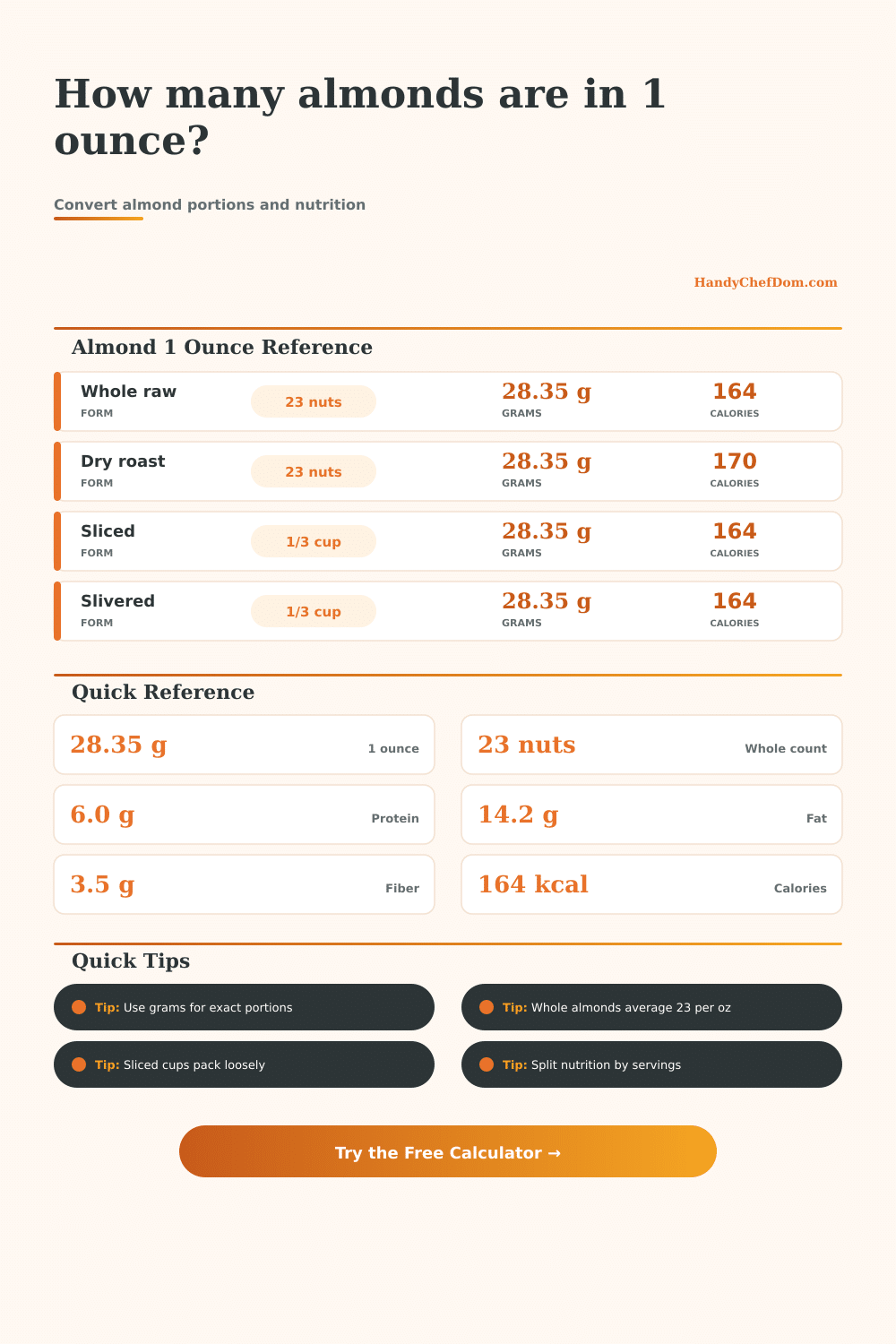
| Raw whole almonds | 164 kcal | 6.0 g | 14.2 g | 6.1 g |
| Dry roasted unsalted | 170 kcal | 5.9 g | 14.9 g | 6.0 g |
| Oil roasted unsalted | 172 kcal | 6.0 g | 15.6 g | 5.5 g |
| Blanched almonds | 165 kcal | 6.2 g | 14.3 g | 5.7 g |
| Measure | Approx Weight | Ounces | Whole Count | Best Use |
|---|---|---|---|---|
| 1 ounce | 28.35 g | 1.00 oz | About 23 | Nutrition label serving |
| 1 whole almond | 1.23 g | 0.043 oz | 1 | Counting snacks |
| 1/4 ounce | 7.09 g | 0.25 oz | About 6 | Small topping |
| 100 grams | 100 g | 3.53 oz | About 81 | Recipe prep |
| Form | Approx Cup Weight | Tablespoon Weight | 1 Oz Volume | Accuracy Note |
|---|---|---|---|---|
| Whole almonds | 143 g | 9 g | About 1/5 cup | Count or weigh |
| Sliced almonds | 92 g | 5.8 g | About 1/3 cup | Loose packing |
| Slivered almonds | 108 g | 6.8 g | About 1/4 to 1/3 cup | Varies by cut |
| Almond flour | 112 g | 7 g | About 1/4 cup | Level cup |
| Scenario | Total Almonds | Servings | Per Serving | Calories Each |
|---|---|---|---|---|
| Single snack bag | 1 oz / 28.35 g | 1 | 23 whole almonds | 164 kcal |
| Four snack prep | 4 oz / 113 g | 4 | 1 oz each | 164 kcal |
| Salad topping bowl | 2 oz / 57 g | 8 | 0.25 oz each | 41 kcal |
| Party topping tray | 8 oz / 227 g | 16 | 0.5 oz each | 82 kcal |
| Type | Calories | Protein | Fat | Fiber |
|---|---|---|---|---|
| Raw whole | 579 kcal | 21.15 g | 49.93 g | 12.5 g |
| Dry roasted | 598 kcal | 20.96 g | 52.54 g | 10.9 g |
| Oil roasted | 607 kcal | 21.23 g | 55.17 g | 10.5 g |
| Blanched | 581 kcal | 21.94 g | 50.62 g | 11.0 g |
Almonds are something that you might just grab out of the pantry without much thought. You feel like it’s a simple snack so you grabs a handful. But that’s when this little bit of math creeps in; nutrition labels aren’t measured by handfuls; they’re listed by gram or ounce. That’s where most folks mess up on there daily intake. After plugging in what you ate/quantities and what form it came in, the calculator does the math for you and spares you from trying to guesstimate if you got a single serving or three in that handful. It makes the idea of “a snack” into a solid number you can monitor.
Most people start here, the trusty ounce. For context, an ounce of raw whole almonds contains approximately twenty-three nuts. Why? Since each almond kernel weigh about two and a half grams on average, that is how many fit into an ounce. It’s a good place to have in mind when doing some basic mental math, so the next time you’re snacking and need to eyeball how much is enough, know that you should of be going for the count of twenty-three. And since we know all almonds aren’t exactly the same, this feature let you change the number depending on size of the nut. If they’re really big, maybe only twenty to an ounce? Or perhaps slightly tinier and closer to a few more? This can make or break reaching those macros so it pays to keep it in mind.
Why We Need to Measure Almonds
But what if we aren’t dealing with whole nuts? Whole almonds are a useful baseline to visualize, but sliced or slivered almonds don’t neatly fit into your palm. In a cup measure, they won’t all sit the same way; they’ll settle and shift around different too. That’s why volume estimates for things like sliced almonds can be misleading: a loose third of a cup isn’t necessarily the same as a pressed down amount. To account for this difference in how packed they are, the calculator lets you specify whether you have whole, sliced, or slivered almonds. Depending on that selection, it will adjust the number of calories and expected weight according to give you an idea of what you’re really getting yourself into. And that avoids falling victim to the trap of thinking “a cup of sliced almonds is just as good as a cup of whole,” nutritionally speaking. That’s not true.
Changing them from whole to sliced change their surface area. This affects how densely they pack, which in turn affects weight per volume. The second wrinkle is in preparation style. Some water weight comes off dry roasted nuts, which give them higher calories per ounce than raw. Though not by much. But when you roast in oil, that brings more fat into the equation, bumping overall caloric density even higher. These changes might be minor if you look at them on a nutrition facts label, but when you multiply them across the day, they starts to matter. The calculator breaks out those changes at the macro level, allowing you to see how each type of prep changes your day-to-day “budget. You can see in real time how the ratio of protein/fat shifts as you choose different preparations. This helps you understand if you should eat less or if oily foods makes you feel full faster.
The gold standard of precise measurement is always by weight. When using a specific amount of nuts, like in a recipe where they are an actual ingredient instead of just a binder (like almond flour), grams beat cups every single time. Almond flour can be very dense or not dense at all based off how tightly packed it is and how fine it is ground. It takes away that variable completely if you use a scale. It accepts both metric and imperial measurements. This makes it easier to follow recipes from other countries without doing math in your head. Type it into grams and get the corresponding number of ounces or individual nuts. That way, it bridges the gap between nutritional science and kitchen habit.
Ultimately, tracking isn’t perfect but it does help increase our awareness. When we know that a single ounce of almonds contains roughly a hundred and sixty four calories, we can use this information to better choose what we eat during the day. We can offset those calories in a healthy way by pairing them with another meal, and regardless if it’s whole or slivered, knowing just how much we’re putting in our mouth makes all the difference. That knowledge becomes more important then any amount on the label. A bite that was once mindless now becomes informed, which is far more valuable than any number on a package.
Before you know it, you’ll be making better decisions. You’ll know what your body is recieveing. You’ll also have much better control over what goes into your mouth. Next time you grab that bag, you’ll know exactly how many nuts goes into a solid ounce.