Hamburger Grilling Time Calculator
Estimate burger grill time from patty weight, thickness, grill temperature, doneness target, flip count, lid position, fresh or frozen start, and rest time.
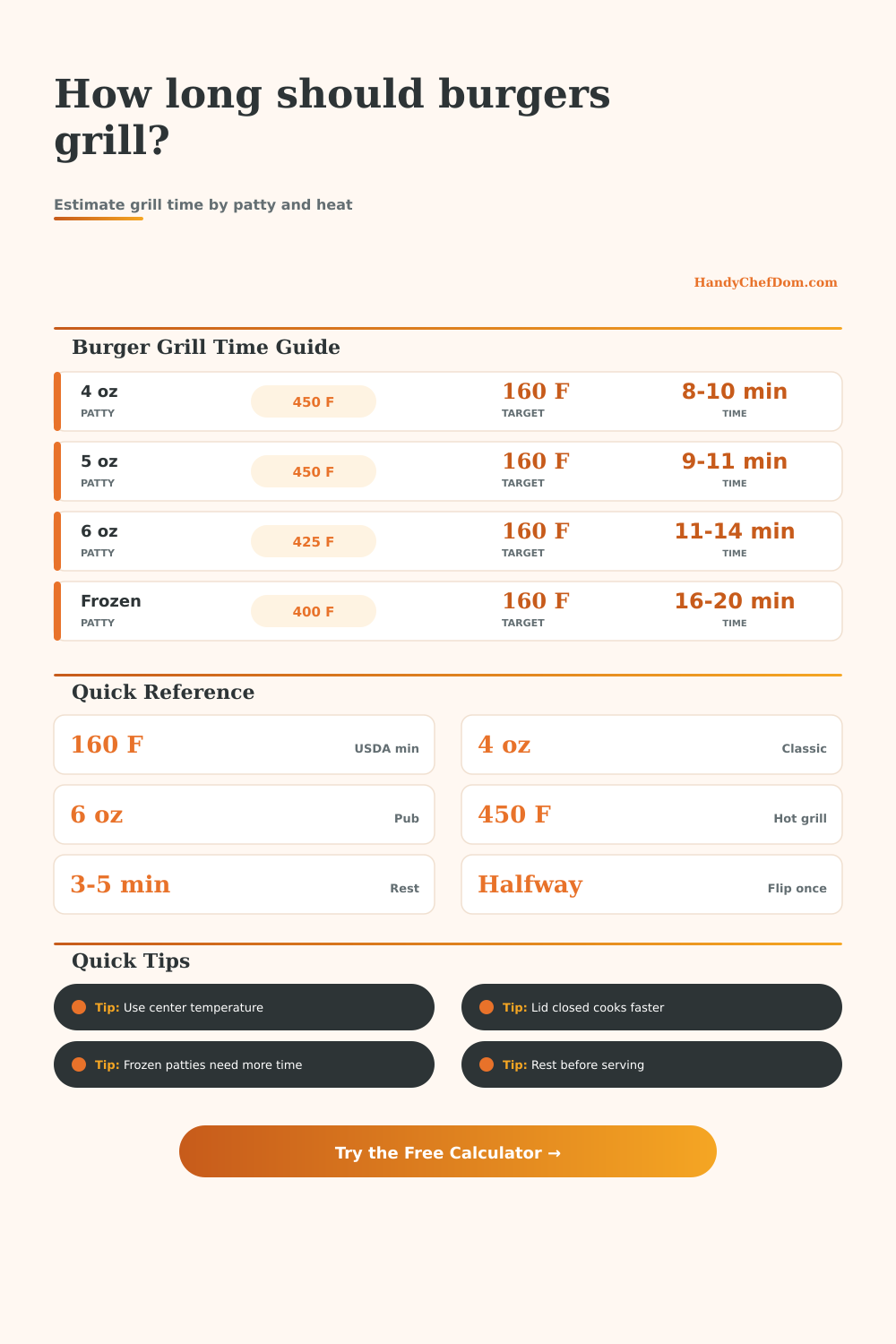
| Patty Size | Typical Thickness | Grill Heat | Estimated Time to 160 F |
|---|---|---|---|
| Slider or small burger, 3 oz | 0.50 to 0.60 in | 425 to 475 F | 6 to 8 minutes |
| Classic burger, 4 oz | 0.70 to 0.80 in | 425 to 475 F | 8 to 10 minutes |
| Pub burger, 5 oz | 0.85 to 1.00 in | 425 to 475 F | 9 to 12 minutes |
| Thick burger, 6 oz | 1.00 to 1.15 in | 400 to 450 F | 11 to 14 minutes |
| Frozen burger, 4 to 5 oz | 0.70 to 0.90 in | 375 to 425 F | 16 to 20 minutes |
| Target | Temperature | Calculator Use | Ground Beef Note |
|---|---|---|---|
| USDA ground meat minimum | 160 F | Default target | Recommended minimum for ground meat |
| Medium-well preference | 150 to 155 F | Shorter estimate | Below the USDA ground meat minimum |
| Medium preference | 140 to 145 F | Much shorter estimate | Below the USDA ground meat minimum |
| Rest carryover | 1 to 5 F | Subtracts from pull temp | Varies by thickness and heat |
| Setting | Time Effect | Best Fit | Calculator Adjustment |
|---|---|---|---|
| Lid closed | Fastest center cooking | Gas or covered charcoal grill | Baseline |
| Mostly closed | Slightly slower | Frequent checks or flare control | Adds about 8 percent |
| Lid open | Slower through center | Thin patties and busy grill setups | Adds about 18 percent |
| More flips | More even heat exposure | Thick patties or hot spots | Small time reduction |
| Starting State | Temperature Pattern | Time Effect | Planning Note |
|---|---|---|---|
| Fresh or thawed | Even start | Baseline | Use timing chart normally |
| Very cold from fridge | Cold center | Adds 8 percent | Expect a slower first side |
| Frozen patty | Frozen center | Adds 55 percent | Check the center carefully |
| Partly thawed | Uneven start | Use chilled or frozen | Choose the colder estimate |
So how do you wrangle this process when your guest list keep growing and the grill space keeps shrinking? How do you cook safely but not burn the patties? This device will help you navigate the space between raw and burned, using what it knows about all of the variables you’ve been guessing at, until it’s too late.
Yes, you want a nice, crispy crust on top of your burger, but also an inside temperature that’s not just right but safe. The calculator give you framework for this juggling act. Any good burger equation has to take thickness versus cooking power into consideration. Cook too quickly on a hot grill and you have a rare (but burned) burger. Cook too slow with a thick patty and you end up with charred meat and cold centers.
How to Cook Perfect Burgers Every Time
This one factors in the thickness of your patty by asking for weight and depth, then compares it against your actual grill temperature. The vast majority of us think we’re throwing our burgers onto five-hundred degree grills just because the dial reads “high,” but more likely than not it’s four-hundred or four-fifty due to surrounding air flow conditions and how dirty/gritty the grate itself might be. There are no magic numbers here, so give them your exact configuration instead of some sort of generic average, if you don’t enter a proper heat value into anything like this, you’ll end up with a bunch of crap coming out the other side.
The other thing that distinguishes amateur grilling from pro grilling is lid management. When the lid stay closed, you’re using radiant heat to cook inside of the burger while trapping it in an oven environment, so it cooks faster overall. Open it, though, and now it’s just the direct flames hitting the meat, which is super fast for char but slow for doneness. As the table on the page demonstrates, cooking with the lid open can add nearly twenty percent to your total time compared to a closed setup. It’s such a small mechanical adjustment, but it make all the difference in terms of when you should of start flipping.
Ground beef is different than whole steaks. You’ll find different doneness targets because grinding up the meat not only tenderizes it, but also spreads out bacteria so thoroughly that food safety guidelines says to cook it all the way through to a temperature of one hundred sixty degrees Fahrenheit. That’s what the calculator assumes is a safe minimum, but you can dial things back if you’re starting with some good, fresh ground beef from a trustworthy source and want to pull it when it’s still pink inside. Keep in mind, though, that burger will still be cooking for a bit once it comes off the heat, carrying over by a couple more degrees. Pulling it early isn’t an act of defiance; it’s physics on your side.
If you’re cooking frozen patties, they bring some wrinkles of their own. Since there are ice crystals to be melted before anything else can start happening, they takes much longer. Cooks will often try to speed up the process which leads to an overdone outside with a still-icy interior. To counteract this, the tool accounts for extra minutes so you won’t accidentally snatch them early. Resist the urge to cook your frozen burger like you would a fresh one; you’ll only end up disappointed.
Last but not least, always let meat rest. This is especially important with grilled meats, where letting it sit for three to five minutes lets the juices redistribute instead of pouring off your plate the second you take a bite. This also figures into the total ready time on the calculator so you know how long it’ll be until the food is on the table; realistic time that accounts for resting time. Easy to forget when hungry people is waiting but worth it for flavor and texture.
There’s some science and some intuition to grilling, but the link between the two is time. Let the calculator take the variables (heat + mass + lid position) so that you have the mental capacity to concentrate on what really counts: paying close attention to the fire, listening for the sizzle, and believing your thermometer, not your watch. It’s not about making a cooked burger… It’s about cooking like a pro. You need to know exactly when to ease off and let the heat do its work.