Honey Sugar Calculator
Convert teaspoons, tablespoons, cups, grams, milliliters, and ounces of honey into total sugar, per-serving sugar, sugar-teaspoon equivalent, and added sugar limit percentage.
Honey Sugar Results
Calculation Breakdown
| Honey type | Density used | Sugar by weight | Best calculator use |
|---|---|---|---|
| Clover honey | 1.42 g/ml | 82.4% | General spoon, cup, and jar measures |
| Wildflower honey | 1.41 g/ml | 82.0% | Mixed nectar jars and everyday drizzles |
| Acacia honey | 1.38 g/ml | 80.8% | Lighter flowing honey in drinks |
| Orange blossom honey | 1.40 g/ml | 81.8% | Fruit bowls, tea, and citrus sauces |
| Buckwheat honey | 1.45 g/ml | 82.8% | Darker honey with stronger flavor |
| Raw unfiltered honey | 1.43 g/ml | 81.5% | Crystallized or less filtered jars |
| Manuka style honey | 1.44 g/ml | 82.2% | Thicker spooned honey portions |
| Creamed honey spread | 1.36 g/ml | 80.5% | Spreadable honey measured by spoon |
Nutrition basis: common honey averages about 82 g carbohydrate sugars per 100 g. The calculator varies density and sugar percentage by style to reflect kitchen measuring differences.
| Measured honey | Approx honey weight | Approx total sugar | Sugar teaspoons equivalent |
|---|---|---|---|
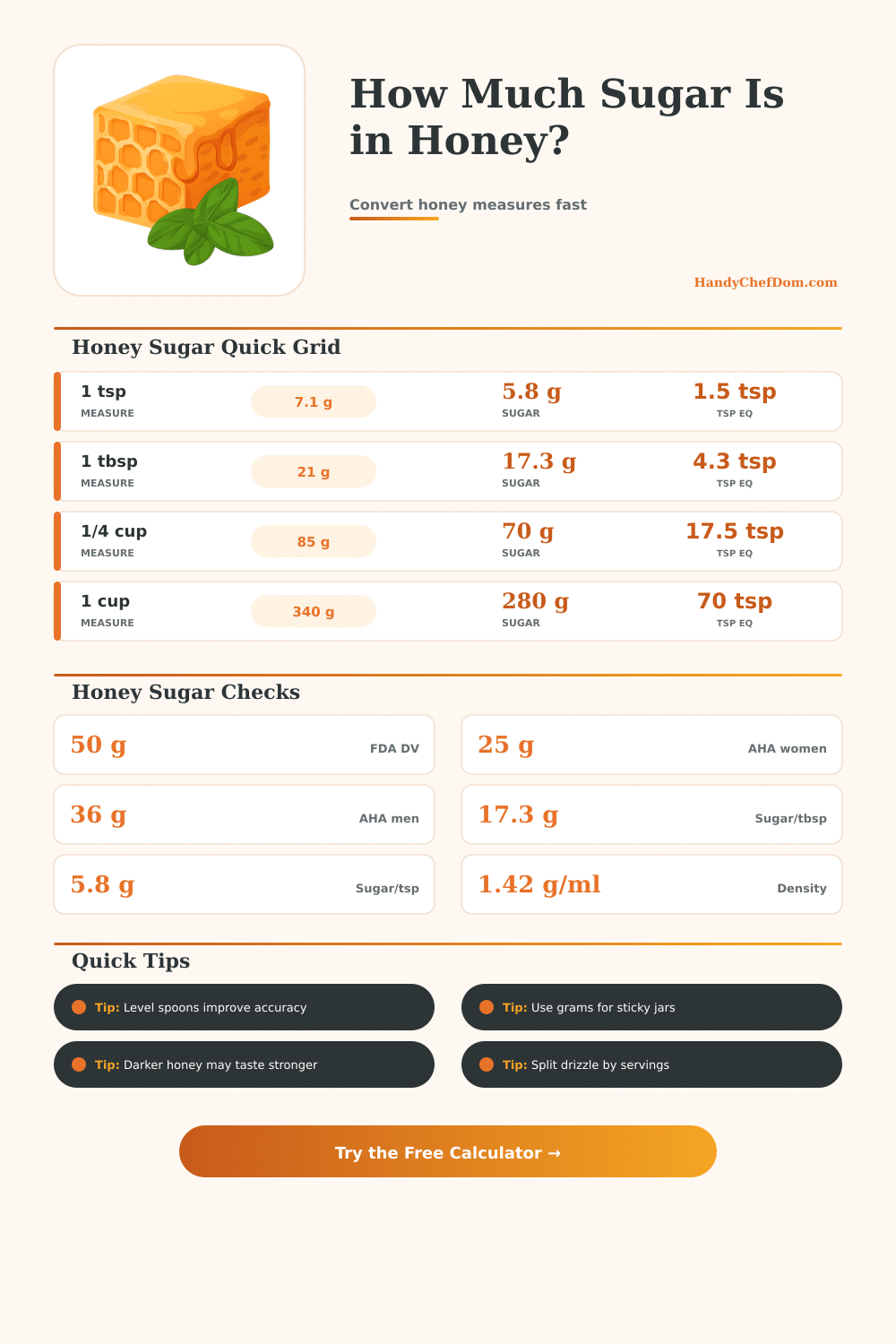
| 1 teaspoon | 7.0 to 7.3 g | 5.7 to 6.0 g | About 1.4 to 1.5 tsp sugar |
| 1 tablespoon | 20.4 to 21.5 g | 16.4 to 17.8 g | About 4.1 to 4.5 tsp sugar |
| 1/4 US cup | 81.5 to 85.8 g | 65.6 to 71.0 g | About 16.4 to 17.8 tsp sugar |
| 1/3 US cup | 108.8 to 114.4 g | 87.6 to 94.7 g | About 21.9 to 23.7 tsp sugar |
| 1/2 US cup | 163.1 to 171.6 g | 131.3 to 142.1 g | About 32.8 to 35.5 tsp sugar |
| 1 US cup | 326.2 to 343.1 g | 262.6 to 284.1 g | About 65.7 to 71.0 tsp sugar |
| 100 grams | 100 g | 80.5 to 82.8 g | About 20.1 to 20.7 tsp sugar |
| 1 ounce by weight | 28.35 g | 22.8 to 23.5 g | About 5.7 to 5.9 tsp sugar |
| Honey use | Typical measure | Servings | Estimated sugar per serving |
|---|---|---|---|
| Tea or coffee spoon | 1 teaspoon | 1 | About 5.8 g sugar |
| Yogurt bowl drizzle | 1 tablespoon | 2 | About 8.6 g sugar |
| Fruit platter drizzle | 1/3 cup | 10 | About 9.1 g sugar |
| Honey mustard glaze | 1/4 cup | 6 | About 11.7 g sugar |
| Granola batch sweetener | 1/2 cup | 12 | About 11.7 g sugar |
| Dessert tray syrup | 1 cup | 24 | About 11.7 g sugar |
| Guide option | Daily grams | Teaspoon equivalent | How the calculator uses it |
|---|---|---|---|
| FDA Daily Value | 50 g | 12.5 tsp sugar | Percent Daily Value style comparison |
| AHA women and children | 25 g | 6.25 tsp sugar | Stricter daily added sugar comparison |
| AHA men | 36 g | 9 tsp sugar | Stricter daily added sugar comparison |
| Small meal target | 10 g | 2.5 tsp sugar | Portion check for one meal or snack |
| Custom guide | Your entry | Limit divided by 4 | Flexible target for household planning |
Maybe you believe that honey is a more wholesome alternative to refined sugar, after all, it’s a natural product! Maybe you spread it on toast or drizzle it onto your yogurt, assuming it is better for you than those white crystals. But here’s the thing: Honey is still sugar. Your body converts it into fructose and glucose for fuel, which means that your metabolism doesn’t care where the sugar comes from; it treats the sugars basically the same way. When you look at the nutritional label, you’ll see how fast those teaspoons starts to accumulate.
Honey is hard to measure in the kitchen because it is so thick. A cup of honey actualy weighs much more than a cup of juice or milk. In fact, it’s about 40 percent denser than water. So when replacing sugar with honey but keeping your cups the same volume, you’ll end up with a sweet loaf that sinks like a brick rather than a light and fluffy cake. Because it’s concentrated, less honey (by volume) is just as sweet. This is why most bakers finds out the hard way, after baking a gummy bread or sunken-in muffin, that they needed to use less honey. But the calculator does the math for you, no need to guess how many grams of sugar were used in that drizzle.
Honey Is Still Sugar
After all, honey comes in all kinds of forms from creamed to raw, each one having a slightly different density then the processed clover variety. Each type of honey have its own subtleties; more flavor and maybe a different kind of sweetness. Some are mild (acacia), some are strong (dark buckwheat) and others are somewhere in between; these differences will help you decide how to use each honey, like in a sweet way versus a savory one.
But if you’re keeping close tabs on your sugar intake day-to-day, those weight differences matters for accuracy. A single tablespoon of honey has about seventeen grams of sugar. Not much when compared to a cup, but it might help put things into perspective. That’s a third of the total recommended amount of sugar per day for women by the American Heart Association. Stirring a little honey into your coffee? You just had that much before you knew it…
But what about splitting into “per-person” portions? With granola, we’re making 12 servings, so that honey per-portion figure go down drastically from one serving of oatmeal. A tablespoon all on its own is a lot; but as part of a big batch, it’s just a small bit of sweetness. The volume is less important than how much each portion is, which is why I think this makes such a huge difference. Even with a whole cup of honey for a dessert platter, you could have reasonable servings of it if everyone shares. This is also why the tool calculates the per-portion impact based off your chosen group size, it lets you see what the distribution looks like.
Efficiency and waste matter in the kitchen as well. The honey gets everywhere. Sticking to spoons like glue, coating every measuring cup. Want accuracy? Scrape it out then weigh the honey. Using grams removes the variable of how heaped or leveled your spoon happens to be. When something is that viscous, gravity fights you. Weighing in grams takes the guesswork out of whether you’re heaping or leveling your spoon. It is a tiny tweak, but if you bake precisely or are watching what you eat carefuly, it matters.
I’m a huge fan of honey; it’s so good! And I believe we should of respect how strong it is as an ingredient. Just because something is derived from bees doesn’t mean it’s a free pass. Yes, have some fun with it and enjoy the sweetness but don’t overdo it just like any other added sugar. Use it, in small amounts, if you know what that means for your intake.
Next time you go to grab that jar, stop and reflect on weight vs. Volume. When you know the numbers you’ll be able to control it while still enjoying the taste you adore.