🧴 Arrowroot Powder to Add to Body Butter Calculator
Estimate arrowroot grams, teaspoons, percentage, finished batch weight, and dry-feel texture for practical DIY body butter batches.
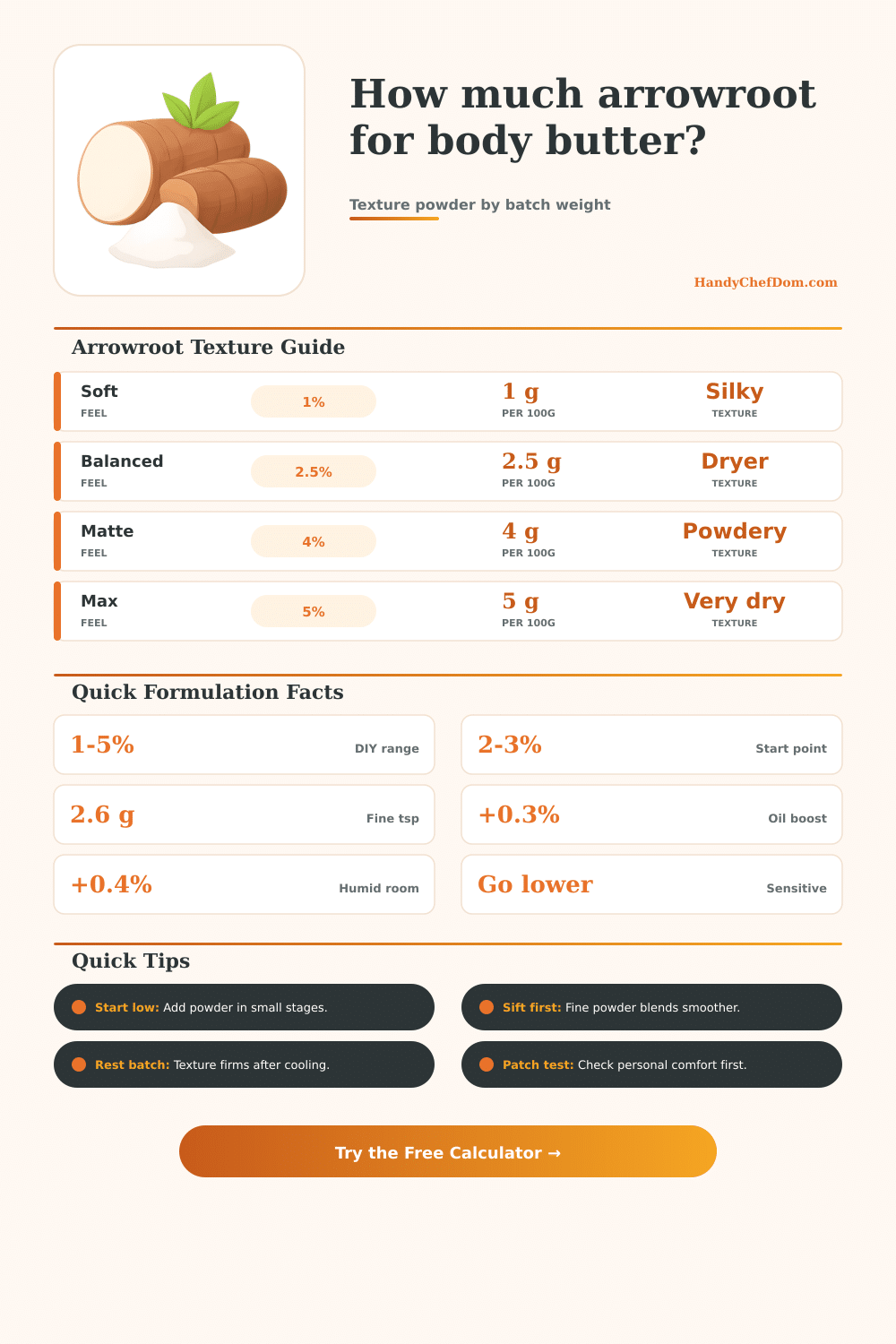
Reference range: many cosmetic DIY body butter formulas use arrowroot powder at about 1-5% of the butter and oil weight. Start lower when testing a new formula.
| Arrowroot Percent | Dry Feel Result | Best Use | Batch Note |
|---|---|---|---|
| 1.0-1.5% | Soft and silky with slight oil slip | Rich night butters, soft shea formulas, cautious test jars | Good first test for sensitive or unfamiliar formulas |
| 2.0-3.0% | Balanced less-greasy finish | Most whipped body butter batches and everyday jars | Common starting range before personal adjustments |
| 3.0-4.0% | Dry touch with a powder-soft finish | Warm weather, higher liquid oil, mango butter blends | Sift well so powder disperses evenly |
| 4.0-5.0% | Matte, very dry, noticeably powdery | Small test batches only when a very dry feel is desired | Can feel draggy if the formula is already firm |
| Main Butter | Texture Character | Powder Adjustment | Practical Note |
|---|---|---|---|
| Shea butter | Rich, cushiony, can feel slightly tacky | Baseline | Often lands well around 2-3% arrowroot |
| Mango butter | Dryer and lighter than shea | Use slightly less | Too much powder can make it feel thin or dusty |
| Cocoa butter | Firm, waxy, glossy slip | Use slightly more if oily | Powder helps reduce shine but cannot soften hardness |
| Kokum butter | Firm, brittle, naturally dry | Use less | Stay near the low end unless oils are high |
| Avocado butter | Soft, creamy, richer glide | Use slightly more | Useful for balancing a heavier after-feel |
| Mixed butters | Depends on hard and soft butter ratio | Use the calculator baseline | Make a mini test before scaling a large batch |
| Spoon Style | Approx Grams per Tsp | Best For | Accuracy Note |
|---|---|---|---|
| Fluffy spooned arrowroot | About 2.3 g per teaspoon | Loose powder straight from a bag or jar | Can vary a lot, so weigh for repeat batches |
| Standard sifted arrowroot | About 2.6 g per teaspoon | Most practical DIY kitchen measuring | Use level teaspoons, not heaping spoonfuls |
| Packed level teaspoon | About 3.0 g per teaspoon | Denser powders or tapped measuring spoons | May under-estimate teaspoons if powder is compacted |
| Scale-first formula | Use grams as the target | Repeatable body butter batches | Teaspoons are shown only as a helpful estimate |
| Powder Option | Texture Effect | Typical Use Range | Calculator Note |
|---|---|---|---|
| Arrowroot powder | Soft dry feel with low grit when sifted | About 1-5% | This calculator is tuned for arrowroot |
| Tapioca starch | Silky slip, similar powder feel | Often similar to arrowroot | Start at the same percent, then test feel |
| Cornstarch | Dryer matte feel, can be more powdery | Use conservatively | Try less than the arrowroot result first |
| Rice starch | Velvety and absorbent | Low to moderate levels | Can feel noticeable if not very fine |
| Silica microspheres | Very dry, silky, lightweight slip | Usually much lower | Not interchangeable gram for gram |
When you make body butter at home, the body butter may feel more heavier than you would expect of the body butter. Arrowroot powder are used as an ingredient that change the way that the body butter feels on the skin. Arrowroot powder does not play a role in changing the way that the body butter store or the length of time that the body butter lasts.
Arrowroot powder only changes the way that the body butter feels when it is applied to a skin. The amount of arrowroot powder that should be added to the body butter depend upon several different variable. Each of these variables will need to be considered in order to determine the correct amount of arrowroot powder that should be added.
How Much Arrowroot Powder to Add to Body Butter
The type of butter that you use in the body butter will impact the texture of the body butter; shea butter tend to be more tacky than other butters, mango butter is dry, and cocoa butter tends to be firm to the touch. The type of liquid oil that are used will change the texture of the body butter; body butters with a higher percentage of liquid oils will have a more slippery texture to the body butter. Finally, the climate in which the body butter will be used will impact the texture of the body butter; climates that is humid will tend to maintain the body butter in a soft state, while climates that is dry will leave the body butter feeling grease.
The calculator will perform the math necessary to find the amount of arrowroot powder that should be used in the body butter. The calculator will use the weight of the batch of body butter that will be made and the type of butter that will be used to find the amount of arrowroot powder. The calculator will also use the percentage of oil that will be used in the body butter and the climate in which the body butter will be used to find the amount of arrowroot powder.
Furthermore, the calculator will use the fineness of the arrowroot powder that will be used and the sensitivity of the skin of the individual using the body butter to find the amount of arrowroot powder that should be used. The calculator will display the arrowroot powder amount in percentage form, in gram, and in teaspoons so that the individual doesnt have to guess at the amount of arrowroot powder that should be used in the body butter. Additionally, the calculator will provide a score that indicate whether the body butter will be silky when applied to the skin or whether the body butter will be dry.
Fresh batch of body butter will often feel softer than body butters that have sat for approximately one day. Because body butter change once it is mixed together, arrowroot powder is often added in two stage to the body butter. Arrowroot powder can be added during the initial mixing of the body butter, but the second stage of arrowroot powder may be added after the body butter has set to firm.
Additionally, it is always a good idea to make and use a small jar of body butter to test how well the body butter work for the skin of the individual creating the body butter. The fineness of the arrowroot powder impact the texture of the body butter that is created. Finer arrowroot powder will allow the body butter to be more even in texture than arrowroot powder that is coarse in texture.
The calculator will lower the amount of arrowroot powder that is recommended if the individual select the coarse arrowroot powder setting; this is to ensure that the individual does not add too much arrowroot powder to the body butter. The sensitivity of the skin impact the amount of arrowroot powder that is recommended in the calculator. Individuals with sensitive skin will get a lower suggest amount of arrowroot powder than individuals whose skin comfort isnt a concern to those individuals.
Although arrowroot powder can be used in the body butter, other starch can be used if arrowroot powder is not available. However, the other starches are not the same as arrowroot powder. Tapioca powder perform in the same way as arrowroot powder, however.
Cornstarch creates a drier body butter than arrowroot powder when used in lower amounts. Rice starch creates a texture that is somewhere in between cornstarch and arrowroot powder. Therefore, because the other starches are not the same as arrowroot powder, individuals should of make a new test batch of body butter if they wish to change the type of starch that is used.
After creating body butters, individuals will be able to read the result of the body butter recipes to influence the creation of future batches. If individuals find that the body butter is too rich, they can add more arrowroot powder to the next batch. However, if the body butter feels dry enough to the individual, they can use the same percentage of arrowroot powder for the next batch to be create.
While the calculator can save individuals the need to perform mathematical calculations to determine the amount of arrowroot powder that should be used in the body butter, individuals will eventualy remember the amounts of arrowroot powder that work well with their skin and the climate in which they live.