🍞 Baking Percentage Calculator
Convert baker's percentages into exact ingredient weights for any recipe
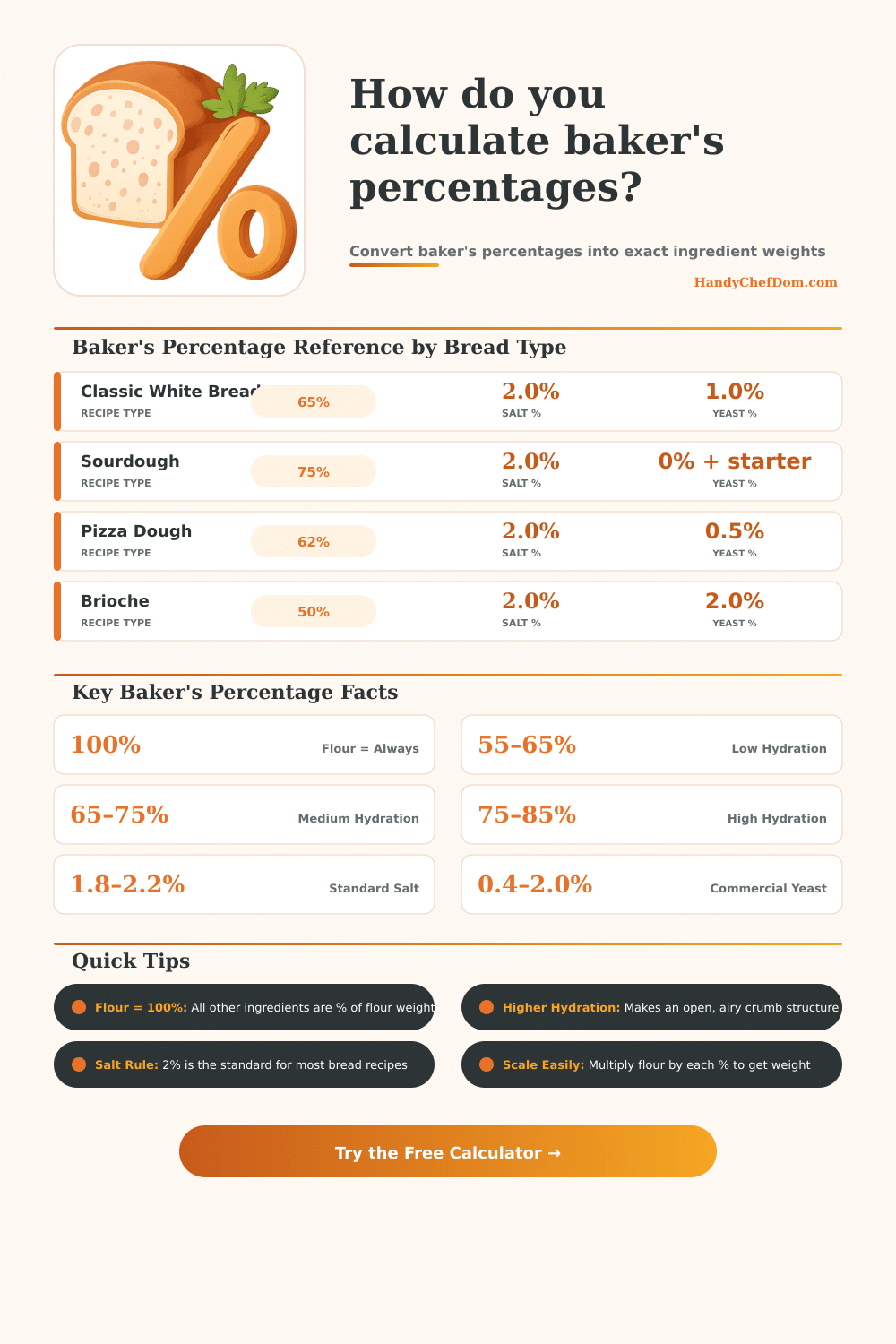
| Recipe Type | Hydration | Salt | Yeast | Fat | Sugar | Total % |
|---|---|---|---|---|---|---|
| Classic White Bread | 65% | 2.0% | 1.0% | 0% | 0% | 168% |
| Sourdough | 75% | 2.0% | 0% | 0% | 0% | 177% + starter |
| Pizza Dough | 62% | 2.0% | 0.5% | 2% | 0% | 166.5% |
| Brioche | 50% | 2.0% | 2.0% | 40% | 8% | 242% |
| Bagels | 55% | 1.8% | 1.0% | 0% | 0% | 157.8% |
| Baguette | 68% | 2.0% | 0.4% | 0% | 0% | 170.4% |
| Focaccia | 78% | 2.0% | 1.0% | 5% | 0% | 186% |
| Whole Wheat | 72% | 2.0% | 1.0% | 0% | 2% | 177% |
| Ingredient | % of Flour | Weight (g) | Approx. Cups / tbsp |
|---|---|---|---|
| Flour | 100% | 1,000g | 8 cups (AP flour) |
| Water (65% hydration) | 65% | 650g | 2¾ cups |
| Salt | 2% | 20g | 3½ tsp |
| Instant Yeast | 1% | 10g | 3½ tsp |
| Active Dry Yeast | 1% | 10g | 1 tbsp + 1 tsp |
| Olive / Vegetable Oil | 2% | 20g | 1½ tbsp |
| Butter (brioche) | 40% | 400g | 1¾ cups |
| Sugar / Honey | 5% | 50g | ¼ cup |
| Flour Amount | Total Dough (65% hyd) | White Bread Loaves | Pizza Balls (250g) |
|---|---|---|---|
| 250g (½ lb) | ~422g | ½ loaf | 1 ball |
| 500g (1 lb) | ~845g | 1 loaf | 3 balls |
| 750g (1½ lb) | ~1,268g | 1½ loaves | 5 balls |
| 1,000g (2.2 lb) | ~1,690g | 2 loaves | 6 balls |
| 1,500g (3.3 lb) | ~2,535g | 3 loaves | 10 balls |
| 2,000g (4.4 lb) | ~3,380g | 4 loaves | 13 balls |
Baking is a way of cooking foods by means of steady heat, usually in an oven, although one can do it also in warm ashes or on warm rocks. Bread is the most commonly baked product even so many other kinds of foods can be baked. During the process heat moves slowly, what turns liquids or wet mixes into solid form.
Here the temperature has a big role. For baking one commonly uses a range of 325 to 375 degrees. When it reaches around 425, that is more like roasting.
Baking Basics
Under 275 degrees, it becomes more like warming or slow cooking.
One can bake many different stuff. Cakes, cookies, pies, tarts, muffins, scones, brownies, blondies, cupcakes and dishes of baked treats are only some options. Recipes include both sweet and salty baked goods, for instance breads, brownies and similar.
Fun and creative baking ideas include samples like smooth veggie brownies, carrot cake cokoies and lemon filled bread. A variety of baked foods benefit from fresh herbs, what does not always come to the mind of folks.
For beginners, simple recipes like cornbread, fruit cobblers and brownies give fast enjoyment. For new bakers the main thing to learn is the different ways to mix ingredients. If one practices the skill, it will improve every recipe.
Rather than in cooking, adding your own changes too baking can lead to failure. Your own toppings or stuffings after the baked item exits from the oven can turn average pastry into something special.
Baking can be simple or complex as oneself makes it. With some basic tools, buying quality ingredients and following the directions, one gets wonderful results with little effort. It is like a chemistry lab.
For the best results everything should be fresh. Dry goods like flour, sugar, baking powder and baking soda should not sit in cabinets months or years. All work spaces need careful cleaning before the start.
Read the recipe before you begin. Mix and check the ingredients according to amounts and freshness. Making sure that everything is ready before the start really helps.
Cookie dough can be prepared before and stay in the refrigerator up to three days. Cookie dough in a plastic bag can last up to three months. Frozen dough balls require only one extra minute for baking, without needing to melt.
The size of cake portions depends on the cutting method. For a sheet cake a standard piece is around one inch wide at the broadest place. An eight inch round cake can serve sixteen or twenty-two people from the same cake.
A nine to ten inch loaf gives fifteen bigger pieces or twenty to forty smaller ones. Cakes three to six inches tall, baked in the same large pan, deliver thesame amount of pieces, because they follow the same cutting pattern.