Honey Specific Gravity Calculator
Estimate Brix, moisture, and water content from specific gravity or Brix input to classify honey density for blending, bottling, or mead planning.
🍯 Honey Batch Presets
📝 Input Parameters
📊 Honey Reference Grid
📋 Conversion and Batch Tables
| SG | Brix | Moisture | Texture |
|---|---|---|---|
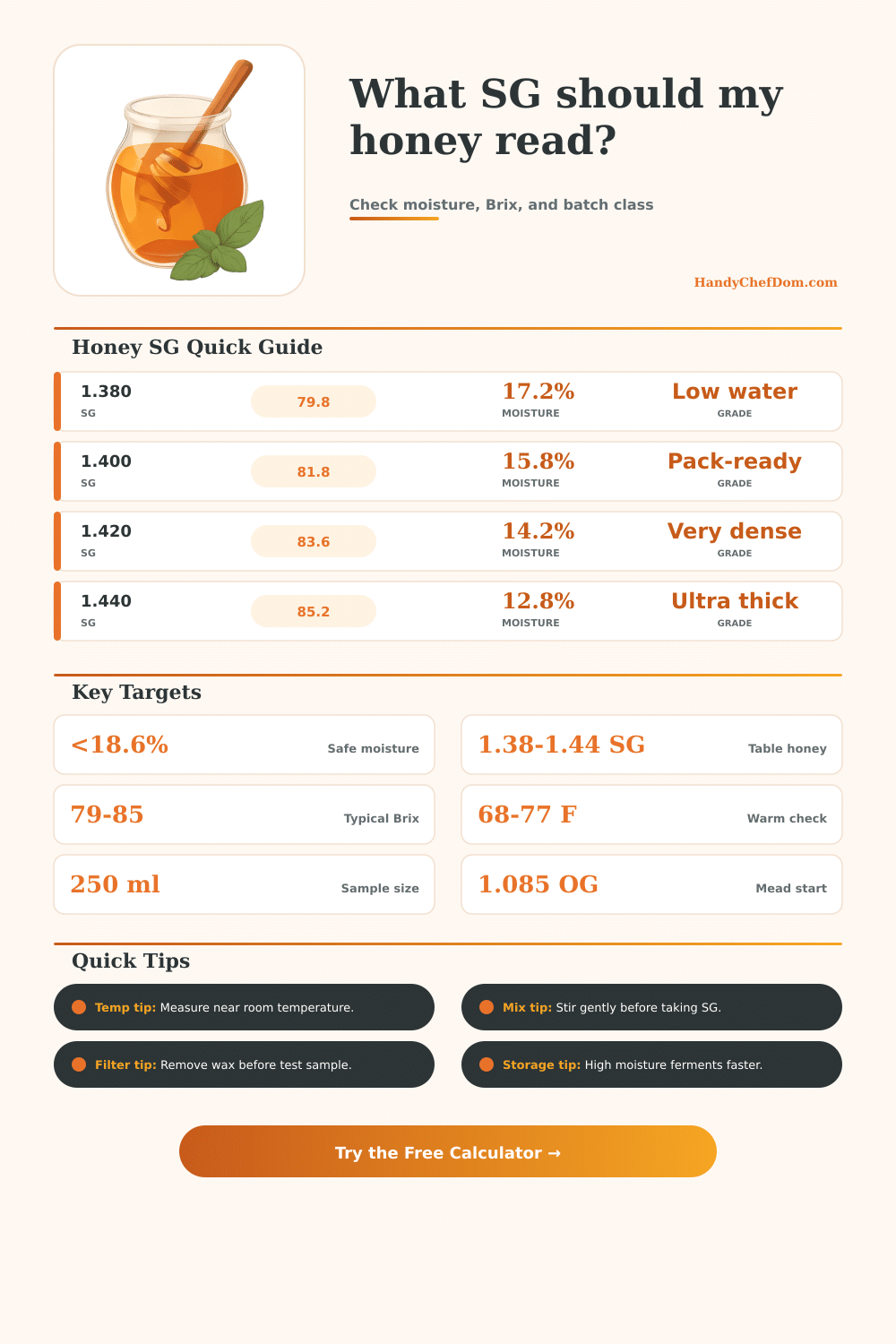
| 1.370 | 78.8 | 18.6% | Flowing |
| 1.390 | 80.9 | 16.9% | Balanced |
| 1.410 | 82.8 | 15.2% | Dense |
| 1.430 | 84.4 | 13.8% | Very dense |
| Batch | Honey Type | Moisture | Expected SG |
|---|---|---|---|
| 20 lb lot | Clover | 17.8% | 1.384 |
| 35 lb lot | Orange | 17.1% | 1.392 |
| 50 lb lot | Buckwheat | 15.6% | 1.413 |
| 80 lb lot | Manuka | 14.5% | 1.427 |
| Moisture | Water Risk | Storage Class | Action |
|---|---|---|---|
| 19.5%+ | High | Short hold | Dry blend |
| 18.7-19.4% | Medium | Watch lot | Fast pack |
| 17.0-18.6% | Low | Stable | Standard |
| <17.0% | Very low | Dense | Warm fill |
| Jar Size | Imperial Yield | Metric Yield | Use Case |
|---|---|---|---|
| 8 oz | Pantry gift | 240 ml | Sampler |
| 12 oz | Table use | 355 ml | Family jar |
| 16 oz | Farm stand | 475 ml | Main sale |
| 32 oz | Bulk refill | 950 ml | Heavy users |
Specific gravity is a measurement of how much heavier a volume of honey is then the same volume of water. Because honey contain mostly sugar solids and a smaller percentage of water than water itself, the weight of the honey can be used to determine the moisture content of the honey. Honey with a lower moisture content will be thicker and less likely to experience fermentation while stored in a jar.
Thin honey, which contains more moisture, is more likely to undergo this fermentation process. A calculator can be used to mathematically calculate these differance in weight. A calculator removes the need to refer to conversion charts or to guess at the adjustments in the weight of the honey according to the temperature of the honey sample.
How to Use a Specific Gravity Calculator for Honey
The effect of temperature on honey and specific gravity is due to the fact that honey expand when the honey is warm. As the honey expands, its volume increase; however, the hydrometer will register a lower reading due to the increased volume. Using the calculator, the temperature adjustment for honey samples that are taken at temperatures that is a few degrees above the room temperature will provide for the adjustment of the specific gravity reading to account for this expansion of the honey.
The calculator also can account for the cooler temperature of the honey sample. Many people will skip this step in adjusting the specific gravity readings for honey. Due to the fact that many people skip this step, the measurements from the same batch of honey will disagree with one another.
However, while the adjustment to account for the temperature of the honey is small, the adjustment prevents errors in the blending of honey batch. The type of honey will impact the specific gravity and density of that honey. For example, clover honey will register as having a lower specific gravity than honey made from buckwheat or manuka honey.
The honey from manuka farms has a different density than other type of honey due to the particular sugars that are found in manuka honey. Each of these honey types can be selected in the calculator; the calculator accounts for the natural differences in specific gravity among varieties of honey. By selecting each type of honey in the calculator, it is possible to blend different lot of honey together and produce a product that is consistent in its retail product.
If the adjustment for honey type is not performed correctly, the blend of honey lots will produce a honey with an unexpected moisture content. An adjustment for the moisture content of the honey can be made within the calculator. Honey left in an open tank in humid weather will absorb water from the humid air.
Honey stored in a dry curing room may lose some of its moisture. While the moisture content of honey is generally not drastically different from lot to lot, these difference can impact the specific gravity reading that determines the classification of the honey. An adjustment for the moisture content allows for the specific gravity reading to reflect the true moisture content of that batch of honey.
Based off the specific gravity reading of the honey, there are instructions regarding the proper handling of that honey. Should the specific gravity of the honey be above eighteen and a half percent, the honey should either be bottled quickly or blended with honey that has a lower moisture content. Should the specific gravity of the honey be below eighteen and half percent, the honey will remain stable for long periods of time.
While the density of the honey will provide a clear verdict for the beekeeper as to the moisture content of the batch of honey, the calculator will also estimate how many jar of honey can be filled from that batch of honey. This estimation accounts for the loss of honey that occurs during the processing of the honey into jars; the beekeeper does not need to guess at this measurement. Mead maker use specific gravity readings to determine the amount of sugar content that is contained within the honey.
Mead makers need to know the amount of sugar in the honey to determine the original gravity of the mead that will be made from the honey once water is added to the honey. The potential sugar content is displayed for the beekeeper to make an informed decision about whether or not that lot of honey will contain the amount of sugar needed to make the desired strength of mead. The use of this calculator prevents the mistake of thinking that each bucket of honey will produce the same results when water is added to the honey.
Reference tables for specific gravity of honey are provided on the calculators page. These tables provides quick checks of the data that is displayed for each batch of honey. The tables help determine whether the specific gravity reading of the honey is an outlier; if it is an outlier, the beekeeper can determine whether that specific gravity reading is incorrect.
This prevents the beekeeper from making a purchase of honey or blending honey batches based on an incorrect reading. A quick glance at the reference tables allow the beekeeper to determine whether the specific gravity reading of honey is normal for that type of honey. Common mistakes in the testing of honey samples dont usually involve mathematics.
Instead, the mistake that occurs most often is in the sampling of the honey; a sample of the honey taken from the top of the settling tank will have a different specific gravity than a sample taken from the middle or bottom of the settling tank. Additionally, if the sample of honey that is tested contains wax particles, these particles may impact the accuracy of the refractometer measurement. While the calculator cannot account for these errors, it will ensure that the specific gravity measurements taken of the honey are consistent.
By ensuring that the specific gravity measurements are consistent, the beekeeper can create a batch record of each batch of honey that is produced by the apiarist.