🥤 Baking Soda for Heartburn Calculator
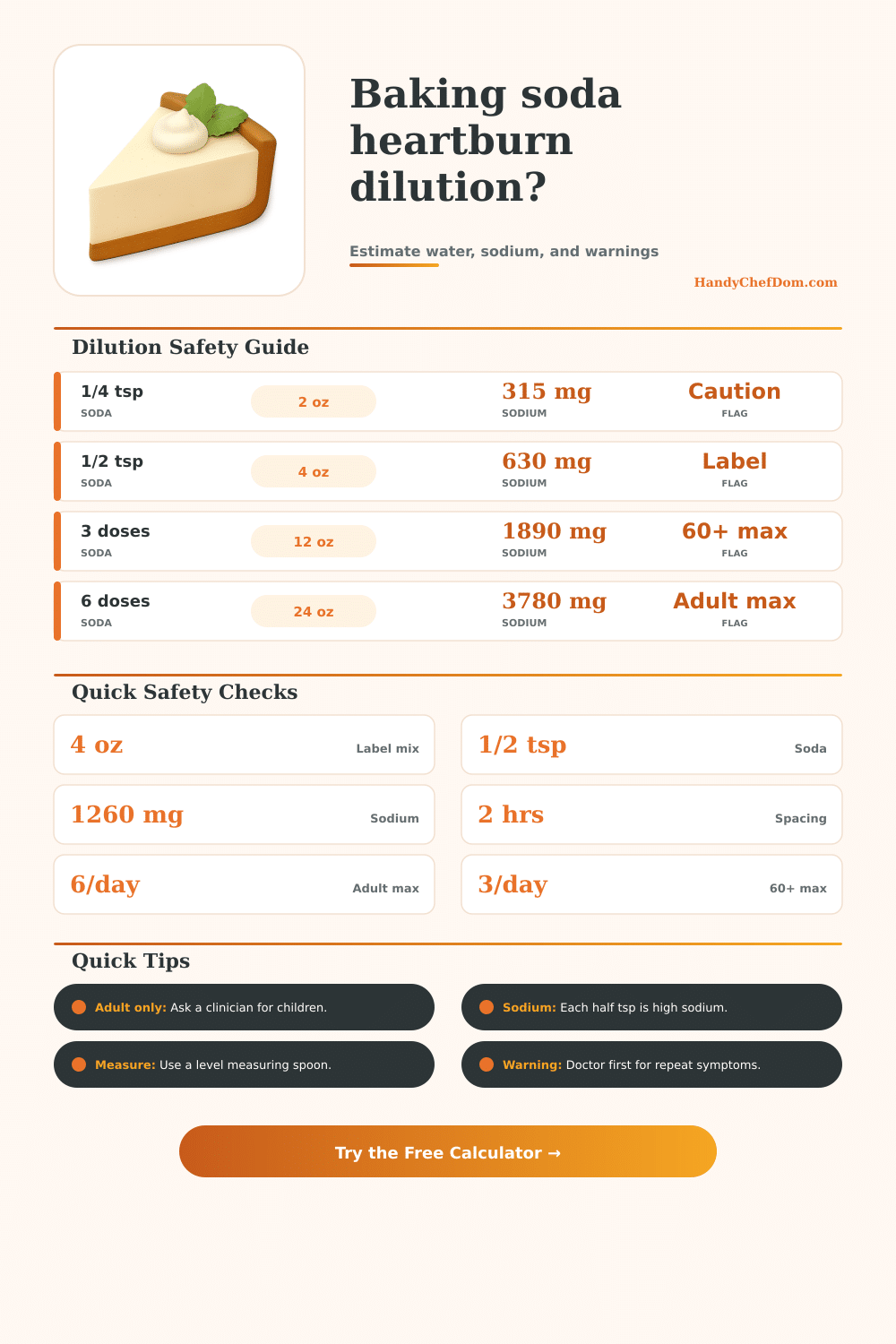
Informational dilution screen for adults: estimate water, baking soda weight, sodium, frequency limits, and warning flags before asking a clinician.
Use level recipe measuring spoons or a scale. Kitchen teaspoons, rounded scoops, and compacted powder can make the dose much larger than intended.
| Baking Soda Amount | Approx Grams | Estimated Sodium | Cautious Reading |
|---|---|---|---|
| 1/8 level teaspoon | 0.6 g | 160 mg sodium | Small amount, still sodium |
| 1/4 level teaspoon | 1.15 g | 315 mg sodium | Half of common label amount |
| 1/2 level teaspoon | 2.3 g | 630 mg sodium | Common label-style amount |
| 1 level teaspoon | 4.6 g | 1260 mg sodium | High sodium; above one label serving |
| Rounded teaspoon | About 6.9 g | About 1890 mg sodium | Unreliable and easy to overshoot |
| Compacted teaspoon | About 6.0 g | About 1640 mg sodium | Powder packing raises exposure |
| Water Entered | Metric Equivalent | Matches 1/2 tsp Label Dilution? | Calculator Flag |
|---|---|---|---|
| 2 fl oz | 59 ml | No, only half the water | Too concentrated |
| 4 fl oz | 118 ml | Yes, for 1/2 teaspoon | Meets dilution screen |
| 6 fl oz | 177 ml | More diluted than label style | Water amount ok |
| 8 fl oz | 237 ml | Full cup water | More diluted, still sodium |
| 120 ml | 4.1 fl oz | Close to label style | Meets dilution screen |
| 250 ml | 8.5 fl oz | More diluted | Water amount ok |
| Age Group | Adult-Only Limit Display | Spacing Display | Warning Language |
|---|---|---|---|
| Adult under 60 | Up to 6 half-teaspoon servings in 24h | At least 2 hours apart | Follow product label; ask doctor first |
| Adult 60 or older | Up to 3 half-teaspoon servings in 24h | At least 2 hours apart | Lower limit; ask doctor first |
| Under 18 | No dosing from this calculator | Not applicable | Do not use without clinician guidance |
| Sodium-restricted diet | Doctor or pharmacist first | Not a self-care screen | Sodium load may be inappropriate |
| Kidney, heart, liver condition | Doctor or pharmacist first | Not a self-care screen | Fluid and sodium risks need review |
| Pregnant or breastfeeding | Doctor or pharmacist first | Not a self-care screen | Use clinician guidance |
| Warning Trigger | Calculator Threshold | Why It Matters | Displayed Action |
|---|---|---|---|
| Large spoon amount | Over 1/2 teaspoon per mixture | Sodium rises fast | Do not exceed label; consult doctor |
| Too little water | Less than 8 fl oz per teaspoon | More concentrated mixture | Dissolve completely in enough water |
| Too soon | Under 2 hours since last serving | May exceed label spacing | Do not repeat early |
| Daily count high | Above age-based limit | High sodium and alkalinity exposure | Stop and contact clinician |
| Ongoing symptoms | More than 14 days | Needs medical evaluation | Consult doctor |
| Emergency symptoms | Chest pain or severe symptoms | May not be heartburn | Seek urgent care |
Reference assumptions inside this calculator: one level teaspoon baking soda is estimated at 4.6 g sodium bicarbonate, sodium is about 27.4% of sodium bicarbonate by weight, and common antacid labels may vary. Always follow the exact product label and clinician advice.
Baking soda is a substance that many peoples use to treat heartburn. Baking soda is often used for treating heartburn due to baking soda’s ability to provide quick relief to an uncomfortable symptoms of heartburn. The way that an individual uses baking soda determine both the amount of sodium that that individual consumes, as well as the way that the baking soda are diluted in the water that is used to take the baking soda.
Using the calculator that is described in the article allow individuals to calculate the amount of sodium that will be contained in the doses of baking soda that is taken by an individual, as well as to view the dilution ratio of that baking soda in the water that is consumed. In order to use the calculator to determine the amount of sodium that will be included in the doses of baking soda that are taken by an individual, the individual must enter specific number into the input fields for the calculator. The individual must enter the amount of water that is to be used in taking the baking soda into one of the fields of the calculator; the lower amount of water that is used will result in a lower dilution ratio for the baking soda.
Baking Soda for Heartburn: Sodium, Water Mix, and Safety
The amount of baking soda that is to be used in teaspoons must also be entered into the calculator; one teaspoon may contain more of the powder than another teaspoon due to the fact that the teaspoon may be heap rather than level. Additionally, the individual can also select the age and health profile for the calculator; individuals of different ages may have different health profiles, and different health profiles may contain conditions that increases the amount of care that must be taken in the sodium consumption of that individual. For instance, individuals with kidney problem or high blood pressure must take more care in there sodium consumption than other individuals.
Many individuals do not realize that baking soda contains a large amount of sodium; baking soda contains approximately 27% sodium by weight. As a result, every half teaspoon of baking soda contain hundreds of mg of sodium. For individuals that consume little sodium as part of their diet, the sodium content of baking soda is a sodium that should of been considered prior to consuming baking soda to relieve heartburn.
The calculator help to track the total sodium content of the baking soda that is consumed, as well as allows individuals to compare the sodium content to their daily sodium limit. Additionally, the calculator also tracks how many time that individual utilize baking soda as a means of relieving heartburn within a single day, which helps to ensure that they do not utilize too much baking soda within a single day. The reference tables that is provided for the reader can help individuals to understand the relationship between the various measurements of baking soda and the weight of that baking soda; reference tables are include for both baking soda and water amounts.
These tables provide information regarding both the weight of a teaspoon of baking soda, as well as how various amount of water may change the dilution strength of the baking soda. These tables allow individuals to understand if the amount of baking soda and water that they utilize is any more concentrated than the amount of baking soda and water that is described on the baking soda label. For instance, if an individual utilize a kitchen teaspoon rather than a level teaspoon, they may be utilizing more baking soda than they intend to, and more baking soda will lead to more sodium consume by the body.
It is important for individuals to recognize the difference between occasional heartburn and chronic heartburn. Chronic heartburn often requires medical attention from an individual’s doctor. The heartburn symptom questionnaire that is included in the website ask for the length of time that the heartburn symptoms have been occurring; if the individual experiences heartburn symptoms for more than two week, they may need to see a doctor.
While the website cant diagnose any health issue for the individual, the calculator may help the individual to understand if the use of baking soda to treat their heartburn has become a frequent habit. The primary purpose of baking soda is to reduce the amount of heartburn that an individual may experience. As such, the website and calculator provide information regarding the chemistry of baking soda, the habit of the individual that utilizes baking soda, and the impact of that baking soda on the body.
These features and benefits of the website will allow individuals to understand the exact impact that baking soda can have upon their body, and to determine whether they should continue to use baking soda to relieve their heartburn symptoms or whether they should contact their doctor.