🌿 Thyme in a Sprig Calculator
Convert fresh thyme sprigs into chopped leaves, dried thyme, ground thyme, bundles, and scaled recipe amounts without guessing.
Use the sprig count for thyme you have on hand, or choose a recipe form to calculate the fresh sprigs needed after scaling servings and herb strength.
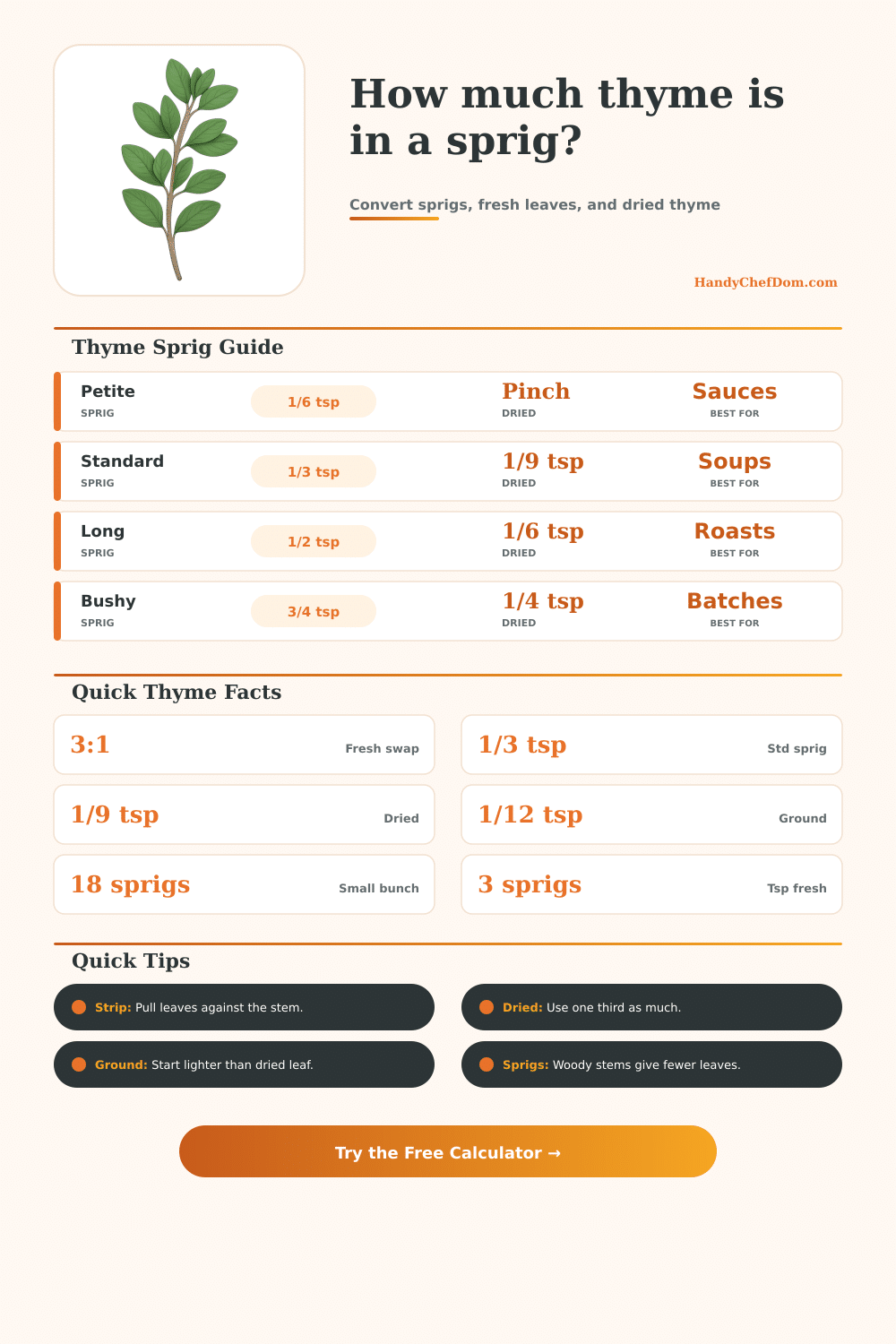
| Sprig Type | Fresh Leaves | Dried Leaf Swap | Best Use |
|---|---|---|---|
| Petite tender sprig | 1/6 tsp | Small pinch | Pan sauces and butter finishes |
| Standard market sprig | 1/3 tsp | 1/9 tsp | Soups, stews, stuffing, and skillets |
| Long garden sprig | 1/2 tsp | 1/6 tsp | Roasts, sheet pans, and marinades |
| Woody roasting sprig | 1/4 tsp | Scant 1/8 tsp | Braises where stems are removed |
| Bushy flowering tip | 3/4 tsp | 1/4 tsp | Large batches and herb blends |
| Soft lemon thyme sprig | 1/4 tsp | Scant 1/8 tsp | Fish, vegetables, and light sauces |
| Recipe Calls For | Fresh Sprigs | Chopped Fresh | Dried Leaves |
|---|---|---|---|
| 1 teaspoon fresh thyme | 3 standard sprigs | 1 tsp | 1/3 tsp |
| 1 tablespoon fresh thyme | 9 standard sprigs | 1 tbsp | 1 tsp |
| 1 teaspoon dried thyme | 9 standard sprigs | 1 tbsp | 1 tsp |
| 1/2 teaspoon dried thyme | 4 to 5 sprigs | 1 1/2 tsp | 1/2 tsp |
| 1 bouquet garnish | 4 to 6 sprigs | 1 1/2 tsp | 1/2 tsp |
| 1 teaspoon ground thyme | 12 standard sprigs | 4 tsp | 1 1/3 tsp |
| Scenario | Servings | Sprigs | Chopped Fresh Yield |
|---|---|---|---|
| Pan sauce for two | 2 | 2 sprigs | 2/3 tsp |
| Weeknight soup pot | 4 | 4 to 6 sprigs | 1 1/3 to 2 tsp |
| Roast chicken tray | 4 | 6 to 8 sprigs | 2 to 2 2/3 tsp |
| Holiday stuffing pan | 10 | 12 to 18 sprigs | 4 to 6 tsp |
| Bean stew batch | 8 | 8 to 12 sprigs | 2 2/3 to 4 tsp |
| Meal prep marinade | 6 | 5 to 7 sprigs | 1 2/3 to 2 1/3 tsp |
| Bundle Style | Typical Sprigs | Fresh Leaves | Dried Equivalent |
|---|---|---|---|
| Mini clamshell | 8 sprigs | 2 2/3 tsp | Scant 1 tsp |
| Small herb pack | 12 sprigs | 4 tsp | 1 1/3 tsp |
| Market bunch | 18 sprigs | 2 tbsp | 2 tsp |
| Garden handful | 24 sprigs | 8 tsp | 2 2/3 tsp |
| Prep bundle | 36 sprigs | 1/4 cup | 4 tsp |
| Large herb bunch | 48 sprigs | 1/3 cup | 5 1/3 tsp |
Thyme are one of the herbs that can be found in many types of cooking across the world. However, thyme is usualy measure without precision in many of these kitchens. Recipes will often ask cooks to use a specific number of thyme sprig.
However, the size of the thyme sprig can vary depending on the herb’s growing conditions and how recently it was harvested. Thus, the amount of usable thyme leaf in a thyme sprig can also vary. A petite thyme sprig will contain less thyme leaf than a bushy thyme sprig.
How to Measure Thyme for Cooking
One teaspoon of leaf from a petite thyme sprig will only contain one-sixth of a teaspoon of leaf. In contrast, a bushy thyme sprig will contain three times then amount of leaf. Because thyme leaf in a sprig can vary, it is impossible to state that one thyme sprig will contain the same amount of thyme leaf as another thyme sprig.
However, the provided conversion tool will allow cooks to input the size of their thyme sprigs. Based on the size of the sprigs that the cook select, the tool will calculate the amount of thyme leaf the cook has. Using this information, the tool can convert the amount of fresh thyme leaf into the amount of dried thyme or ground thyme that the cook need.
Dried thyme contains less water than fresh thyme. As a result, dried thyme has a more concentrated flavor than fresh thyme. Many cooks use a ratio of one part dried thyme to three part fresh thyme.
However, using the conversion tool ensure that cooks dont use too much dried thyme. Dried thyme needs to be heat in a pot of fat or liquid to release it’s flavor. In contrast, fresh thyme is typically added towards the end of the cooking process.
Ground thyme is also different than both fresh and dried thyme. Ground thyme is made by break the thyme leaf into tiny pieces. As a result, ground thyme disperse much faster into the dish than dried or fresh thyme.
If too much ground thyme are added to a dish, the flavor will taste sharper and more medicinal. The conversion tool ensures that the measurement for ground thyme is less than the measurement for dried thyme so that cooks do not overuse the herb. Another reason to use this conversion tool is for scaling recipes for more or fewer people.
If cooks want to make a recipe for more than the number of people that the recipe was written for, they will need to use more thyme. The strength of the flavor of thyme will change with the length of time that the thyme simmers in the pot. For example, if a cook is making a stew that simmers for a long time, they may need a different amount of thyme than those who would like a sauce that simmers for only a short time.
Using the conversion tool to adjust the strength of thyme will ensure that the final dish contains the same flavor of thyme regardless of the length of time that the thyme simmers in the pot. The amount of usable thyme leaf in a thyme sprig will always be less than one would expect simply from the amount of leaf on the sprig. This is because thyme sprigs contain woody stems.
Stripping the leaves from these stems will leave behind only the leaf portion of the sprig. Using the strip-yield field in the conversion tool allows cooks to account for sprigs that have more woody thyme than leaf. Using this field ensure cooks get the correct amount of thyme leaf in their recipes.
Finally, another benefit of using this thyme conversion tool is that cooks can switch between the type of thyme that they use. Whether they use fresh, dried, or ground thyme, the tool allows cooks to switch between these types so that their food contains the same flavor of thyme as the other dishes that use this herb.