🌴 Fiber in Dates Calculator
Estimate fiber from date type, count, grams, pitted state, chopped cup volume, servings, and daily fiber target.
Choose the date variety and the measurement style you trust most. Count and weight entries can adjust for pits; chopped volume is calculated as edible chopped dates.
| Date Type | Fiber per 100 g | Edible g/date | Fiber per Date |
|---|---|---|---|
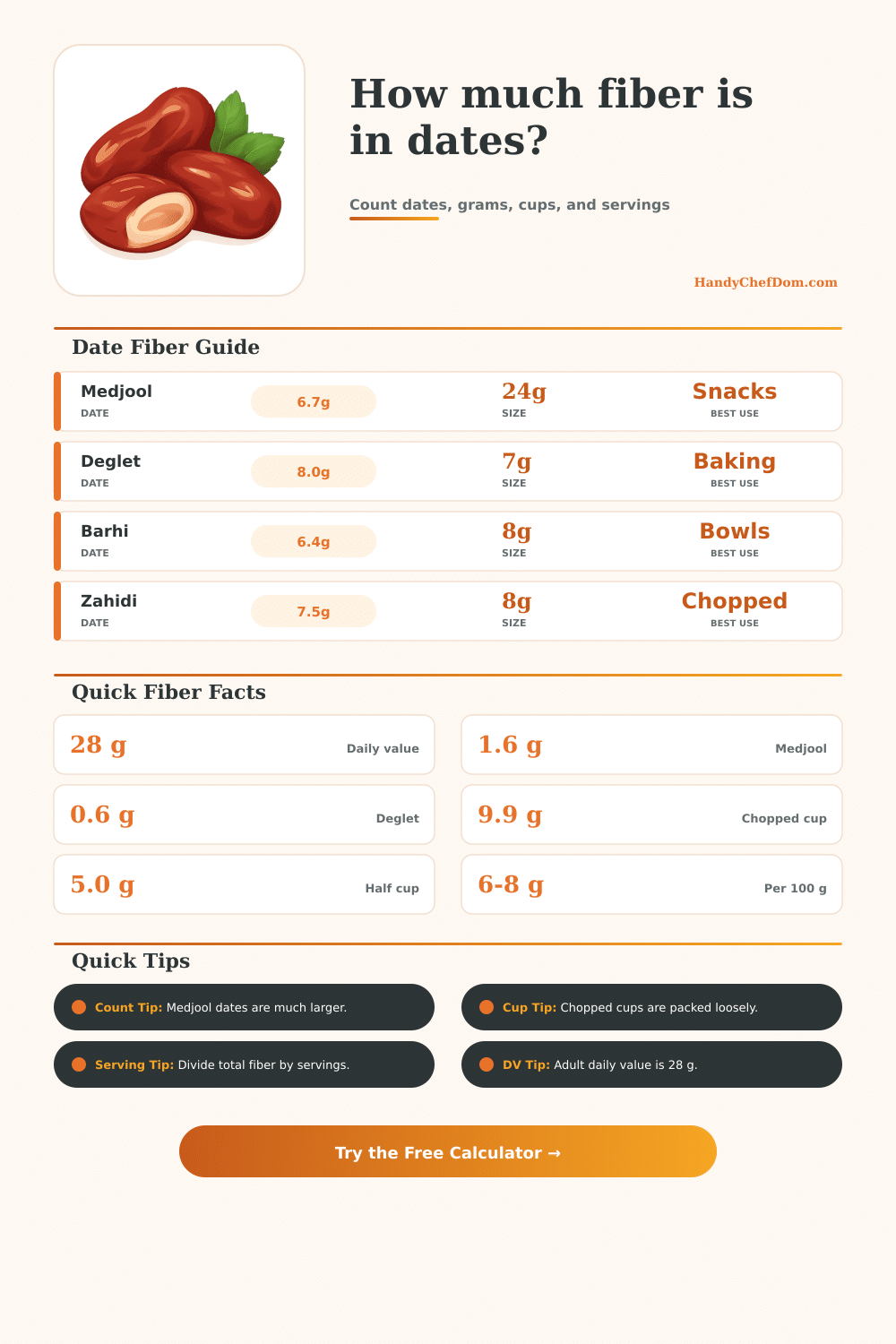
| Medjool | 6.7 g | 24 g | 1.6 g |
| Deglet Noor | 8.0 g | 7 g | 0.6 g |
| Barhi | 6.4 g | 8 g | 0.5 g |
| Zahidi | 7.5 g | 8.3 g | 0.6 g |
| Halawi | 7.0 g | 9 g | 0.6 g |
| Khudri | 8.0 g | 9.5 g | 0.8 g |
| Ajwa | 6.5 g | 7.5 g | 0.5 g |
| Sukkari | 7.1 g | 10 g | 0.7 g |
| Chopped Pitted Volume | Approx Weight | Medjool Fiber | Deglet Fiber |
|---|---|---|---|
| 1 tablespoon | 9 g | 0.6 g | 0.7 g |
| 1/4 cup | 37 g | 2.5 g | 3.0 g |
| 1/3 cup | 49 g | 3.3 g | 3.9 g |
| 1/2 cup | 74 g | 5.0 g | 5.9 g |
| 3/4 cup | 110 g | 7.4 g | 8.8 g |
| 1 cup | 147 g | 9.8 g | 11.8 g |
| Common Portion | Medjool Fiber | Deglet Fiber | Daily Value Share |
|---|---|---|---|
| 1 large Medjool | 1.6 g | 0.6 g for 1 Deglet | 6% or 2% |
| 2 large Medjool | 3.2 g | 1.1 g for 2 Deglet | 11% or 4% |
| 3 large Medjool | 4.8 g | 1.7 g for 3 Deglet | 17% or 6% |
| 5 Deglet snack | 8.0 g if Medjool | 2.8 g | 29% or 10% |
| 10 Deglet baking | 16.1 g if Medjool | 5.6 g | 57% or 20% |
| 12 Medjool tray | 19.3 g | 6.7 g if Deglet | 69% or 24% |
| Fiber Target | Daily Grams | Medjool Equivalent | Deglet Equivalent |
|---|---|---|---|
| Adult daily value | 28 g | About 17 dates | About 50 dates |
| Common women target | 25 g | About 16 dates | About 45 dates |
| Common men target | 38 g | About 24 dates | About 68 dates |
| Teen comparison | 31 g | About 19 dates | About 55 dates |
| Child comparison | 19 g | About 12 dates | About 34 dates |
| Half daily value | 14 g | About 9 dates | About 25 dates |
Dates are an fruit that many peoples eat as snack. Dates contains a specific amount of fiber, which can vary depending on the variety of date that are consumed. For example, the varieties of dates can range from large dates, like Medjool dates, to small dates, like Deglet Noor dates.
Because Medjool dates are more larger than Deglet Noor dates, Medjool dates will contain more fiber than Deglet Noor dates if only considering the individual fruit. Thus, the variety of dates that are consumed will have a significant impact upon the amount of fiber that is consume from dates. The calculator that is provide on this page allows for individuals to calculate the fiber content of dates.
How to Use the Date Fiber Calculator
The calculator allow for individuals to select how the dates will be measured. For example, individuals can count the dates individual, weighed, or the calculator can measure the volume of chopped dates. Each of these option will allow for individuals to calculate the fiber content of dates that are prepared in a certain way.
Additionally, individuals can select whether the dates to be counted is pitted or unpitted. Unpitted dates will contain the seed of the dates, which do not contain fiber. Thus, the dates will contain less fiber than the same amount of pitted dates of the same weight.
The size of dates is another factor that will impact the amount of fiber that is consume from dates. For example, because Medjool dates are three times as heavy than Deglet Noor dates, two Medjool dates will contain more fiber than five or six Deglet Noor dates. The fiber content calculator utilize specific density value for each type of date.
These specific values allows for the calculator to report the fiber content of dates, even if the dates are measured by volume in a measuring cup. It is possible for individuals to make mistake when measuring chopped dates by volume. For example, if an individual pack the chopped dates into the measuring cup tightly, more dates will be contained in the cup than if the dates are only loose filled into the cup.
Thus, individuals should ensure that they select the method based off the actual form of the dates that are being measured to ensure accuracy in the measurement of fiber content. The fiber content of dates is similar to other dried fruit that contain fiber, as well as natural sugar. Due to the fiber and sugar content of dates, dates may help individuals feel full.
The way in which dates are consumed will have an impact upon the effect of the fiber content of dates. For example, dates can be consumed alone or you can incorporate them into another meal, such as yogurt or oatmeal. While the date fiber calculator can help to estimate the fiber content of dates that are to be consumed, it does not replace the information contain on the nutrition label of a package of dates.
The fiber content of dates can be compare to other dried fruits, as. For example, dried fruits like prunes and dried figs has similar amounts of fiber to dates. However, raisins contains less fiber than dates.
Raisins are made from dates that have been processed in a different manner then dates that are consumed as snacks. By comparing the fiber content of different dried fruits, individuals can rotate the snack that are consumed. By rotating the snacks that are consumed, individuals can avoid flavor fatigue from the same snacks that are continuous consumed.
In addition to calculating the fiber content of dates, the calculator also allow individuals to enter there daily target for fiber intake. The fiber content calculator will display the fiber content of dates as a percentage of the individuals daily target. This percentage will indicate the proportion of the individuals daily fiber goal that dates will contribute.
This percentage can help individuals to plan the remainder of their days meal to ensure that they meet their daily fiber goal. Additionally, regular use of the date fiber calculator will help individuals to understand how many portion of dates contain specific amounts of fiber. Thus, regular use of this calculator will help individuals understand how different variety of dates may contribute to their fiber intake.