🧈 Salt to Add to Unsalted Butter Calculator
Turn unsalted butter into light, classic, savory, or bold salted butter with crystal-specific teaspoons, grams, recipe scale, and sodium per serving.
Enter the butter amount before scaling. The calculator scales the butter, applies the chosen salted-butter target, converts the salt into your crystal type, then estimates sodium for the whole batch and per serving.
| Butter Amount | Tablespoons | Grams | Salt at 1.25% |
|---|---|---|---|
| 1/2 stick | 4 tbsp | 56.7 g | 0.7 g |
| 1 stick | 8 tbsp | 113.4 g | 1.4 g |
| 2 sticks | 16 tbsp | 226.8 g | 2.8 g |
| 3 sticks | 24 tbsp | 340.2 g | 4.3 g |
| 4 sticks | 32 tbsp | 453.6 g | 5.7 g |
| 500 g block | 35.3 tbsp | 500 g | 6.3 g |
| Salted Level | Salt Percent | Per Stick | Best Fit |
|---|---|---|---|
| Barely salted | 0.6% | 0.7 g | Sweet baking when recipe salt stays separate |
| Light salted | 0.9% | 1.0 g | Cookies, cakes, and gentle buttercream |
| Classic salted | 1.25% | 1.4 g | General salted butter replacement |
| European style | 1.5% | 1.7 g | Richer table butter and bread service |
| Savory finish | 1.8% | 2.0 g | Vegetables, potatoes, and sauces |
| Bold compound | 2.2% | 2.5 g | Herb logs, steak butter, and toast spread |
| Salt Crystal | Grams Per Tsp | 1 g Equals | Texture Note |
|---|---|---|---|
| Table salt | 6.1 g | 0.16 tsp | Dense, strong teaspoon reading |
| Fine sea salt | 5.7 g | 0.18 tsp | Reliable for baking and smooth butter |
| Pickling salt | 6.0 g | 0.17 tsp | Fine grains dissolve evenly |
| Morton kosher | 4.8 g | 0.21 tsp | Medium flakes, less dense than table salt |
| Diamond kosher | 2.8 g | 0.36 tsp | Large flakes need more teaspoon volume |
| Flaky finishing | 1.9 g | 0.53 tsp | Best folded in for visible crunch |
| Serving Plan | Butter Portion | Classic Sodium | Practical Use |
|---|---|---|---|
| Thin toast swipe | 1 tsp butter | 19 mg | Light spread on warm bread |
| Standard pat | 1 tbsp butter | 79 mg | Vegetables, rolls, pancakes |
| Baking serving | 1/2 tbsp butter | 39 mg | Cookies or cake slices |
| Compound slice | 2 tbsp butter | 158 mg | Steak, corn, potatoes |
| Family batch | 2 sticks total | 1115 mg | Divide across recipe portions |
| Metric block | 250 g total | 1229 mg | Bakery scaling and batch prep |
To transform unsalted butter into salted butter, it is necessary to understand the relation between the weights of the butter and the weight of the salt that is to be added to the butter. Many people who attempts to create salted butter from unsalted butter will guess at the amount of salt that should be added to the butter. However, guessing at the amount of salt that is added to the butter can create an imbalance in the flavors of the butter.
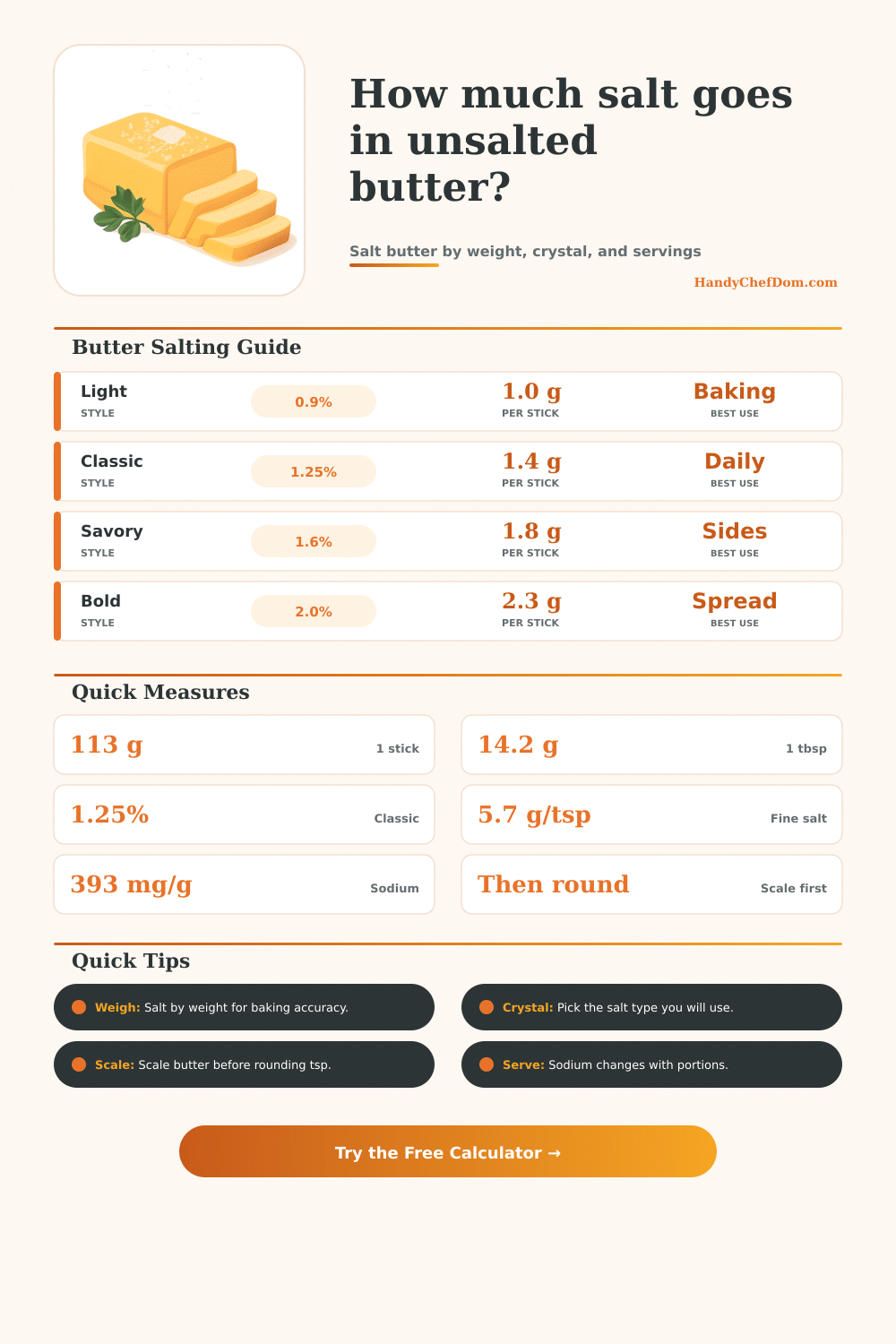
For these reason, it is necessary to determine the percentage of salt that should be added to the unsalted butter, as this percentage will determine the flavor of the resulting salted butter that is created. Commercially salinated butter typically contains 1.25% salt by weight. This percentage of salt is considered to be the standard level of salt add to many recipes.
How Much Salt to Add to Unsalted Butter
For recipes that also contain other salty ingredient, however, a lower percentage of salt can be added to the butter. For recipes like compound butter for steak, for instance, a higher percentage of salt can be added to the butter. You can use the calculator that are provided in the recipe to input the weight of the butter that is to be salted, as well as the percentage of salt that is desire by the recipe.
The calculator will provide the amount of salt (in pounds) that should be added to the butter of that specified weight to achieve the desired percentage of salt in the butter. The size of the crystals in the salt can also impact the amount of salt that is added to the butter. Table salt crystals are much more small in size than other types of salt, such as flaky kosher salt.
A teaspoon of table salt will contain more salt (by weight) than a teaspoon of flaky kosher salt. Thus, if salt is measured by volume (such as by using a teaspoon to measure the salt) instead of being weigh, it is possible to either add too much or too little salt to the butter. Therefore, it is necessary to decide in advance the type of salt that will be used in the butter.
The calculator can also be used to determine the amount of salt that should be measured in teaspoons (instead of pounds) in order to ensure that the correct amount of salt by volume are added to the butter. Finally, the scale at which the butter is to be prepared and the number of servings that will result from the preparation of the butter are two additional factor that must be considered. The amount of salt in the butter will contribute to the total amount of salt contain in the dishes that utilize the salted butter.
For instance, a batch of salted butter prepared for four people will contain a different amount of salt than a large batch of salted butter prepared for a large group of individuals. The calculator will take into consideration the number of servings that will result from the prepared butter, and will provide both the total amount of salt that will be contained in the batch of butter, as well as the amount of salt that will be contained in each serving of that butter. This information is helpful in that it allows you to know how much salt is in one serving of salted butter and helps to ensure the product is correctly seasoned.
When you prepare your salted butter, you must also consider the loss of the butter that is mixed into the recipe. Because butter often sticks to the sides of the mixing bowl or to the spatula, some of the salted butter will be lost during the mixing process. As a result, the concentration of salt within the butter may be affected by this mixing loss.
To account for this loss, you can add a small percentage to your calculations; adding this buffer percentage will ensure that you have enough salted butter to reach your target percentage of salt. The reference tables included on this page display the weight of salt required to reach various percentages of salt in the butter; the tables also show how many teaspoons of salt of various crystal size is equal to the weight of salt required for those percentages. These tables dont need to be memorize; they can be scanned to determine the pattern of the values, and the salt calculator can be used to determine the exact amount of salt required for your specific amount of unsalted butter.
Many cooks tend to make the mistake of assuming all salted butter contain the same amount of salt. The salt levels in different types of salted butter can differ. For instance, European style butter contains a different amount of salt than American style butter.
Additionally, compound butters tend to be saltier than most salted butter product. Using one type of salted butter instead of another can significantly impact the flavor and texture of the foods prepared with the butter. To avoid this mistake, cooks should ensure the target salt percentage of the butter to be used before begin to cook.
Another common mistake is adding the salt before finishing scale the recipe. If the amount of unsalted butter to be used is increased, but the amount of salt is not increased to accommodate the increase in butter, the resulting butter will have too low percentage of salt. Scaling the amount of unsalted butter first and calculating the amount of salt required to achieve the target percentage of salt will ensure the salt percentage of the butter remain the same regardless of how large of a batch of butter is prepared.