🍰 Cake Flour Substitute Calculator
Blend all-purpose flour and cornstarch for a cake flour substitute by grams, cups, protein target, recipe size, sift loss, and cake style.
Choose cups or grams, enter your all-purpose flour protein, then set the cake flour target. The calculator balances flour and cornstarch so the final blend lands close to your protein goal after sift loss.
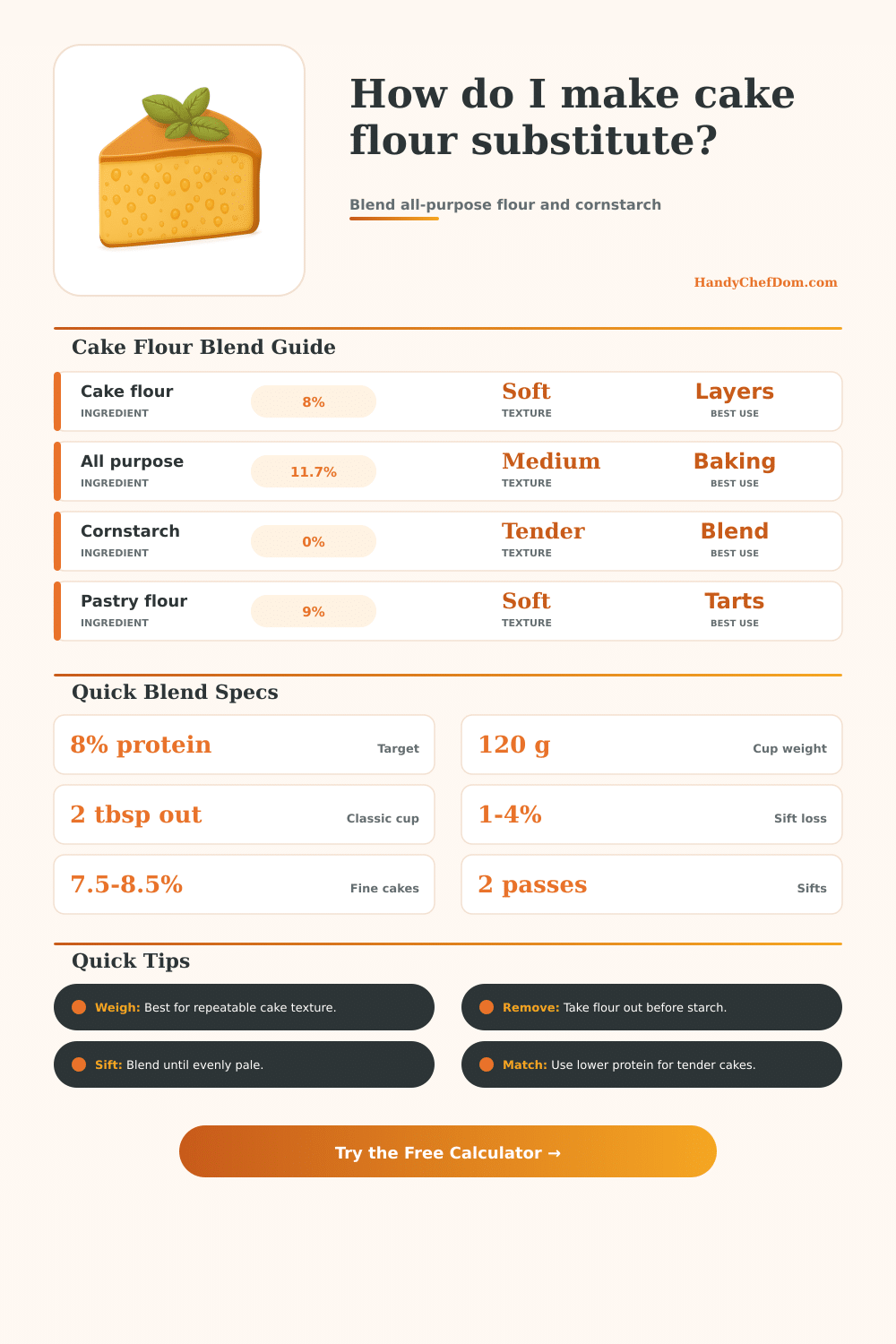
| Flour Type | Typical Protein | Texture Direction | Best Cake Use |
|---|---|---|---|
| Cake flour | 7% to 9% | Very tender, fine crumb | White cakes, sponge, soft cupcakes |
| Pastry flour | 8% to 10% | Tender but slightly stronger | Tea cakes, biscuits, tarts |
| Southern-style all-purpose | 8.5% to 10.5% | Soft all-purpose texture | Quick cakes and tender muffins |
| Standard all-purpose | 10.5% to 12% | Moderate structure | General baking and cookies |
| Bread flour | 12% to 14% | Chewy, strong gluten network | Not ideal for cake flour blends |
| Per 1 Cup Substitute | AP Flour To Use | Cornstarch To Add | Approx Target |
|---|---|---|---|
| Classic spoon-and-level cup | 1 cup minus 2 tbsp | 2 tbsp | About 8% to 9% |
| 120 g cake flour weight | 104 g to 108 g | 12 g to 16 g | About 8% to 8.5% |
| 130 g heavier cup | 113 g to 117 g | 13 g to 17 g | About 8% to 8.5% |
| Low-protein AP flour | 110 g to 114 g | 6 g to 10 g | About 8% to 9% |
| High-protein AP flour | 98 g to 104 g | 16 g to 22 g | About 8% to 8.5% |
| Cake Style | Suggested Protein | Blend Direction | Texture Goal |
|---|---|---|---|
| White or vanilla layer cake | 7.8% to 8.5% | Classic cake flour substitute | Fine, soft, stackable layers |
| Sponge or genoise | 7.5% to 8.2% | Slightly more cornstarch | Light crumb with clean slices |
| Chiffon or angel-style crumb | 7.2% to 8% | Softest practical blend | Feathery and delicate |
| Cupcakes | 8% to 8.8% | Balanced softness | Tender dome, not fragile |
| Sheet cake | 8.2% to 9% | Slightly stronger blend | Moist crumb with easy serving |
| Pound cake | 8.8% to 10% | Less cornstarch | Tender but still structured |
| Batch Size | Cake Flour Needed | Classic Cornstarch | Sifting Note |
|---|---|---|---|
| Half cup equivalent | 60 g | 1 tbsp | Sift at least twice |
| One cup equivalent | 120 g | 2 tbsp | Whisk, then sift |
| Two cup recipe | 240 g | 4 tbsp | Split into two sifts if needed |
| Three cup recipe | 360 g | 6 tbsp | Use a wide bowl for even blending |
| Large sheet cake | 480 g | 8 tbsp | Stir from the bottom before sifting |
| Double batch | 720 g | 12 tbsp | Blend in two smaller batches |
This calculator models protein dilution with cornstarch, which has negligible protein compared with wheat flour. Flour brands vary, so weigh ingredients when possible for the most repeatable cake texture.
In order to bake a cake, one must consider the protein contents of the flour that is to be use. The protein content of the flour will have an impact on the texture of the resulting cake. Flour contain proteins that will react with the water in the cake to form gluten.
Gluten will provide structure to the baked cake, but if there is too much gluten, the resulting cake will be tough; too little gluten, however, will result in a cake that does not have enough structure. Flour that contains a low protein content will create a cake that has a soft texture; flour that contains high levels of protein will create a firmer texture. Cake flour contains low levels of protein (around 8% protein content), while all-purpose flour contain a higher protein content (around 10-12% protein content).
How to Make Cake Flour from All-Purpose Flour
If cake flour isnt available, it is still possible to create a substitute for cake flour by using all-purpose flour and cornstarch. Cornstarch does not contain proteins that will binds with water to form gluten. Thus, by incorporating cornstarch into a mixture of all-purpose flour, the protein content of that flour mixture will decrease.
In order to ensure that the resulting flour mixture contains the appropriate amount of protein for the cake recipe, however, it is necessary to replace a specific amount of all-purpose flour with cornstarch. You can determine the amount of cornstarch that is required by entering the protein percentage of the all-purpose flour that you will use in the recipe, as well as the total amount of flour that will be required for the cake. Using a scale to measure the flour by weight will ensure accuracy in the amount of flour that is measured.
The weight of flour can change when measured in different ways; for instance, flour that is scooped directly into a measuring cup will weigh differently from flour that is dipped into a sack of flour or that is spooned into a measuring cup. Thus, if the weight of the flour change, the protein content of that flour will change as well. In order to ensure that the protein content of the flour is correct, flour should be measured by weight.
One can enter the weight of the flour into a calculator to determine the amount of cornstarch that should be added to the flour in order to achieve the appropriate protein percentage. Sifting the flour is a step that is typically followed in the baking of cakes. When you sift the flour, however, some of the flour will become stuck to the sieve or to the mixing bowl; thus, the amount of flour that is measured will decrease slight as a result of the sifting step.
It is important to account for this loss of flour when the flour mixture is prepared. A calculator can be used to determine the amount of flour that should be measured in order to account for potential loss of flour that result during the sifting step. The type of cake that is to be baked will determine the protein percentage that should be targeted with the flour that is used.
For instance, angel food cakes contain protein percentages of around 7.5% whereas pound cakes contain protein percentages of around 9%. Using too much protein for a recipe that calls for a light texture will result in a cake that is too heavy. Similarly, using too little protein for a recipe that require a heavy cake may result in the cake collapsing during the baking process.
Thus, one must consider the type of cake to be baked in order to ensure that the proper percentage of protein is obtained from the flour mixture. It is also important to avoid common mistake in the baking of cakes. One common mistake is the use of a rule that suggests, for instance, that two tablespoons of flour should be removed for each cup of flour that is used; this type of rule does not account for the protein content of the all-purpose flour that may be used in the recipe.
Another common mistake is to add the cornstarch to the all-purpose flour in a way that pack the flour; packed flour will change the weight of the flour and the amount of each ingredient that should be added to the cake batter. These mistakes can be avoided by first weighing the amount of all-purpose flour that will be used; removing the amount of all-purpose flour that was calculated; adding the cornstarch; and sifting the flour and cornstarch mixture. The manner in which the flour and other ingredients are mixed will also impact the protein content of the baked cake.
If you overmix the mixture of flour and other ingredients, the proteins will be developed to the extent that the resulting cake will be tough. Thus, although the use of cornstarch to control the protein content of the flour mixture is beneficial, care should be taken to ensure that the batter is not overmixed; protein content should be controlled through the use of cornstarch, but also through care in the mixing of the ingredients of the batter. Thus, by controlling the protein content of the flour through the use of cornstarch, and by ensuring that the flour and other ingredients are mixed in a gentle fashion, it is possible to bake a cake that has a consistent and even texture.