🐟 Canned Tuna Protein Calculator
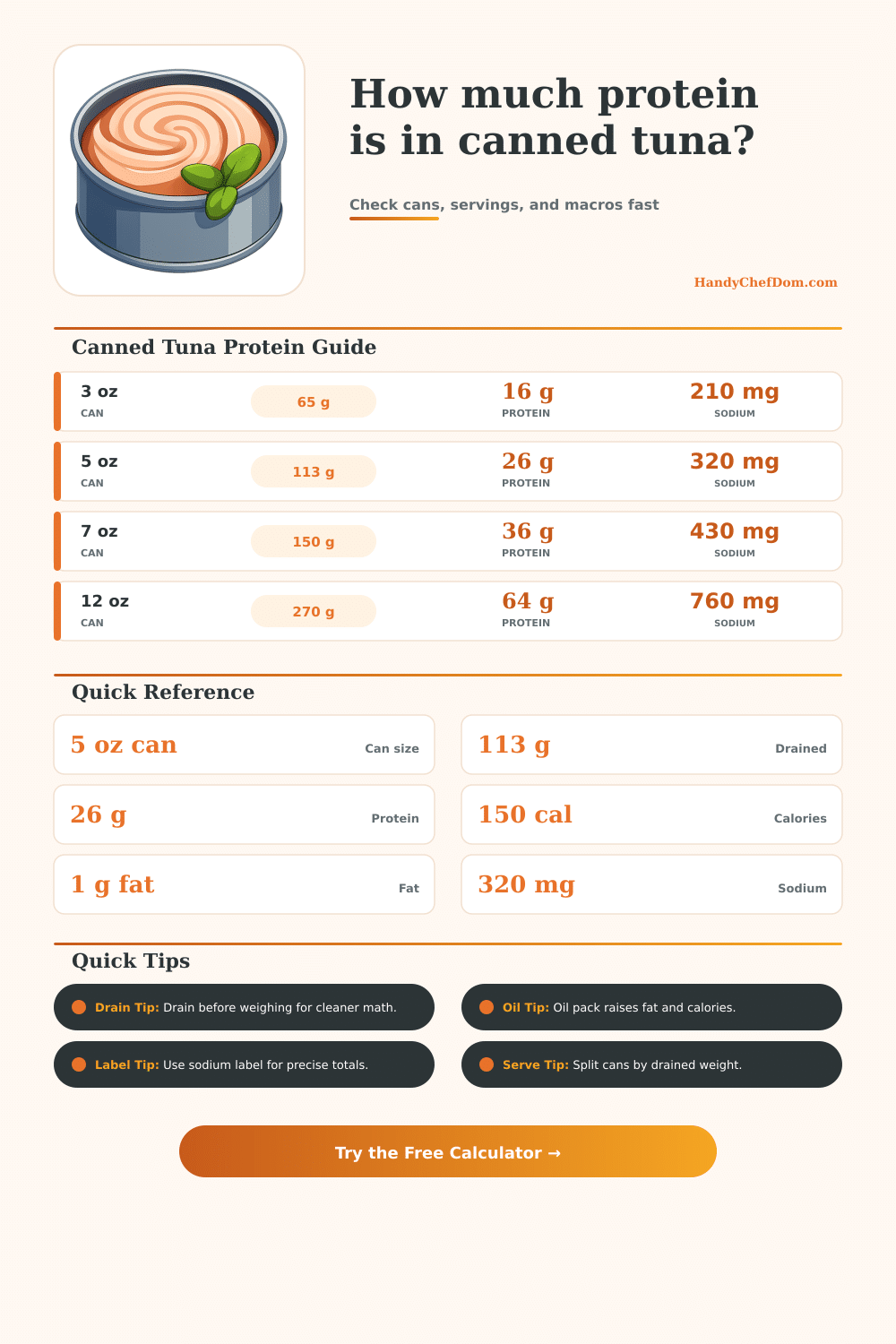
Estimate tuna protein, calories, fat, and sodium from can size, drained weight, pack style, servings, and sandwich or salad use.
Enter the can label values you have. Use drained weight for the most accurate protein, calorie, fat, and sodium estimate.
| Canned tuna label | Protein / 100 g | Calories / 100 g | Fat / 100 g | Sodium / 100 g |
|---|---|---|---|---|
| Chunk light tuna in water | 23 g | 116 cal | 0.8 g | 280 mg |
| Solid white albacore in water | 26 g | 128 cal | 1.2 g | 320 mg |
| Yellowfin tuna in water | 25 g | 122 cal | 1.0 g | 300 mg |
| Chunk light tuna in oil | 24 g | 198 cal | 8.2 g | 310 mg |
| Solid white albacore in oil | 27 g | 205 cal | 8.8 g | 340 mg |
| Low sodium light tuna | 23 g | 116 cal | 0.8 g | 120 mg |
| No salt added albacore | 26 g | 128 cal | 1.2 g | 65 mg |
| Tuna pouch, water pack | 24 g | 110 cal | 0.7 g | 260 mg |
| Can or pouch | Label weight | Typical drained | Protein range | Best use |
|---|---|---|---|---|
| 3 oz pouch | 85 g | 74 g | 17-19 g | Snack plate |
| 5 oz can | 142 g | 113 g | 25-30 g | Sandwiches |
| 6 oz can | 170 g | 130 g | 30-34 g | Salads |
| 7 oz can | 198 g | 150 g | 35-40 g | Meal prep |
| 12 oz can | 340 g | 270 g | 62-73 g | Shared salad |
| 66 oz pouch | 1871 g | 1700 g | 390-460 g | Batch prep |
| Serving use | Target tuna | Protein estimate | Calories estimate | Note |
|---|---|---|---|---|
| Sandwich filling | 56 g | 13-15 g | 65-115 cal | Light lunch |
| Salad topper | 85 g | 20-23 g | 95-175 cal | Main salad |
| Protein bowl | 100 g | 23-27 g | 110-205 cal | High protein |
| Snack plate | 43 g | 10-12 g | 50-90 cal | Small portion |
| Meal prep portion | 113 g | 26-31 g | 130-230 cal | Full can |
| Shared salad bowl | 70 g | 16-19 g | 80-145 cal | Split bowl |
| Pack style | Weight effect | Calorie effect | Fat effect | Sodium effect |
|---|---|---|---|---|
| Water pack, drained | Baseline | Baseline | Baseline | Baseline |
| Water pack, lightly drained | +8% | Same rate | Same rate | Same rate |
| Oil pack, well drained | Baseline | +18% | +45% | +5% |
| Oil pack, some oil kept | +15% | +35% | +120% | +8% |
| Pouch, no draining | Label weight | Baseline | Baseline | Baseline |
| Low sodium label | Baseline | Baseline | Baseline | Use label |
Cans of tuna line your pantry. They all look identical from the outside but behave completely differently on nutrition label. Then you check the nutritional information. A can contains low-fat protein. Another can contain protein smothered in a fatty dressing of oil. That’s no magic. There is no marketing. It is just food science.
The real amount of protein varies based off something most people ignore: the size of what’s inside the can, which isn’t marked by the print on the top of the lid. When tracking daily macronutrients from things stored in your kitchen, that’s something to remember. When you put in your can information, the calculator above do the math for you. You won’t have to guess about conversions anymore.
How to Choose Canned Tuna
Drained weight is the critical piece here since water increases volume without increasing protein. On average, a five-ounce can contains roughly four ounces of actual meat once it’s been drained. Using the label weight instead will cause an overestimation of consumption. This gets worse if you prepare meals for the week or have several can per salad.
There’s also the issue of pack style (which most shoppers don’t consider). Gram for gram, water-packed tuna has fewer calories and less fat, but more protein different than oil-packed tuna. It’s not as much about protein density as it is about tradeoffs (flavor and texture). You’ll still have to drain out all the extra liquid, or leave a bit. Either way, you’re increasing amount of energy. For people tracking their macros, water packs are a cleaner starting place.
There are also no-salt options available with pouches; this make sodium tracking simpler if you’re watching your blood pressure. But, there is differences between brands/types which also include different sodium content. And that makes life difficult for people who watch their salt. There are low sodium ones out there, too. But even though they have less salt, the protein content stay about the same. Regardless of how much sodium is in the packing liquid, it doesn’t affect the protein. The difference comes with minerals. While minerals don’t contribute to muscle building, they do contribute to heart health. Look at label type and go for high protein and low sodium.
Knowing those factors in advance makes it simpler to plan meals. If I’m making a main dish salad, I’ll need more ounces of meat compared to if I make sandwiches. When using canned tuna as part of my meal, I’ll serve different portions depending on whether it’s the main part or used as an accent. For snack plates, serving size vary. Meal prep containers often utilize whole cans to simplify division and storage. This way, it help you visualize what one portion actualy looks like when translated into scoops on your plate. It takes something abstract (in grams) and turns it into something concrete.
Albacore vs. Light Tuna: Protein content matters here. But so does price. If you want to be efficient with your spending, then stick with light tuna, it’s less expensive, though it will have a lower protein density. Both are good sources of amino acids for recovery. However, albacore is pricier. Choose based off your nutritional goals.
The various sizes has reference tables that indicate relative amounts of what you’re consuming, which can help with portions. If you regularly use a lot of something, get the larger size (which save money). The small pouches are handy, especially if you take snacks out on hikes or need lunch at the office when there’s no fridge. There’s room for all formats within your overall kitchen plan.
That’s how you take the guess work out of eating well. It eliminates those rough approximations and allows you to create your meals exacty. And it doesn’t really matter about the numbers as much as the consistency that they provide long term. With that clarity, you know what’s in the tin, so you could of made better plans around it. A pantry staple becomes a tool for health change.