🍺 Cans per Keg of Beer Calculator
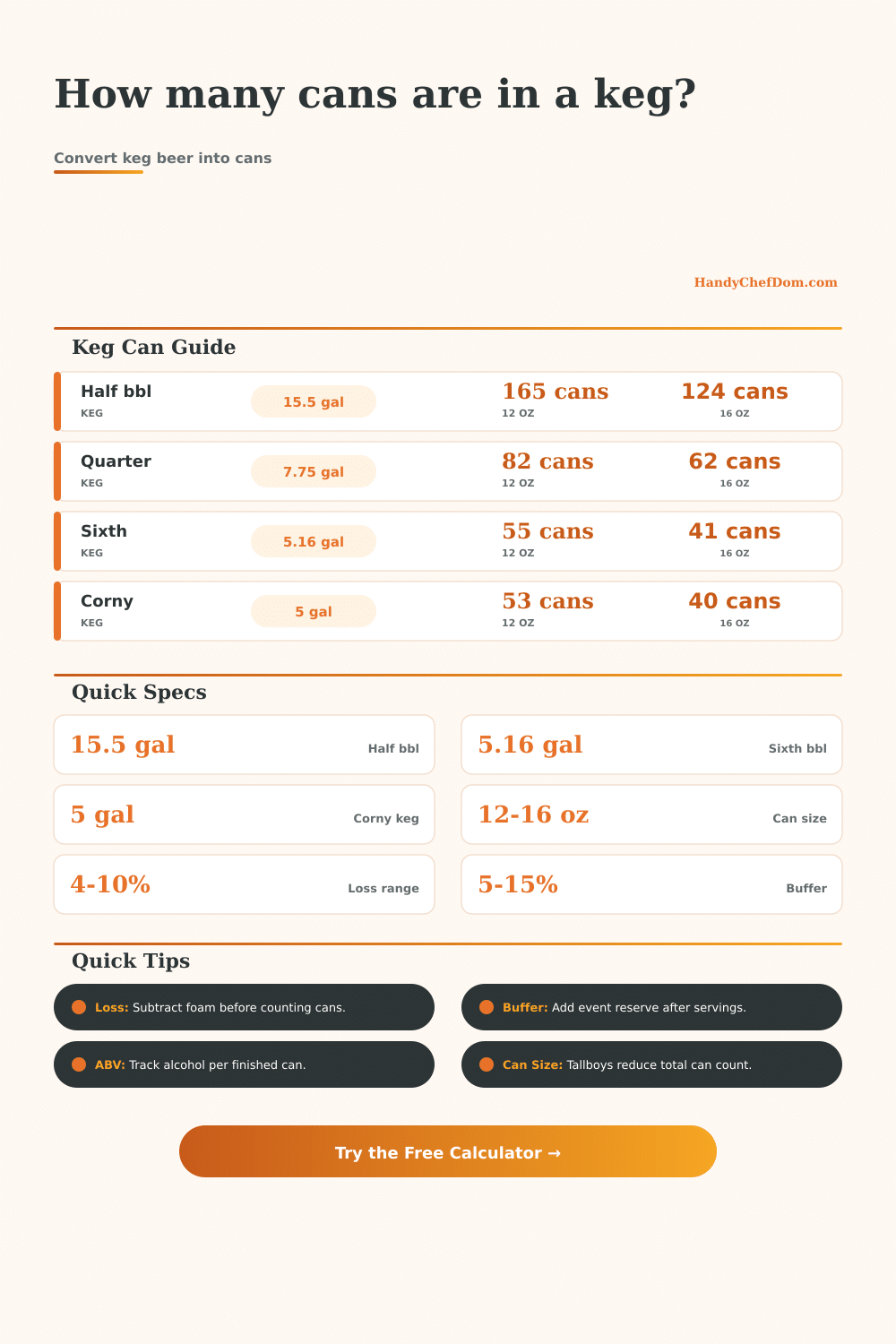
Convert keg size, beer left in the keg, can size, fill loss, foam waste, servings, ABV, and event buffer into realistic can counts.
Use the keg size and actual beer volume first, then apply loss, foam, and buffer so the finished can count reflects what you can actually package or serve.
| Keg profile | Beer volume | 12 oz cans | 16 oz cans |
|---|---|---|---|
| Half barrel keg | 15.5 gal / 1,984 oz | 165 full cans | 124 tallboys |
| Quarter barrel keg | 7.75 gal / 992 oz | 82 full cans | 62 tallboys |
| Slim quarter keg | 7.75 gal / 992 oz | 82 full cans | 62 tallboys |
| Sixth barrel keg | 5.16 gal / 661 oz | 55 full cans | 41 tallboys |
| Corny keg | 5.0 gal / 640 oz | 53 full cans | 40 tallboys |
| European keg | 50 L / 1,691 oz | 140 full cans | 105 tallboys |
| Package size | Fluid ounces | Best use | Half barrel count |
|---|---|---|---|
| Stubby can | 8 oz | Sampler or light pours | 248 cans before loss |
| Standard can | 12 oz | Classic beer service | 165 cans before loss |
| Pint can | 16 oz | Tallboy conversion | 124 cans before loss |
| Imperial pint | 19.2 oz | Large single serves | 103 cans before loss |
| Crowler | 32 oz | Taproom take-away | 62 fills before loss |
| Howler | 64 oz | Shared table pours | 31 fills before loss |
| Scenario | Fill loss | Foam waste | Buffer note |
|---|---|---|---|
| Counter-pressure fill | 2-4% | 1-3% | Use 5% event buffer |
| Clean party tap | 4-6% | 4-7% | Use 10% event buffer |
| Warm outdoor keg | 6-9% | 8-12% | Use 15% event buffer |
| Sampler flights | 3-5% | 5-8% | Use 8% event buffer |
| Wedding service | 4-7% | 5-9% | Use 12% event buffer |
| Taproom canning | 3-6% | 2-5% | Use 6% event buffer |
| Pour style | Serving size | ABV planning | Packaging note |
|---|---|---|---|
| Reception beer | 12 oz | 4.5-5.5% typical | Match cans to guest count |
| Tailgate pours | 12-16 oz | 4.0-6.0% common | Add buffer for repeat pours |
| Homebrew cans | 12 oz | Recipe ABV varies | Plan loss before labels |
| Taproom crowlers | 32 oz | List beer ABV on fill | Use net beer volume |
| Sampler flight | 4-5 oz | Small pours add up | Count servings separately |
| Picnic cans | 12 oz | Lower ABV stretches events | Keep spare cans chilled |
It’s 3 hours before your party starts, and the beer won’t be served from a cold enough cooler. Theory says it should go for at least 5-7 hours, but its hot out there, and this thing foamed up like crazy; you’ve got a half barrel keg but you’re never sure how many serving it’ll yield. You don’t want to run out.
After plugging in your desired loss and keg size, the calculator do all the work for you. Because it is more than just dividing total volume by the size of a single can, it saves you from guessing at conversions and numbers.
How to Use the Beer Calculator
You have to factor in partial cans that won’t fit (and thus get thrown out), plus beer lost to line residue and what escapes as a foam head. Forget this loss and you’ll find yourself out of beer long before the main course arrives.
First, view your keg profile. A normal half barrel keg contain approximately fifteen and a half gallons. That sounds like a lot, right? Wrong! There’s no way you’re ever going to drain every drop out of that thing; there’s always some left at the bottom of container. When you extract that final few ounce, you’ll drag along some O2 or maybe even some sediment.
Then there’s the matter of transferring beer from the keg to your glass/can. This waste more beer. Using the tool, you can define what percent of beer is lost (based off your system). If you’ve got one of those fancy pants counter pressure canners, your waste won’t be much. If you’re pouring beer off a warm tailgate with a low-end tap handle, you can expect increased waste.
Keg life are shortened by foam. This happens by opening the tap too quickly, having the beer at an improper serving temperature (i.e., warm), or using the wrong amount of CO2 pressure. So the calculator let you specify a percent of your keg that will be wasted from foam, which is used in simulation to get close to reality. If you have a wedding where the bar staff knows what they’re doing and you have a proper serving temperature on the beer, keep your foam waste small. If you’re at someone’s house, it’s probably a backyard party. People is self-serve, so increase that number! Better to overestimate your waste then underestimate it.
Next it will calculate how many of those full cans is in your chosen volume (it’ll convert your net volume to full cans). It will then let you select can size. You can choose regular twelve ounce cans or taller sixteen ounce “tallboy” style cans, since they holds a different amount. If you’re choosing cans, more cans equals more waste (packaging), but bigger servings per can. How much variety vs. Volume do you think your party/event require?
There’s a handy table on the page to quickly compare can sizes and keg types. Also keep an eye on alcohol by volume. This allows you to gauge how strong every can is. If it’s a high-ABV imperial stout, people will go through fewer cans. If it’s a session ale, they’ll knock back more. That goes into the total alcohol volume, which gives you some sense of the cumulative strength of the beer. It is a small thing, but it is important when planning responsibly.
Add a buffer. And finally, add a buffer. At a party, somebody is going to spill a drink. Someone else is going to pour their drink on the ground and ask you for more. A keg will turn out less full than expected. A faucet will suddenly spit up suds all over everything. A five to ten percent buffer ensures that you’ve got plenty of beer to handle any and all of this.
What does the tool do? It’ll tell you how much extra (or not) you’ll get compared to what you wanted to serve. If the number come back negative, you need to purchase some cans or pop another keg open. If it’s positive, you can be sure knowing you’ve got yourself a safety net.
Planning is less about the math and more about managing expectations, though the calculator handle the essential math to help you move from guessing to knowing. It doesn’t matter how fast a person drinks beer, that’s beyond your control. All you can do is estimate beer losses due to foam, waste, etc., and plan accordingly. By doing so, you transition from guesswork to knowledge. And this peace of mind is priceless compared to those few extra cans. Instead of staring at the keg in fear, you’ll be having fun at the party. Nobody go thirsty, the taps never stop flowing, and the beer remains cold.