Celery Sodium Calculator
Estimate celery sodium by stalk count, trimmed grams, chopped cups, raw snack sticks, cooked portions, soup base, serving count, added salt, dip sodium, daily limit percent, and party snack tray scaling.
1Celery Sodium Presets
2Celery Amount, Use, Trim, Salt, Dip, and Serving Inputs
Choose stalks, grams, chopped cups, or a snack tray. The calculator estimates trimmed edible celery, sodium from celery itself, optional added salt, optional dip sodium, per-serving sodium, daily limit percent, and tray scaling.
Celery sodium result
Choose celery details, then calculate.
3Live Celery Sodium Snapshot
4Celery Form, Use, and Sodium Grid
| Celery form | Typical amount | Sodium estimate | Yield or capture | Best calculator mode |
|---|---|---|---|---|
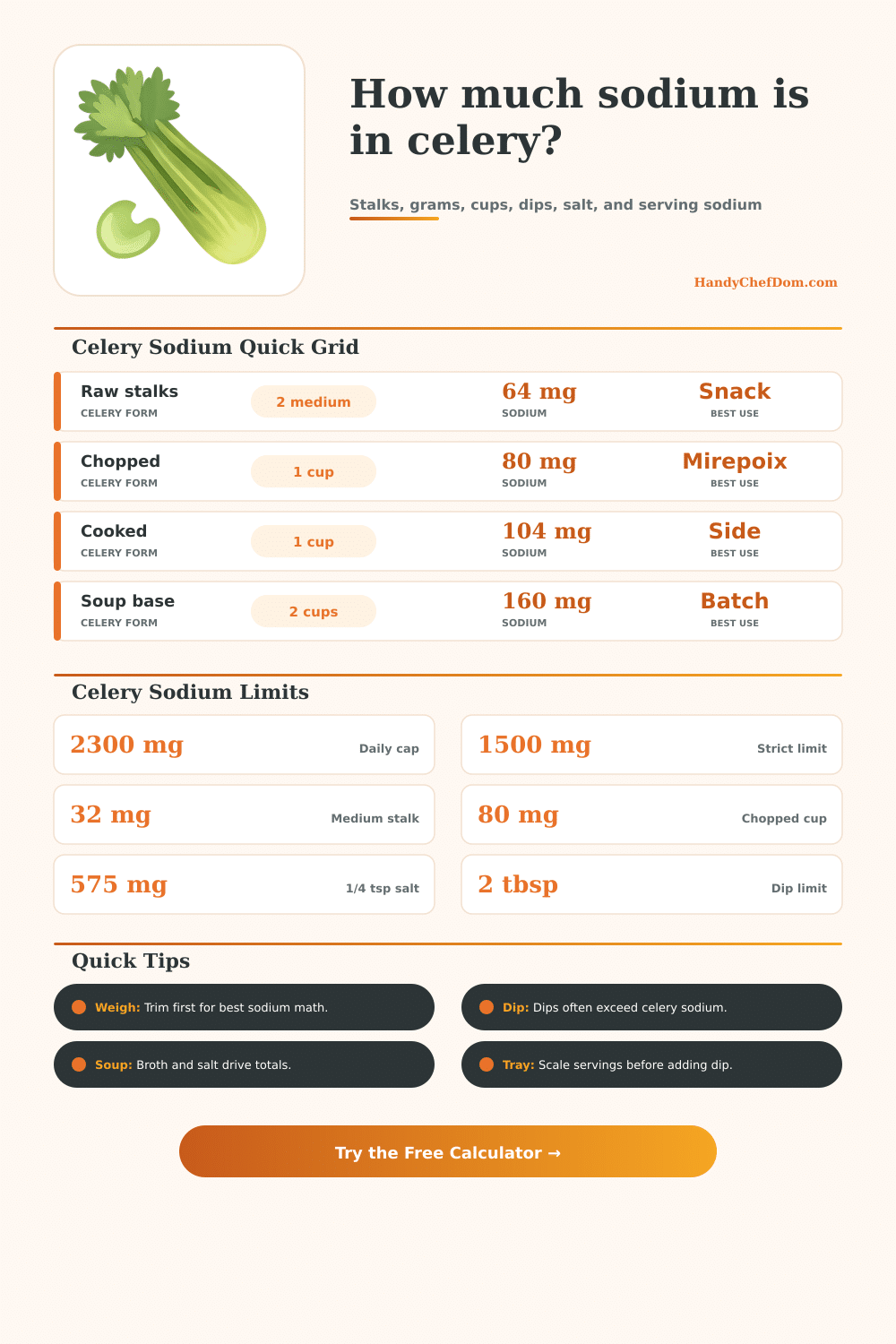
| Raw medium stalk | 40 g before trim, about 32 g edible at 80% | About 32 mg per whole medium rib equivalent | Trim yield matters for leaves and dry ends | Stalk count |
| Inner celery hearts | 30 g small rib | About 24 mg per rib | Often higher edible yield | Stalk count or grams |
| Raw snack sticks | 8 g per stick | About 6 mg per stick | Tray leftovers can reduce eaten sodium | Snack tray scaling |
| Raw chopped celery | 100 g per chopped cup | About 80 mg per cup | Dice size changes cup weight | Chopped cups |
| Cooked celery | 128 g per cooked cup | About 104 mg per cup | Water loss concentrates by cup | Cups or grams |
| Soup base celery | 100 g per cup before simmering | About 80 mg before broth and salt | Strained stocks may retain only part of solids | Cups plus capture |
| Celery juice equivalent | 240 g celery per cup juice | About 190 mg before any salt | High celery mass in a small drink | Grams |
| Pickled celery garnish | 30 g garnish | About 180 mg with brine estimate | Brine sodium dominates | Grams with pickled form |
5Added Salt, Dip, and Spread Table
| Add-on | Calculator sodium rate | Common celery use | Why it changes the result |
|---|---|---|---|
| No dip | 0 mg per tbsp | Plain snack, salad, or soup base | Shows celery's natural sodium only. |
| Ranch dip | About 75 mg per tbsp | Snack sticks and party trays | Two tablespoons can exceed several stalks of celery. |
| Blue cheese dip | About 95 mg per tbsp | Buffalo wing trays | Cheese and seasoning raise sodium quickly. |
| Peanut butter | About 75 mg per tbsp | Ants-on-a-log snacks | Spread sodium depends heavily on brand. |
| Hummus | About 65 mg per tbsp | Vegetable plates | Often moderate, but serving size can creep up. |
| Cream cheese spread | About 45 mg per tbsp | Stuffed celery ribs | Lower per spoon than some dips, still important in batches. |
| Table salt | About 2300 mg per tsp | Soup, braise, or seasoning | A small pinch can dominate celery sodium. |
6Snack Tray Scaling Table
| Tray style | People | Sticks per person | Approx celery sodium | Planning note |
|---|---|---|---|---|
| Small lunch crunch box | 1 | 6 sticks | About 38 mg | Dip usually matters more than celery. |
| Family wing side | 4 | 4 sticks | About 102 mg total | Blue cheese dip can multiply the sodium total. |
| Game-day tray | 12 | 4 sticks | About 307 mg total | Set capture below 100% if leftovers are likely. |
| Office snack platter | 20 | 3 sticks | About 384 mg total | Use serving count to split by attendees. |
| Large buffet tray | 40 | 3 sticks | About 768 mg total | Scale dip separately from celery sticks. |
7Common Celery Sodium Scenarios
| Scenario | Celery setup | Celery sodium | Extras | Per-serving result |
|---|---|---|---|---|
| Two raw stalk snack | 2 medium stalks, 80% trim yield | About 51 mg edible celery sodium | No dip or salt | About 51 mg for one serving |
| One chopped cup in soup | 1 cup raw chopped celery | About 80 mg | 1/4 tsp salt adds about 575 mg | About 82 mg across 8 servings before broth |
| Ants-on-a-log plate | 2 stalks plus 2 tbsp peanut butter | About 51 mg | About 150 mg from peanut butter | About 201 mg for one serving |
| Buffalo wing tray side | 12 people, 4 sticks each | About 307 mg | 12 tbsp blue cheese adds about 1140 mg | About 121 mg per person |
| Low-sodium crunch | 3 small heart ribs | About 58 mg | No dip, no salt, 1500 mg limit | About 4% of a 1500 mg daily limit |
| Pickled garnish batch | 150 g pickled celery | About 900 mg | No extra salt added | About 150 mg across 6 servings |
8Celery Sodium Mode Comparison
Best for snacks, lunches, and recipes where you count whole ribs before trimming.
Best after trimming because edible grams avoid size and leaf waste guesses.
Best for mirepoix, soup, salad, and cooked cups where cup weight changes by cut.
Best for celery sticks, wing platters, parties, leftovers, and dip planning.
9Two Practical Celery Sodium Tips
You probably don’t spend too much time thinking about celery, it’s an innocent-looking vegetable, mostly found quietly hiding in your kitchen drawer. When you pull one out, you grab a stalk, snap it off, and believe you’re doing yourself a service by taking in a low-sodium, zero-calorie vegetable. But there’s sodium in celery, and if you snack on multiple stalks or even fill up a whole tray, the sodium can adds up fast.
With the calculator, you input exactly what you’re doing (no guessing required), and then the magic happens: The calculator do the math for you. That vague green stick becomes a real number, and now you feel confident you’re tracking correcty.
Why You Should Count Celery Sodium
Most people believe they don’t eat too much sodium because they look at added salt instead of the sodium already present in foods. A medium stalk of celery contain approximately thirty-two milligrams of sodium, naturaly found there. Doesn’t seem like much? Add a quarter teaspoon of salt, or even just two tablespoons of ranch dip, and that number gets dwarfed.
Know how much of the sodium in a particular dish are coming from which ingredient. Is it the vegetable (plain celery)? Or is it the dip (celery dipped in something)? Because if you’re aiming for a specific daily amount of sodium, this is an important distinction.
The tool includes three different ways to input your data: estimate chopped cups, weigh your trimmed grams, or simply count up the number of stalks. Counting stalks makes sense when you’re making a quick lunch (most people grab two ribs without pulling out their scale). Weighing in grams makes more sense when you’re balancing flavor profiles and cooking a big batch of something like soup, where precision matter. Measuring in cups works for things like salads, but remember: depending on how finely you dice your ingredients, the cup will weigh more or less.
The tool accounts for this packing style, which keeps you from going overboard on sodium just because your cut turned out finer then expected.
You may also want to consider how much you will actualy get. When I’m picking out celery in the store, there’s a lot of leafy top and dry white end (the bits you don’t end up eating). You can include this “trim” in the calculator (typically it assumes an 80 percent edible portion). If your celery is old or tough, you’ll probably trim more. But you’re not counting calories or sodium based off the weight of something you won’t actualy eat, just how many calories or milligrams of sodium are going onto your plate.
What happens if you scale it up to a party tray or a game day spread with 12 folks chowing down on four sticks apiece? That’s when the math start to get interesting. But then it spirals as you realize how much sodium the dip contain: Blue cheese or ranch dips can have almost 100 milligrams per tablespoon. Add in a couple tablespoons of dip for six tablespoons total on the board, and you’re contributing several hundred milligrams to the mix. The tool helps you see that the celery is just a way to eat a salty condiment, so you can tell if you’re serving your guests a light snack or a large part of their daily limit.
People watching their salt intakes need to know: What’s naturally present vs. What is being added? Celery won’t suddenly turn into a sodium bomb by itself, though cooking it down will concentrate its saltiness somewhat, since water evaporates. It’s a mistake to assume that celery doesn’t factor into your daily limit; hence the danger.
Because celery IS healthy, right? Yes, but it also has a small effect. This can be easily overlooked if you pair it with something like creamy dip or broth. And celery’s such an adaptable ingredient: juice it (to hydrate), cook it (for flavor), or eat it fresh (for crunch). Depending on how you prepare it, the sodium will fluctuate a little, but even at its highest level, it’s still lower than anything processed.
The trick lies in tracking what you’re adding to your portion; and learning to measure it precisely. Once you begin to weigh up instead of guess, the numbers falls into place. And then you realize where that crunchy green is fitting into your food portrait. It is not something to avoid, but simply a way to know what you are already enjoying in your diet.