Chicken Frying Time Calculator
Estimate pan-frying or deep-frying time for wings, thighs, drumsticks, tenders, cutlets, nuggets, and bone-in pieces by size, coating, oil temperature, and batch layout.
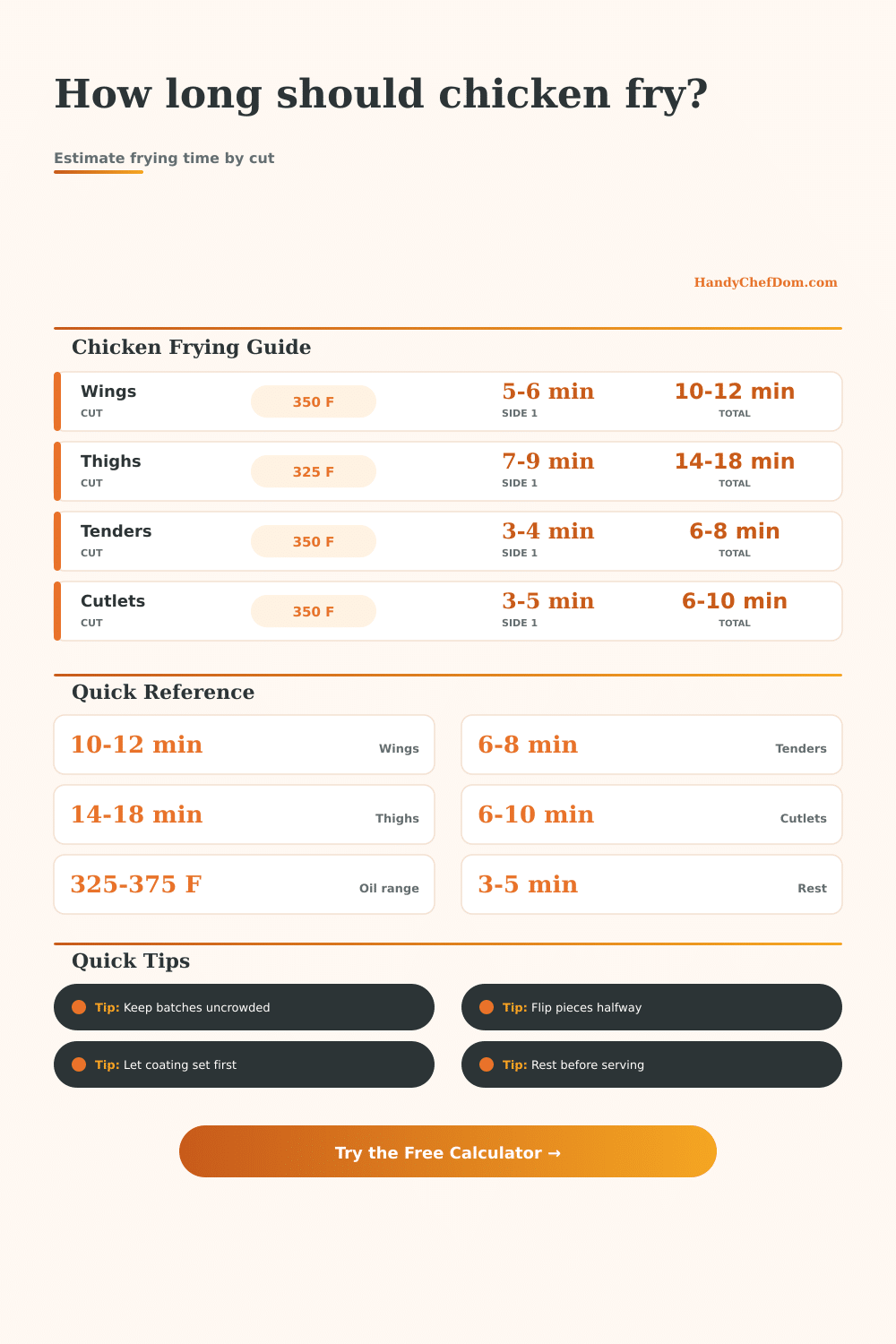
| Chicken Cut | Typical Piece Size | Oil Temperature | Estimated Total Time | Best Setup |
|---|---|---|---|---|
| Thin Breast Cutlets | 3-5 oz / 85-142 g, about 1/2 in thick | 350-360°F / 177-182°C | 6-10 minutes | Pan fry or shallow fry |
| Chicken Tenders | 1.5-2.5 oz / 43-71 g each | 350°F / 177°C | 6-8 minutes | Deep fry or shallow fry |
| Wings or Wingettes | 1.5-2.5 oz / 43-71 g each | 350°F / 177°C | 10-12 minutes | Deep fry with turns |
| Drumsticks | 3-5 oz / 85-142 g each | 325-340°F / 163-171°C | 12-16 minutes | Deep fry, rotate often |
| Bone-In Thighs | 5-7 oz / 142-198 g each | 325°F / 163°C | 14-18 minutes | Lower heat, steady bubbling |
| Thick Breast Fillets | 5-8 oz / 142-227 g each | 325-340°F / 163-171°C | 10-15 minutes | Shallow fry or oven finish |
| Total Chicken | Small Pieces | Medium Pieces | Large Bone-In | Planning Note |
|---|---|---|---|---|
| 1 lb / 0.45 kg | 1 batch | 1 batch | 1 batch | Good for a small skillet or fryer basket |
| 2 lb / 0.9 kg | 1-2 batches | 2 batches | 2 batches | Leave space so the oil recovers quickly |
| 3 lb / 1.4 kg | 2 batches | 2-3 batches | 3 batches | Hold cooked pieces on a rack while finishing |
| 5 lb / 2.3 kg | 3 batches | 4 batches | 4-5 batches | Sort similar sizes together for even timing |
| Oil Type | Typical Smoke Point | Best Frying Range | Calculator Fit | Planning Note |
|---|---|---|---|---|
| Peanut Oil | About 450°F / 232°C | 325-375°F / 163-191°C | Excellent | Common high-heat frying oil |
| Canola Oil | About 400°F / 204°C | 325-360°F / 163-182°C | Good | Stay below sustained smoking |
| Corn or Soybean Oil | About 450°F / 232°C | 325-375°F / 163-191°C | Excellent | Good margin for deep frying |
| Unrefined Olive Oil | Often below 375°F / 191°C | Lower pan-fry heat | Limited | Better for gentler cooking |
| Target | Use Case | Effect on Time | Safety Note | Texture Note |
|---|---|---|---|---|
| 165°F / 74°C | All poultry minimum | Baseline | USDA minimum for chicken | Juiciest calculator target |
| 170°F / 77°C | Wings and drumsticks | Add about 4% | Above minimum | Slightly firmer dark meat |
| 175°F / 79°C | Bone-in thighs | Add about 8% | Above minimum | More tender connective tissue |
| 180°F / 82°C | Very tender dark meat | Add about 12% | Above minimum | Best for pull-apart texture |
There’s not much margin for error in fried chicken. You can adjust a steak if it looks rare. No problem. Cook it too long and it will be dry and tough. Raw chicken become dangerous so you have to get it right.
The final outcome depends on understanding how things cook, managing your batches, and keeping the temperature consistent. Most folks think you just heat up some oil, then fry. What you do is try to keep it hot. If you drop cold chicken into the oil it cools the oil. If you drop too many pieces of chicken in the oil cools down and won’t get hot again. They’ll steam instead of fry.
How to Cook Perfect Fried Chicken
The calculator figures out what size batch is right and when to add them. It factors in pan crowding and cooking time. Restricted oil circulation mean slower heat transfer. That’s why early batches are good while later batches may not be as good.
What’s the right coat? How does the coating affect heat transfer to the meat? Flour, a very fine layer that doesn’t seal well, lets heat in fast. It helps keep tender cuts moist. Thick coatings (like the craggy crust on Southern-style fried chicken) need more protection: Double dredge them into buttermilk and then back into flour.
It create a buffer between meat and the hot pan. As the outside gets crispy-crisp it shields the interior from over-browning. But it also slows heat conduction. To be sure the inside reaches safety temp, you’ll have to fry longer or lower the frying temp. That’s where this tool comes in. You don’t have to guess based off appearance alone.
The type of cut also matters. Boneless chicken cooks faster than bone-in. Meatier parts, such as drumsticks or thighs, has more insulation, which means they will be slower to cook through. That’s not necessarily bad; the insulation prevents dark meat from drying out during a longer cooking period. Breast meat doesn’t have that protection.
The tricky thing about it is that it needs to be timed just right. A mixed bag of cut won’t get you consistent results. For consistent results, sort your chicken into groups based on their bone structure and size before frying.
The finished product texture is based off the oil temp. For whole (bone in) items, many cooks prefer frying at 325 degrees or slightly less. That lower temperature breaks down the collagen while not burning the skin. Small tenders can be fried at higher temps like 375. These little guys will form a crust quickly so they don’t dry out.
Here’s how various cooking oils reacts to heat. High-temp cooking with an oil that has a low smoke point mess up air quality fast. It also spoils the meal. Respect your ingredients and take time to fry them. Do not rush the transfer of heat.
After the frying there’s just as much importance in resting the chicken as frying. The juices in the meat redistribute while it rests. When you bite down on it, the liquid doesn’t run out. Use timers to control the batches, use a thermometer, and eventualy you will get the feel for it. It’s about controlling the heat, not luck.