🍋 Limes per Pound Calculator
Estimate how many limes to buy, how much juice and zest they should yield, and how many garnish wedges you can cut from the same batch.
Use pounds when you already have a bag of limes, or switch the goal to juice, zest, or wedges when a recipe gives a target yield.
| Lime type | Average weight | Limes per lb | Best use |
|---|---|---|---|
| Key limes | 0.60-0.80 oz | 20-27 | Pie, curd, small-batch juice |
| Mexican limes | 1.00-1.40 oz | 11-16 | Salsa, tacos, bright finishing |
| Small Persian | 1.60-2.10 oz | 8-10 | Weeknight cooking and wedges |
| Medium Persian | 2.40-3.00 oz | 5-7 | Grocery bags and cocktails |
| Large Persian | 3.20-4.20 oz | 4-5 | Pitchers and high-juice prep |
| Bearss limes | 3.00-3.80 oz | 4-5 | Juicing, zesting, bar prep |
| Lime size | Juice per lime | Zest per lime | Notes |
|---|---|---|---|
| Key lime | 0.75-1 tbsp | 0.5-0.8 tsp | Many small fruits for one cup |
| Small Persian | 1.25-1.75 tbsp | 1.0-1.3 tsp | Good balance for cooking |
| Medium Persian | 1.75-2.5 tbsp | 1.5-2.0 tsp | Most common recipe estimate |
| Large Persian | 2.5-3.5 tbsp | 2.0-2.5 tsp | Best for pitchers and batching |
| Bearss lime | 2.25-3 tbsp | 1.8-2.4 tsp | Firm rind and strong zest yield |
| Mixed bag | 1.5-2.25 tbsp | 1.2-1.8 tsp | Measure one sample lime first |
| Shopping amount | Key limes | Medium Persian | Large Persian |
|---|---|---|---|
| 0.5 lb | 11-12 limes | 3 limes | 2-3 limes |
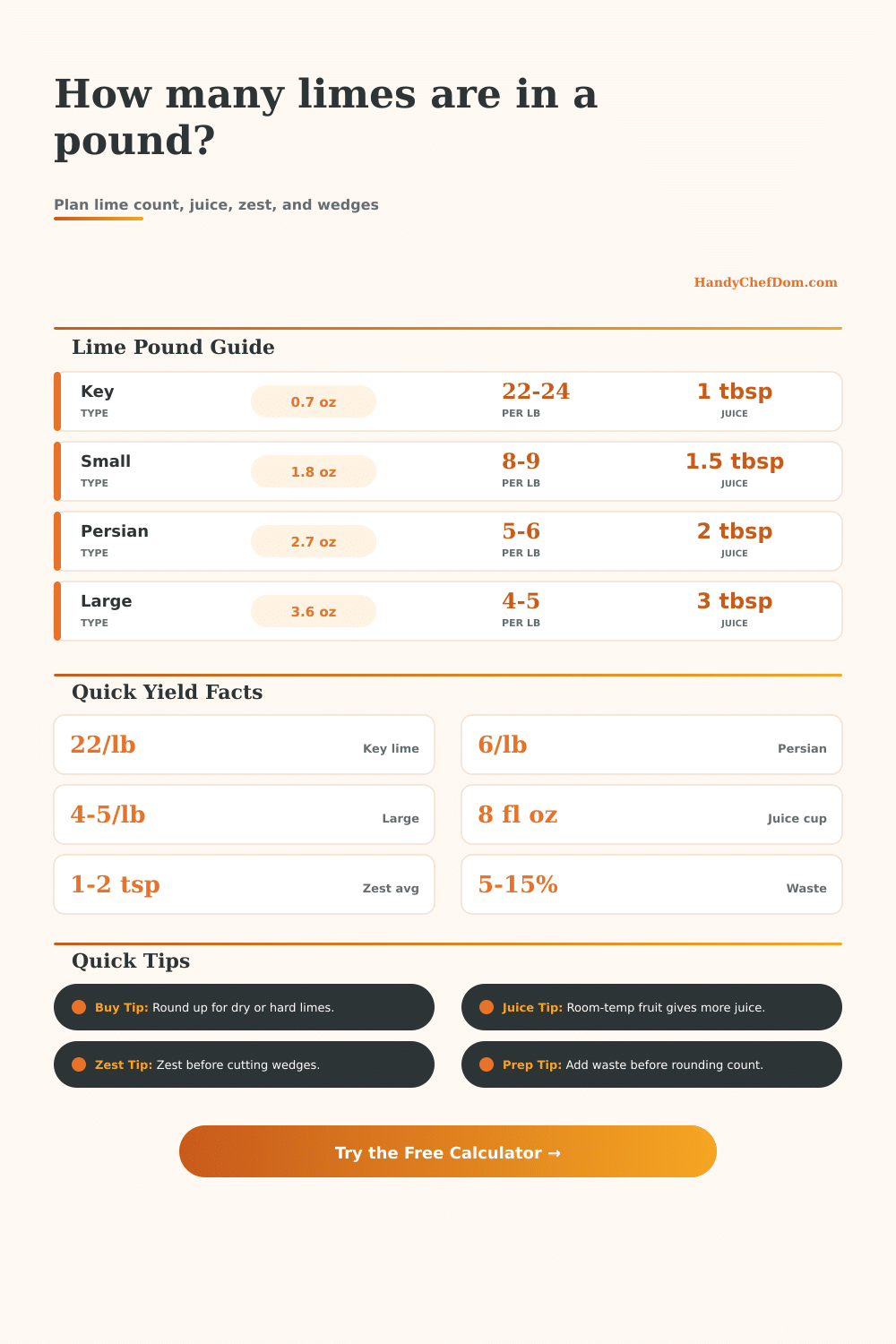
| 1 lb | 22-24 limes | 5-6 limes | 4-5 limes |
| 2 lb | 44-48 limes | 11-12 limes | 9-10 limes |
| 3 lb | 66-72 limes | 16-18 limes | 13-15 limes |
| 5 lb | 110-120 limes | 27-30 limes | 22-25 limes |
| 10 lb | 220-240 limes | 54-60 limes | 44-50 limes |
| Prep goal | Typical target | Lime estimate | Waste buffer |
|---|---|---|---|
| Margarita juice | 2 cups juice | 16-22 Persian | 10% |
| Taco wedges | 32 wedges | 6 medium limes | 5% |
| Cocktail tray | 120 wedges | 20 medium limes | 8% |
| Baking zest | 12 tsp zest | 6-9 Persian | 12% |
| Limeade pitcher | 1.5 cups juice | 12-17 Persian | 10% |
| Key lime pie | 0.75 cup juice | 12-16 Key limes | 10% |
Recipe measurements is always in volume (measuring cups). However, when buying produce from stores, they sold by weight. The gap between what the cup says and what the scale says lead to a lot of cooking mistakes.
For example, a pound of limes isn’t telling you anything about the volume of juice you’ll recieve. How do you know which lime type to use? A pound of Key limes is equivalent to 2 dozen of small, yellowish-green, fragrant ones; a pound of Persian limes are more like 5 or 6, since those is bigger and less acid. (The common supermarket green is a Persian lime.) A pound of Key limes won’t yield as much juice then a pound of Persian limes. So if you purchase a pound of the former, don’t expect as much as what you’d get from a pound of the latter.
How to Get the Right Amount of Lime Juice
The page’s calculator will help with that math and prevent error.
Consider contents as well. Not all limes are created equal. There are some that just don’t give up their juice: they’re thick skinned or even dry. To combat this, pro kitchens anticipates a ten to fifteen percent loss when trimming and accounting for dry fruit. If you’re making a large batch of drinks, keep this in mind. Better to purchase more limes than find yourself short in the middle of a meal.
Because of this, zest is more complex. The oil in rind retains the flavor. Once you slice up a lime (for wedges), it can’t be zested. So if you need both zest and juice in a recipe, you’ll need to purchase multiple limes. Enter how much zest you want from the tool, and it’ll adjust your number of limes accordingely. No more ending with too little zest but plenty of juice!
How much juice you can get depends off temperature. A room-temperature lime is soft; cold ones are firmer and grip their juice tighter. To get maximum juice, roll a lime on the countertop before cutting into it, which will rupture some of those inner membranes and let out more juice. Here’s how to get more juice per fruit.
The amount of juice you’ll get depends not only on the size of your limes (see reference tables for yield by size), but also on how much juice is inside them (so use the numbers as a guideline). Naturaly fruit varies in both respects. A few extra limes might not make much difference if you’re making a key lime pie for a big group, but when you need accurate ingredients for a recipe, that little difference can be huge. With the right amount of fresh lime juice from a certain number of limes, the tartness of a key lime pie is just right. Get the wrong number of limes (or bottled juice instead), and all bets are off… The pie’s balance is thrown out of whack.
With the tool, though, you can specify exactly what amount of juice you need. Then, choose which kind of lime(s) to purchase and let the system determine how many fruits it should of picked up.
There’s an expectation game when cooking with citrus: You can’t tell how much you’ll get by buying a certain amount (unless they’re all the same size, which they won’t be). But if you plan well, you can control that part. Knowing how much waste, how much juice, and how much to expect helps eliminate the guesswork involved in preparing your meal. You don’t hope there’s enough juice; you know there is. You enter the produce aisle armed with knowledge of exactly what you need to look for, and how many you should buy so that your dinner doesn’t fall short.