🥛 Cocoa Powder for Chocolate Milk Calculator
Scale cocoa powder, sugar, milk cups, servings, and syrup slurry for hot, cold, blended, dairy, and non-dairy chocolate milk.
Choose milk volume and serving size first. The calculator then scales cocoa tablespoons and grams, sugar ratio, slurry liquid, syrup yield, and mixing method so cocoa dissolves instead of floating on top.
| Cocoa Type | Approx Weight | Flavor Pull | Best Mix Method | Chocolate Milk Note |
|---|---|---|---|---|
| Natural cocoa powder | 5.3 g per tbsp | Bright, tangy | Hot slurry or blender | Classic homemade chocolate milk |
| Dutch-process cocoa | 5.1 g per tbsp | Smooth, mellow | Hot slurry | Good for dark, rounded flavor |
| Black cocoa accent | 4.8 g per tbsp | Very dark | Hot syrup slurry | Use as a partial cocoa blend |
| Natural and Dutch blend | 5.2 g per tbsp | Balanced | Cold shake with slurry | Reliable pitcher chocolate milk |
| High-fat cocoa | 5.8 g per tbsp | Round, rich | Whisk or stovetop | Feels fuller with less sugar |
| Raw cacao powder | 5.6 g per tbsp | Bitter, fruity | Blender | Needs more sweetener balance |
| Extra dark alkalized cocoa | 5.0 g per tbsp | Dark, smooth | Hot bloom | Strong color and flavor |
| Drinking cocoa style | 4.6 g per tbsp | Soft, mild | Cold whisk | Easy for light chocolate milk |
| Milk Cups | Light Cocoa | Classic Cocoa | Rich Cocoa | Classic Sugar |
|---|---|---|---|---|
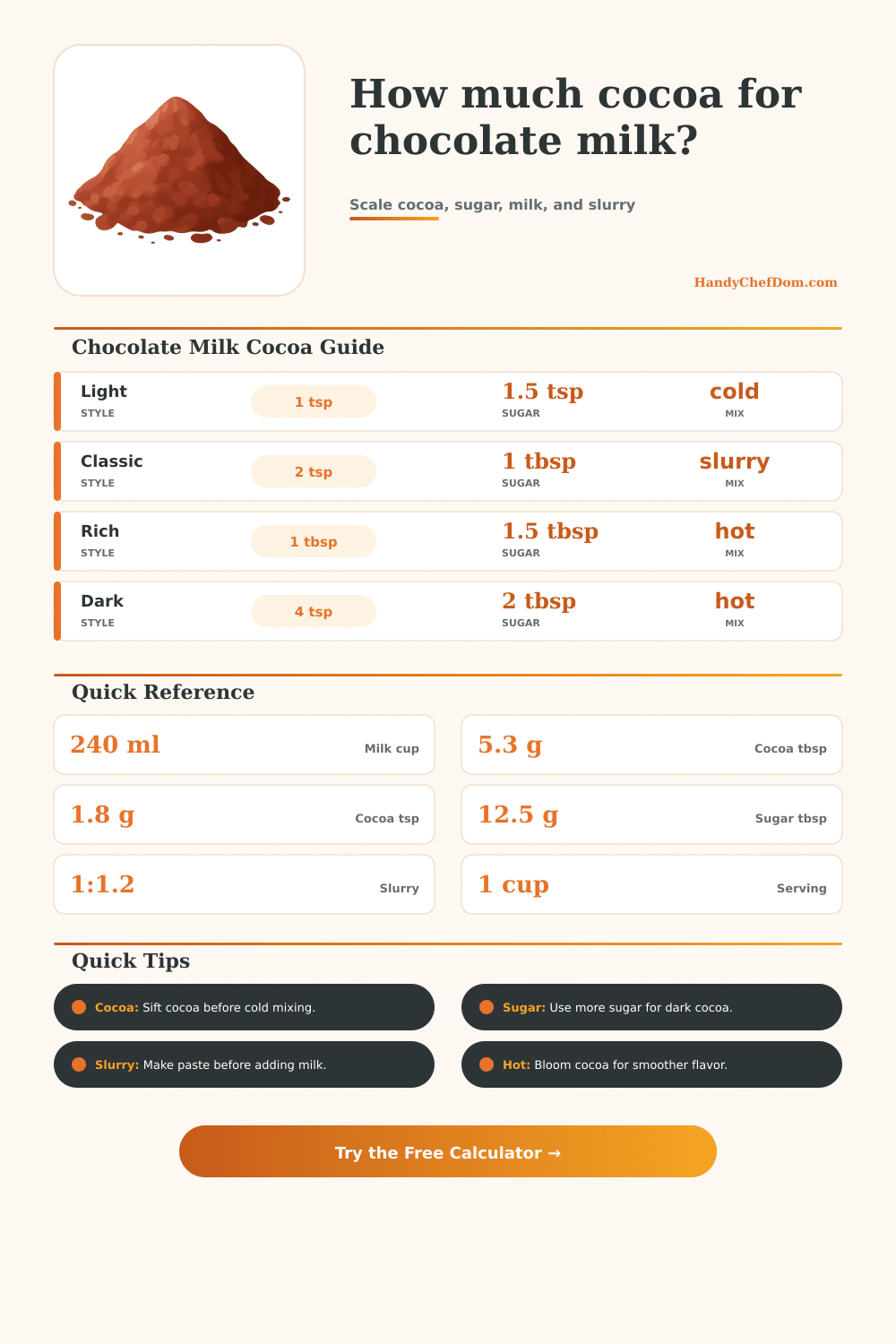
| 1 cup | 1 tsp | 2 tsp | 1 tbsp | 2 to 3 tsp |
| 2 cups | 2 tsp | 1.3 tbsp | 2 tbsp | 1.5 tbsp |
| 4 cups | 1.3 tbsp | 2.7 tbsp | 4 tbsp | 3 tbsp |
| 8 cups | 2.7 tbsp | 5.3 tbsp | 8 tbsp | 6 tbsp |
| 16 cups | 5.3 tbsp | 10.7 tbsp | 16 tbsp | 12 tbsp |
| Mix Method | Cocoa Prep | Slurry Range | Texture Result | Best Batch Size |
|---|---|---|---|---|
| Cold shake or jar | Sift first | 1.4 to 1.8 tbsp liquid per tbsp cocoa | Good, may need rest | 1 to 3 cups |
| Cold whisk | Paste first | 1.3 to 1.6 tbsp liquid per tbsp cocoa | Smooth with patience | 2 to 6 cups |
| Hot syrup slurry | Bloom cocoa | 1.0 to 1.4 tbsp liquid per tbsp cocoa | Smoothest | Any pitcher |
| Microwave bloom | Heat slurry only | 1.1 to 1.5 tbsp liquid per tbsp cocoa | Fast and smooth | 1 to 4 cups |
| Blender or frother | Add dry slowly | 0.8 to 1.2 tbsp liquid per tbsp cocoa | Foamy and even | 1 to 8 cups |
| Stovetop batch | Whisk warm | 1.0 to 1.3 tbsp liquid per tbsp cocoa | Very smooth | 4 cups or more |
| Drink Goal | Cocoa Per Cup | Sugar Ratio | Slurry Style | Serving Cue |
|---|---|---|---|---|
| Light chocolate milk | 0.33 tbsp | 120% to 150% | Cold shake | Kids or mild cocoa |
| Classic chocolate milk | 0.67 tbsp | 125% to 160% | Warm slurry | Balanced everyday glass |
| Rich chocolate milk | 1 tbsp | 130% to 180% | Hot syrup | Dessert-style glass |
| Dark cocoa-forward milk | 1.25 tbsp | 150% to 210% | Hot bloom | Adults, less milky taste |
| Make-ahead concentrate | 1.4 tbsp | 150% to 220% | Thick syrup | Stir into cold milk later |
It might seem like making chocolate milk is easy: just add milk to some cocoa powder and sugar. But then that cocoa won’t mix in… And once it does, drink will be too sweet! Or it might not be sweet enough. How do you know what amount of cocoa to use? What ratio of sugar should you use to complement it? Do you want to shake this cold, or heat it up first? Do you even want to make one glass, or an entire pitcher?
You answer these questions before you start pouring and they affect the flavor: light vs overwhelming; gritty vs rounded. They also factor into scaleability: whether it scales cleanly for one glass or a full pitcher.
How to Make Good Chocolate Milk
The kind of cocoa also makes a difference (each is different in terms of both bitterness and density). Dutch-process cocoa taste darker and smoother; this allows for using the same quantity but making it richer without having to adjust sweetness as much. Black cocoa deepens things up but is best used in small quantities. Raw cacao tends to be more bitter and fruity. And naturaly cocoa will have a brighter edge that requires more sweetness to balance it all.
Once you select the cocoa and volume of milk involved, the calculator above do the math for you. It gets rid of the guesswork about actual weight of each tablespoon.
How do you mix it? It matters more different than you would think. If you’re mixing by hand in a small batch, building a slurry then cold shaking is the way to go. It will take some time for cocoa to hydrate though. A hot slurry make a difference. It blooms the powder, so the flavors release quicker and texture becomes silkier. When working with thicker non-dairy milks, blender or frother routes tends to break up clumps and add air, which is helpful. You can choose your route and the slurry volume recommendation will adjust accordingly.
Balance’s a matter of personal taste when it comes to sugar ratio. For some, cocoa leads; for them, sweetener is kept humble. Others think of chocolate milk as dessert; they prefer it much sweeter. The simple scale in this calculator just reflects how much sugar you plan to put in proportion to cocoa. Then it translates that into your chosen sweetener. One number eliminates eyeballing and adds syrupy/flat to the mix, which most people do.
Cocoa is affected by your choice of milk. Whole milk will soften edges and coat the tongue, allowing you to use slightly less cocoa while maintaining a feeling of similar richness. For example, skim milk (or almond milk) will let the cocoa come through more directly and the same amount may taste stronger than whole milk. The calculator takes this into account in the final cocoa load so the intensity setting still lands where you’d expect it.
It is particularly helpful that they has laid out some standard cocoa mixes in their reference tables on the page. These are great if you go from one glass to a party pitcher, for example. Then you don’t need to recalculate the entire thing by hand, you can just use the same flavor profile. If you want to premix a jar of concentrate to drink throughout, you also should of consider the slurry thicknesses.
After setting the numbers, it’s time to taste. Different temperatures and how long they sits will make the sweetener, cocoa strength, and milk fat interact differently. Usually tweaking after your initial batch matters far more then trying to get perfect settings at start. Having a solid starting value from the calculator means that those tweaks can be small rather than having to start from scratch each time.