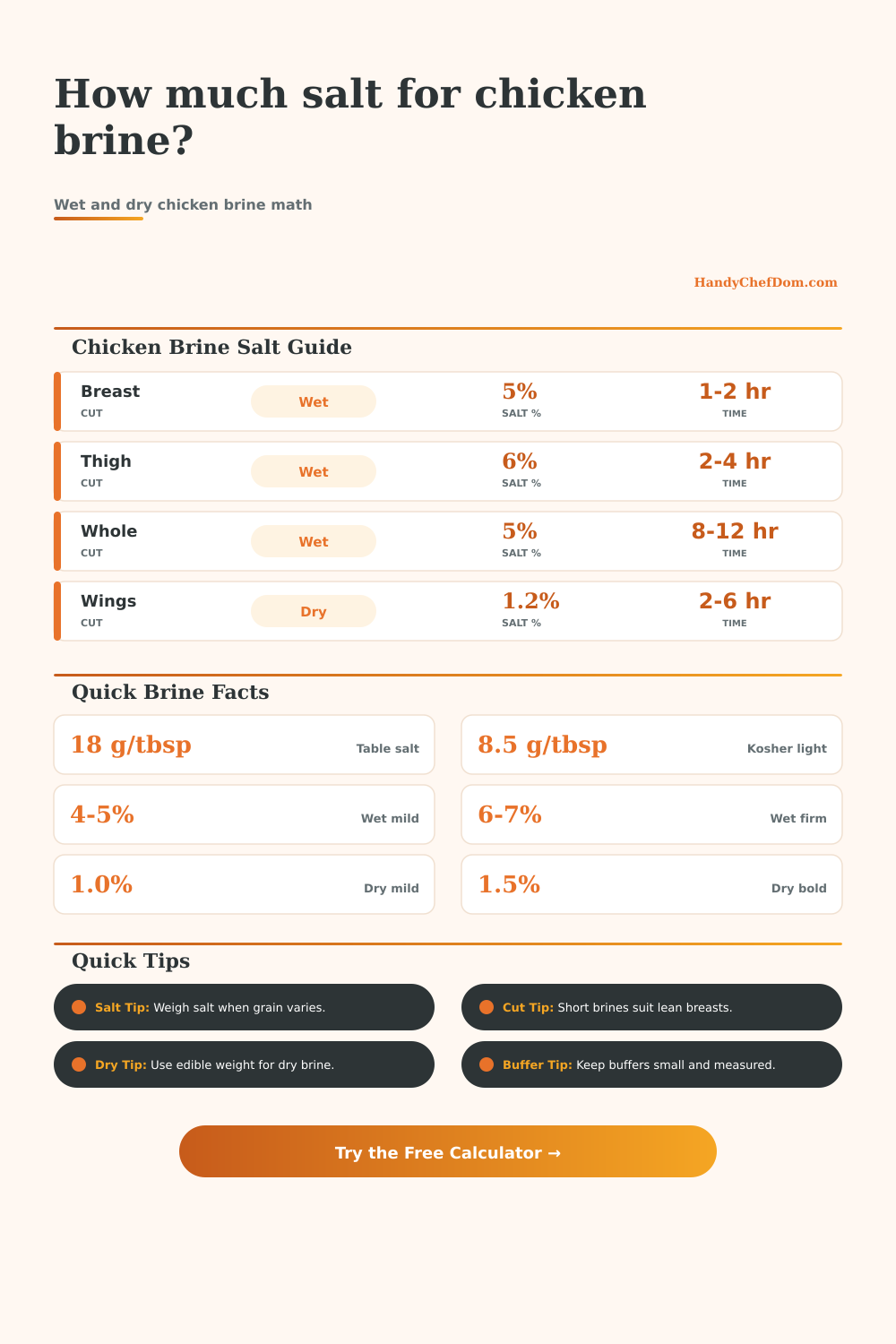
🍗 Salt per Chicken Brine Calculator
Calculate chicken brine salt from cut weight, wet or dry style, water volume, target salinity, salt grain, brine time, sugar adjustment, edible yield, and buffer.
Wet brine estimates use salt as a percent of water weight. Equilibrium wet brine uses water plus edible chicken weight. Dry brine estimates use salt as a percent of edible chicken weight.
| Salt Type | Approx Grams per Tbsp | Approx Grams per Tsp | Best Calculator Use |
|---|---|---|---|
| Diamond Crystal kosher salt | 8.5 g | 2.8 g | Light, fluffy crystals for brines measured by spoons |
| Morton coarse kosher salt | 15 g | 5 g | Denser kosher salt that needs smaller spoon volume |
| Fine table salt | 18 g | 6 g | Consistent fine grains when weighing is not available |
| Fine sea salt | 18 g | 6 g | Similar spoon weight to table salt in most brine math |
| Coarse sea salt | 15 g | 5 g | Good when fully dissolved before adding chicken |
| Pickling or canning salt | 19 g | 6.3 g | Fine, additive-free salt that dissolves quickly |
| Fine pink salt, plain sodium chloride | 17 g | 5.7 g | Use only plain culinary salt, not curing salt |
| Flaky finishing salt | 7 g | 2.3 g | Best weighed because flakes crush unevenly |
| Chicken Cut | Default Edible Yield | Good Wet Salinity | Typical Brine Window |
|---|---|---|---|
| Whole chicken, standard roaster | 70% | 5% | 8 to 12 hours |
| Spatchcock chicken | 72% | 5% | 6 to 10 hours |
| Boneless skinless breasts | 98% | 4% | 30 minutes to 2 hours |
| Bone-in split breasts | 78% | 4.5% | 1 to 3 hours |
| Bone-in chicken thighs | 80% | 6% | 2 to 6 hours |
| Boneless chicken thighs | 96% | 5.5% | 1 to 4 hours |
| Chicken drumsticks | 72% | 5.5% | 2 to 6 hours |
| Chicken wings | 65% | 5% | 2 to 6 hours or dry rest |
| Chicken tenders | 99% | 3.5% | 20 to 60 minutes |
| Mixed bone-in pieces | 75% | 5.5% | 3 to 8 hours |
| Brine Method | Salt Basis | Common Percentage | Calculator Detail |
|---|---|---|---|
| Wet brine by water salinity | Water weight only | 4% to 7% | Fastest way to scale classic poultry brines |
| Wet equilibrium brine | Water plus edible chicken | 1.5% to 2.2% | Lower percentage because the meat weight is included |
| Dry brine by edible weight | Edible chicken weight | 0.8% to 1.7% | Best for crisp skin and precise salt control |
| Sweet poultry brine | Water weight with taste adjustment | 4% to 6% | Sugar softens perceived salt, but salt is still weighed |
| Aromatic poultry brine | Liquid after displacement | 4.5% to 6% | Large herb, onion, or citrus volume slightly changes liquid mass |
| Buttermilk-style brine | Liquid weight with lower salinity | 3.5% to 5% | Uses a softer target because the liquid clings to the chicken |
| Conversion Grid | Imperial Amount | Metric Equivalent | Brine Math Use |
|---|---|---|---|
| Water cup | 1 cup | 236.6 ml | About 236.6 g water |
| Water quart | 4 cups | 946 ml | About 946 g water |
| Water gallon | 16 cups | 3.785 L | About 3785 g water |
| Chicken pound | 1 lb | 453.6 g | Dry brine weight basis |
| Salt ounce | 1 oz | 28.35 g | Useful when scale reads ounces |
| Tablespoon | 3 tsp | 14.79 ml | Weight changes by salt type |
| Half cup salt | 8 tbsp | 118 ml | Very different grams by grain |
| Full cup salt | 16 tbsp | 237 ml | Use selected salt density |
Salt affects meat. Sure, you’ve screwed up meat with salt before, but have you attempted to eyeball that ratio? It’s tricky stuff, especialy for home cooks seeking a deliciously juicy piece of chicken without over-salting the whole dinner. Getting the exact amount right can be the difference between a good brine and a bad one. And when it comes down to a couple of grams of salt (or even fewer), having a precise formula takes out all the guess work.
Enter your brine style and use calculator above to let it do the math for you. No more “should I use five or four?”
How to Use the Brine Calculator
First, keep in mind that different types of salt is not the same. For example, if you use fine table salt instead of Diamond Crystal kosher salt and don’t change the volume then you’ve doubled amount of salt. Table salt is really dense (one tablespoon holds almost 18 grams) where kosher crystals are very fluffy (a tablespoon only has around 8.5 grams). You must account for this difference when mixing brines to avoid mistakes. Measuring a little bit may be easy, but when the grains are small they get packed tightly. By weight, this mean you’re adding almost twice the sodium. The app allows you to choose what kind of salt you have so no matter what the grain size, total number of grams remains correct.
Dry brines is different than wet brines. A wet brine involves creating a solution of salt dissolved in water which then penetrates meat with moisture. How much does this vary? Depends on how heavy water is. Not on chicken. With a whole roaster, you’re usually targeting between four and six percent salinity. But what percentage of the total does that represent? It’s only a percentage of weight of the water. Herbs, sugar, etc., displace water. They affect concentration. We let you enter those aromatics into the calculator then we stay on target with our final salt recommendation.
With dry brining, you put salt right onto meat instead. But how much? That’s a percent, too: it’s a percent based off the amount of edible meat in chicken. What exactly do I mean by “edible?” With a boneless breast, nearly all of piece is edible so count on its entire weight. With a whole chicken, more than half of it isn’t edible (it’s bones). Before counting, factor out mass of those bones. Otherwise, you’ll under-season the meat. The calculator wants to know what percent of the chicken is edible. No matter the anatomy, it maintain the accuracy of your seasoning.
In addition to salinity, timing matter. Leaner cuts, such as boneless breasts, will pick up brine fast. Too much, however, and it get mushy. Often that’s only a half hour or so soak for a thin breast. Darker meat has higher levels of fat and connective tissue. It can takes a little longer. Drumsticks and thighs will benefit from several hours soaking in briny solution. The tool guides you to what’s a safe soak period for each cut, based off their presets. Before you do anything, that means no over-brining.
Sugar changes the flavor, too. Adding sweetness to your brine will make that same amount of salt taste less salty. With this tool you can back off just a bit on salt and still get your desired level of “salty” with added sugar (or citrus). And yes, it’s only slightly different. But it will also help the finished dish taste balanced.
It’s about control. Brining is all about control. It’s about controlling the structure of proteins. It’s about knowing how various cuts are going to behave with a given amount of salt so that there isn’t any guess work. Your chicken is seasoned all through and tenderized without having to worry about the salt anymore. That’s the payoff for getting the numbers correct; it lets you focus on heat.