Cookie Dough per Cookie Calculator

🍪 Cookie Dough per Cookie Calculator

Calculate dough grams or ounces per cookie from scoop number, batch dough weight, add-ins, spread factor, target diameter, baked yield, dough loss, and servings.

🍪 Cookie Dough Presets
📝 Dough Inputs

Choose whether the portion is driven by scoop size, a target baked diameter, or an exact dough weight. Batch weight is the finished mixed dough before scooping.

Use the total finished dough weight after mixing.
Used only when exact mode is selected.
Higher spread means a wider cookie from the same dough ball.
Chips, nuts, oats, raisins, or chopped candy as percent of dough weight.
This estimates baked cookie weight from raw dough weight.
Dough Per Cookie
0
oz each
Baked Yield
0
cookies from batch
Batch Needed
0
oz for target
Baked Size
0
in diameter
Cookie Dough Breakdown
Planning modeUse scoop number
Cookie style and scoopClassic drop cookie, #40
Batch dough entered35.3 oz
Usable dough after loss34.2 oz
Scoop portion estimate0.76 oz
Diameter portion estimate0.90 oz
Chosen raw dough portion1.00 oz
Baked weight estimate0.88 oz
Target yield dough required32 cookies
Serving coverage16 servings
Add-ins and density factor22%
Spread factor used1.85x
🧮 Conversion Grid
28 g
One ounce
Useful baseline for classic chocolate chip cookies.
#40
Standard scoop
About 22 ml before dough density is applied.
454 g
One pound
Yields about 16 classic one ounce portions before loss.
1.8x
Typical spread
A chilled drop cookie often lands near this range.
📊 Scoop, Size, and Style Comparison
Mini Cookies
12-16 g
Small lunchbox or tasting portions; #70 to #60 scoops work well.
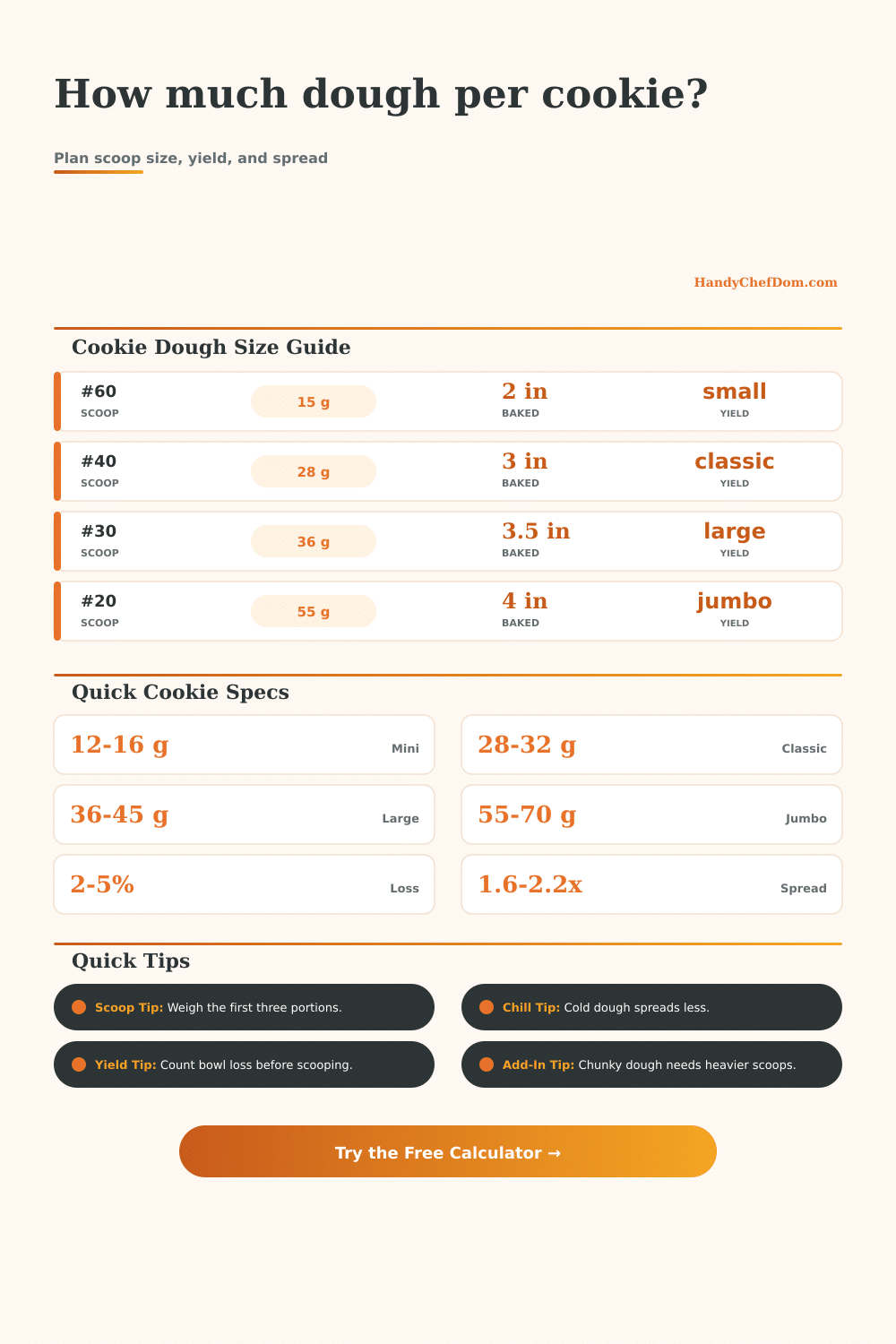
Classic Cookies
28-32 g
Everyday three inch cookies usually fit a #40 scoop.
Bakery Cookies
45-60 g
Large chewy cookies often use #24 to #20 scoops.
Stuffed Cookies
65-90 g
Filled centers need extra dough around the insert.
📋 Reference Tables
Scoop NumberApprox VolumeTypical Dough WeightCookie Size Use
#100 scoop9.5 ml9 to 12 gTasting cookies or tiny sandwich cookies
#70 scoop13.5 ml12 to 16 gMini lunchbox cookies
#60 scoop15 ml14 to 18 gSmall drop cookies
#50 scoop19 ml18 to 23 gSmall classic cookies
#40 scoop22 ml24 to 32 gClassic chocolate chip cookies
#30 scoop30 ml33 to 42 gLarge chewy cookies
#24 scoop38 ml42 to 52 gBakery case cookies
#20 scoop47 ml52 to 65 gJumbo cookies
Cookie StyleDensity RangeSpread FactorBaked Weight
Classic drop cookie0.94 to 1.00 g/ml1.7 to 2.0x86% to 90% of dough
Thin crisp cookie0.90 to 0.98 g/ml2.0 to 2.4x82% to 87% of dough
Thick chewy cookie0.98 to 1.08 g/ml1.4 to 1.7x88% to 92% of dough
Oatmeal or chunky dough1.02 to 1.14 g/ml1.3 to 1.6x88% to 92% of dough
Shortbread style1.05 to 1.16 g/ml1.1 to 1.4x90% to 94% of dough
Stuffed center cookie1.04 to 1.18 g/ml1.2 to 1.5x89% to 93% of dough
Batch Dough WeightMini 15 gClassic 30 gLarge 45 g
500 g dough32 cookies16 cookies10 cookies
750 g dough48 cookies24 cookies16 cookies
1000 g dough64 cookies32 cookies21 cookies
1500 g dough97 cookies48 cookies32 cookies
2000 g dough129 cookies64 cookies43 cookies
3000 g dough194 cookies97 cookies64 cookies
Add-In LevelPortion CueSpread EffectBest Planning Move
0% to 10%Smooth doughSpreads evenlyUse scoop estimate directly
10% to 25%Chip cookie rangeModerate spreadWeigh several scoops and average
25% to 35%Loaded doughSlightly unevenAdd a few grams per cookie
35% to 45%Chunky doughLess roundUse a larger scoop or hand shape
Stuffed centerHeavy middleLower spreadPlan dough shell plus filling weight
Oats or nutsMore textureLower spreadCheck diameter after a test bake
Portion check: Scoop six cookies onto a scale, divide by six, and use that average as the exact dough per cookie for the whole batch.
Spread check: Bake one test cookie before portioning the full tray when dough is warm, heavily loaded with add-ins, or newly reformulated.

Cookie baking is a guessing game for most bakers. Scoop a ball of dough onto the pan, cross your fingers, and pray you got it right on time. Sometimes they turns out all wonky. They might spread too much, burn up, or have something else go wrong. But professional vs. Batch-to-batch results aren’t magical, it’s just math masquerading as intuition.

The best part is portion control. How big will your balls be? How do you know if you don’t weigh them? For most recipes, an ounce (or so) of dough per ball makes 3 inch cookie with no structural issues. With heavy chocolate or dense nuts, the same-ounce dough feels heavier and doesn’t spread as much. That’s a completely different texture. The tiny variable is what decide mouthfeel.

Stop Guessing: The Math Behind Perfect Cookies

To do the math for you, I built this calculator (above). Simply input your batch weight and desired yield, and it will tell you how much to put in each scoop.

The point is: Before you begin scooping, you need to know what kind of cookie you’re baking. Is it a delicate sugar cookie that’s prone to spreading? Or is it a hearty oatmeal raisin that’s heavy on the filling? A thinner cookie needs a lighter touch or perhaps chilled dough to prevent it from stretching as it bakes. A taller, denser cookie might benefit from a bigger portion so it doesn’t dry out in the middle. Half the battle is knowing where your own recipe fit into that equation.

The second part of the equation? Temperature. Warm dough is going to run; cold dough will hold its shape. And if the dough gets too warm, problems will occur. This might happen because your kitchen’s heating up as you mix or because you’re working with it too aggressively. The fats will soften, the structure will collapse, and those edges won’t set properly until they touch heat.

Enter the tool’s spread factor. Its purpose is to predict just how wide a cookie will get when exposed to heat. One point eight indicates near-double growth from raw cookie’s diameter. That’s a lot, right? It should of sounded crazy, but it’s actualy standard for a chocolate chip cookie at room temperature. Want to be precise? You need to factor that in.

The physics of the dough can also be altered by add-ins. While a chunk of candy bar or walnut will make your cookie weigh more and be less flexible, a plain ole’ butter cookie has lesser. As the batter spreads out, these add-ins interrupt the flow and often cause a slight decrease in diameter coupled with a rougher edge. The density of an add-in changes the outcome; see the chart below to compare final sizes based off this.

And it’s not all about volume. It’s about what’s in the volume. Oatmeal absorbs moisture and is relatively dense, so a scoop of oatmeal dough are heavier than a scoop of shortbread. This in turn means a final product that is thicker and heavier.

Baking has an unglamorous side where you lose stuff. Some dough gets stuck in the bowl. Other dough get stuck to the scoop handle. And some dough turns into steam in the oven and evaporates. Don’t ignore these losses. Otherwise, you’ll always be under your target yield. “I’m planning to make 20 cookies” becomes “I only made 18 cookies,” even though you didn’t account for any waste. Account for a few percent of loss upfront, and you avoid the panic of being two cookies shy when it comes time to deliver the goods to the guest list.

We’re not trying to make baking a chemistry experiment. We want to take out the guesswork and get back to eating. When you know your yield, spread, and portion control, you worry less about the oven and trust the process more. You let the dough do its thing after giving it room to start.
Cookie Dough per Cookie Calculator

Leave a Comment