🍅 Tomato Paste to Thicken Sauce Calculator
Estimate tomato paste for thickening an existing sauce by volume, sauce style, target body, tomato intensity, and simmer time.
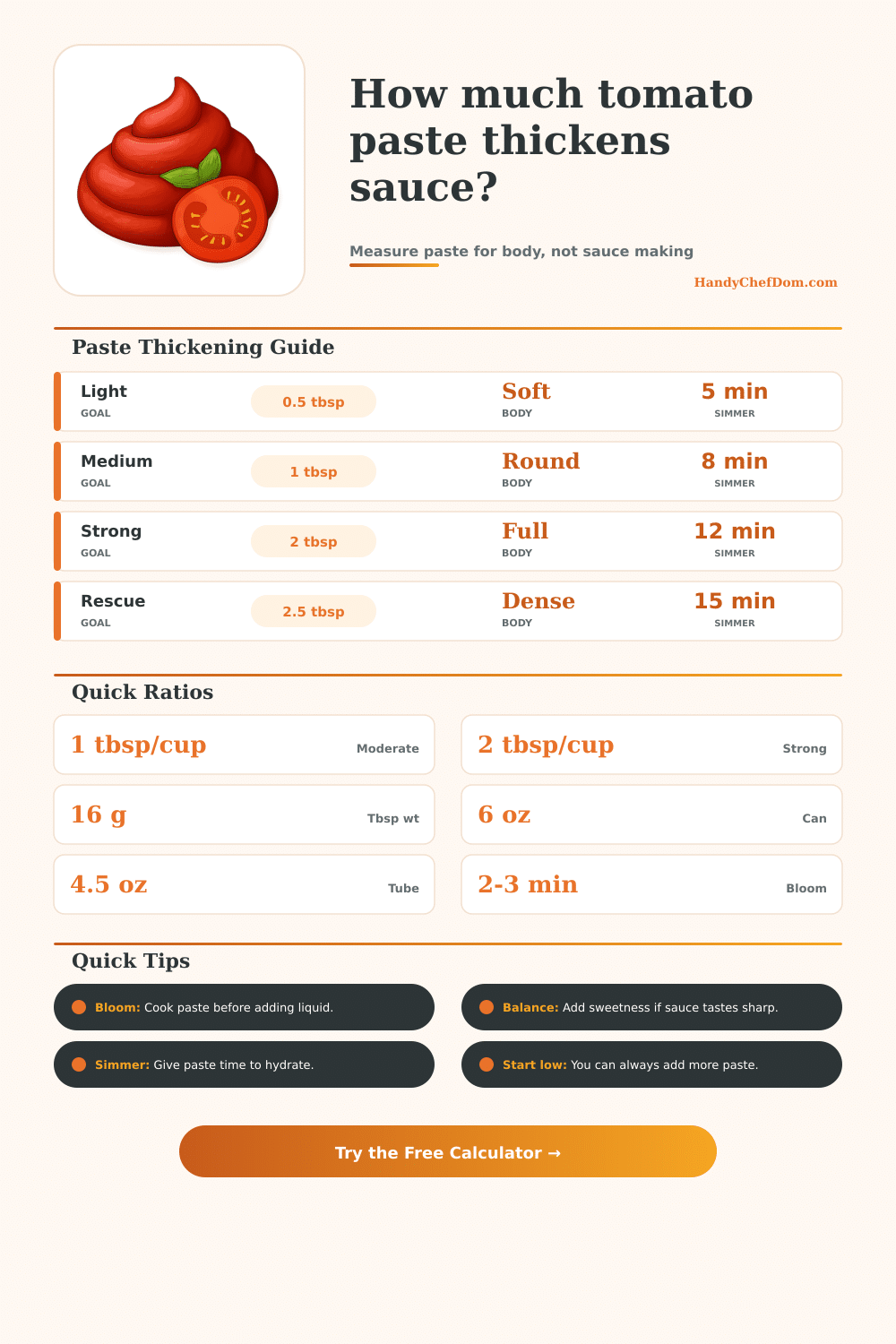
Use this when you already have a sauce and want more body. Moderate thickening starts near 1 tablespoon tomato paste per cup of sauce; strong body starts near 2 tablespoons per cup.
| Paste Measure | Weight | Volume Use | Kitchen Note |
|---|---|---|---|
| 1 teaspoon | 5 g / 0.18 oz | Small correction | Good for pan sauces |
| 1 tablespoon | 16 g / 0.56 oz | Moderate per cup | Baseline thickening |
| 2 tablespoons | 32 g / 1.13 oz | Strong per cup | Rich tomato body |
| 1/4 cup | 64 g / 2.26 oz | Large batch boost | Four tablespoons |
| 6 oz can | 170 g / 6 oz | About 10.6 tbsp | Common full can |
| 4.5 oz tube | 128 g / 4.5 oz | About 8 tbsp | Easy partial use |
| Thickness Level | Spoon Test | Paste Range | Best Target |
|---|---|---|---|
| Watery | Runs like broth | 1.5-2 tbsp/cup | Soup base rescue |
| Loose | Thin coating | 1-1.5 tbsp/cup | Marinara and pan sauce |
| Medium | Coats spoon | 0.5-1 tbsp/cup | Pasta sauce body |
| Thick | Slow drip | 0.25-0.75 tbsp/cup | Stew and braise finish |
| Very thick | Holds trail | 0-0.25 tbsp/cup | Only adjust flavor |
| Over-thick | Mounds heavily | No paste | Loosen with liquid |
| Recipe Type | Starting Rate | Modifier | Flavor Caution |
|---|---|---|---|
| Marinara | 1 tbsp/cup | 1.00x | Classic tomato body |
| Pan sauce | 0.75 tbsp/cup | 0.85x | Can overpower drippings |
| Soup base | 0.75 tbsp/cup | 0.75x | Simmer before adding cream |
| Stew sauce | 1.25 tbsp/cup | 1.10x | Works with long simmer |
| Pizza sauce | 1.5 tbsp/cup | 1.20x | Stop before pasty texture |
| Braise liquid | 1 tbsp/cup | 1.05x | Balance with stock |
| Thickener | Best Use | Texture | Tradeoff |
|---|---|---|---|
| Tomato paste | Red sauces | Dense and clingy | Adds tomato intensity |
| Simmer reduction | Any sauce | Natural body | Needs more time |
| Roux | Gravy style sauces | Velvety | Adds flour and fat |
| Cornstarch | Quick glossy finish | Slick and clear | Can taste starchy |
| Vegetable puree | Soup and stew | Rustic body | Changes flavor base |
| Breadcrumbs | Rustic stews | Hearty and opaque | Not smooth |
Calculator notes: the estimate uses 16 grams per tablespoon tomato paste, 1 tablespoon per cup for moderate thickening, and 2 tablespoons per cup for strong body.
You can thicken a thin sauce with tomato paste, but you need to know how much to use so flavor stays balanced. Sometimes, just a teaspoon more or less is the difference between concentrated tomato and sauce that clings to the pasta. Too many cook is guessing and getting either heavy or sharp-flavored meals as their results.
The calculator explains what-ifs of your ingredients. I care about the volume field because in a ratio, you can’t just copy and paste from a small skillet sauce into a large pot of stew. While they may appear to be similar in “thinness”, they are not. The calculator treats those kinds of starting conditions as different problem.
How To Use Tomato Paste For Thick Sauce
Running off the spoon versus coating back of a spoon makes all the difference. The speed of addition depend on sauce type. Adding too much tomato might knock out brightness of a bright pan sauce. However, extra body will benefit a long-simmered stew that can absorbs more paste without turning one-note. Decide whether you want a light boost to maintain control over what’s already there, or bold settings to nudge the tomato forward. This is good for a flat-tasting sauce, but it is risky otherwise if you are happy with balance.
Longer simmer times allows water to reduce. That means that in order to get same body of sauce, you’re going to use less paste. The paste has to do more work during shorter cook times. Sweetness and acidity is accounted for by the balance setting, while thickness is managed by current and target thickness settings. A sauce that’s on the sharp side will prompt tool to advise using a lighter hand to avoid having to adjust with sugar at the end.
This reasoning are shown in various ways in reference tables. There’s one that tells you which size of container has how many tablespoons. Then there are other tables that compare things like cornstarch and reduction versus paste, so that you’ll know whether tomato is your best thickener choice. This is useful if calculator gives you a large number. Maybe you don’t need more paste, but instead a quick cornstarch mixture or just another ten minutes on the stovetop.
The tool isn’t necessarily about having one right answer. It’s about being able to see trade-offs at the same time. What do I have? What do I want? How much paste should of I use? It tells you how long you’ll need to simmer. It tells you if your container will cover it. It provides other details as well.
That kind of openness help you start cooking dinner right away, instead of having to fix mistakes at the stove.