🍛 Cornstarch to Thicken Curry Calculator
Calculate cornstarch slurry for curry by cups or quarts, curry style, coconut or dairy level, current thickness, target thickness, simmer time, slurry ratio, and spice-oil level.
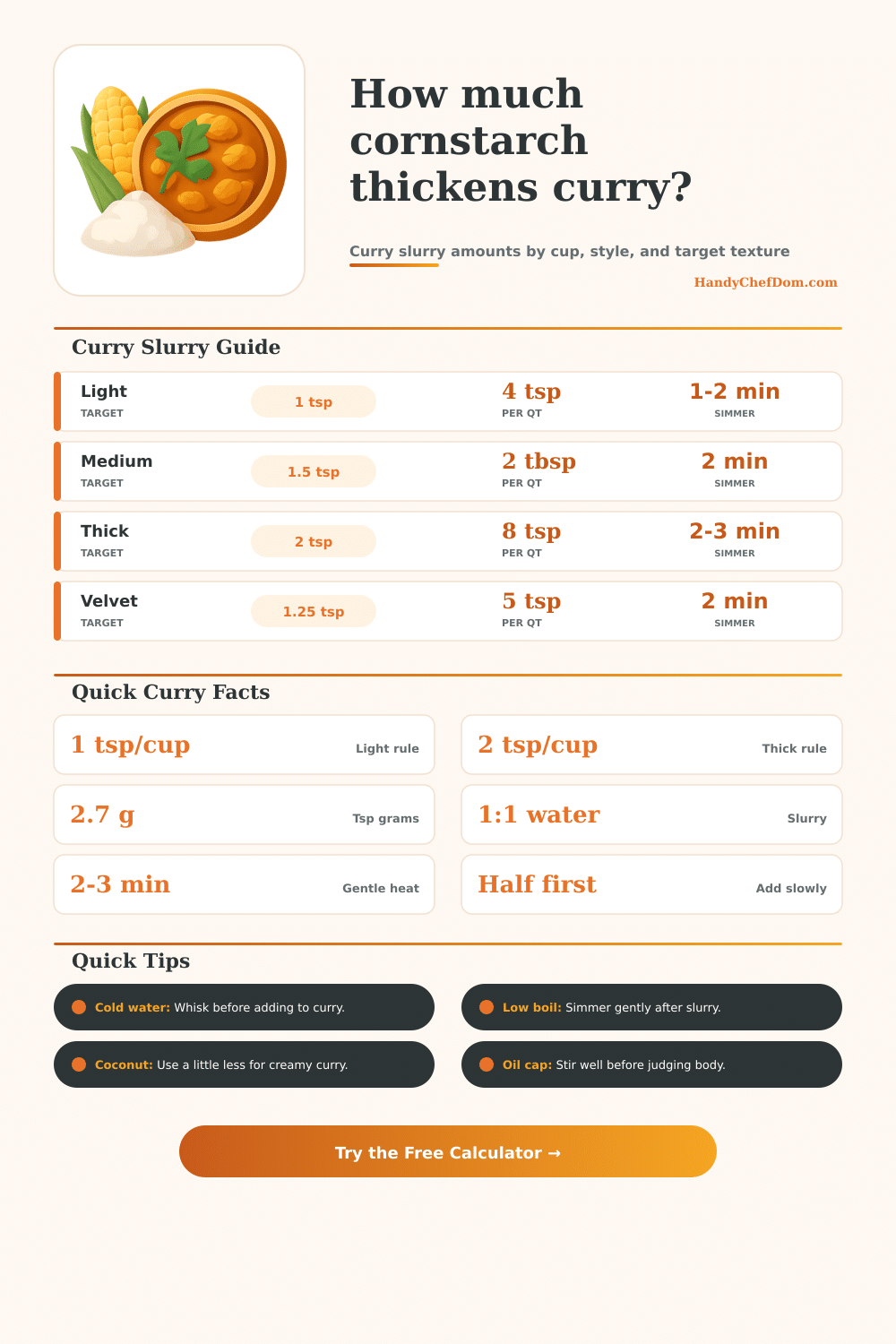
Reference rule: start near 1 teaspoon cornstarch per cup for light thickening and 2 teaspoons per cup for thicker curry. Make the slurry with equal cold water unless you choose a looser ratio.
| Curry Style | Starting Cornstarch | Adjustment Logic | Texture Cue |
|---|---|---|---|
| Coconut milk curry | 1 to 1.5 tsp per cup | Rich coconut already coats the spoon, so start modestly. | Glossy sauce with a soft pour. |
| Tomato masala curry | 1.25 to 2 tsp per cup | Tomato and onion bases can need a little more starch for polish. | Sauce clings lightly to rice. |
| Brothy Thai-style curry | 0.75 to 1.25 tsp per cup | Keep the finish loose so aromatics and coconut stay bright. | Thin ribbon from the spoon. |
| Japanese curry sauce | 1 to 2 tsp per cup | Works for quick body when the curry roux finish is still loose. | Smooth spoon-coating sauce. |
| Lentil or dal curry | 0.5 to 1 tsp per cup | Lentils thicken as they stand, so use a lighter cornstarch hand. | Soft body without paste texture. |
| Vegetable curry | 1.25 to 2 tsp per cup | Watery vegetables can loosen the sauce after simmering. | Coats vegetables without pooling. |
| Slurry Ratio | Water For 1 Tbsp Cornstarch | Best Use | Handling Note |
|---|---|---|---|
| 1:1 | 1 tablespoon cold water | Most curry thickening | Compact slurry, easy to measure. |
| 1.5:1 | 1.5 tablespoons cold water | Small pans or creamy curries | Pourable without adding much liquid. |
| 2:1 | 2 tablespoons cold water | Large pots and batch cooking | Streams in more evenly. |
| 3:1 | 3 tablespoons cold water | Very hot or delicate curry | Adds extra water, so simmer briefly. |
| Thickener | Typical Curry Use | Texture Result | Watch Point |
|---|---|---|---|
| Cornstarch slurry | Quick final adjustment | Smooth, glossy, spoon-coating | Whisk with cold water first. |
| Flour or roux | Longer-cooked curry sauce | Opaque and hearty | Cook out raw flour flavor. |
| Arrowroot slurry | Short finishing gloss | Clearer, shiny finish | Avoid long hard boiling. |
| Ground nuts or seeds | Korma-style richness | Rich, creamy body | Changes flavor and texture. |
| Simmer reduction | Flavor concentration | Natural body | Salt and spice intensify. |
| Target Texture | Per Cup Guide | Spoon Test | Curry Match |
|---|---|---|---|
| Light pourable | About 1 tsp cornstarch | Leaves a thin glossy film. | Thai-style, coconut, vegetable curry. |
| Medium spoon-coating | About 1.5 tsp cornstarch | Coats spoon, then drips cleanly. | Masala, chicken curry, weeknight bowls. |
| Thick curry sauce | About 2 tsp cornstarch | Holds a ribbon for a moment. | Rice plates, curry gravy, large batches. |
| Clingy naan-scooping | 2 tsp plus careful simmer | Clings to bread and vegetables. | Dryer masala finish or leftovers. |
In order to achieve the correct thickness for the curry sauce, a person must perform some measurement of the curry sauce and it’s variable. When the curry sauce are served, it may be too thin. Alternatively, after the cook finishes the curry sauce, it may become too thick.
One tool that may help a person to even out the thickness of the sauce is the use of a cornstarch slurry. The amount of cornstarch slurry that a person should use in the sauce, however, depends upon several factor regarding the curry sauce. One of the factors that will impact the amount of cornstarch slurry that is needed is the thickness of both the current and target thickness of the sauce.
How to Thicken Curry Sauce with Cornstarch Slurry
If the sauce is currently very watery, the cornstarch slurry that is added will help to thicken the sauce to the target thickness that coats a spoon. If the sauce already has a light film of thickness to it, however, less cornstarch slurry will be needed to reach the target thickness of the sauce. The way in which people eat the sauce can also impact the thickness of the sauce.
For example, sauces that are to be pour over rice may be thinner than sauces that are to be used for dipping bread. Additionally, the length of time during which the sauce simmers can impact the thickness of the sauce; cornstarch slurry thickens the sauce quickly, and simmerming the sauce for long periods can result in the sauce becoming too thick with the cornstarch slurry. The ingredient of the curry sauce can also impact the amount of cornstarch slurry.
Sauces that contain coconut milk or dairy products will be thicker than sauces that do not contain these ingredient, so less cornstarch slurry will be needed for sauces with these ingredients. Additionally, sauces that contain oil will tend to be thinner than sauces that do not contain oil. However, the effect of oil upon thickness is in the opposite of the effect of coconut milk and dairy product upon thickness.
Sauces that contain oil may appear thinner than the actual sauce, so more cornstarch slurry will be needed with sauces that contain oil. There are a variety of method for thickening the curry sauce. One of the methods that a cook can utilize is the addition of a cornstarch slurry; it is faster than employing a roux (a mixture of butter and flour) to thicken the sauce.
While a roux will produce a sauce with a matte texture when it is poured, the cornstarch slurry will help to produce a glossy texture in the sauce. Arrowroot can also be used to thicken the sauce; it will, like cornstarch, produce a glossy texture to the sauce. However, arrowroot weaken if the sauce simmers for long periods of time.
Reduction of the sauce is another method that can be employed to thicken the sauce. However, because the reduction method increases the amount of salt and spices that is contained within the sauce, it is a method that can change the flavor of the sauce. Because the ingredient that are included in different type of curry can impact the thickness of that curry sauce, each type of curry require a different approach to thickening the sauce.
For example, lentil curries tend to thicken after the lentil sauce sits, so less cornstarch slurry should of been added to lentil sauce. Additionally, vegetable curries that contain watery vegetable like zucchini will become thinner with cooking of those vegetables, so the amount of cornstarch slurry will need to be accounted for in the preparation of such curries. In order to even out the sauce to the proper thickness while avoiding the sauce becoming too thick itself, it is recommended to add the cornstarch slurry in two stage.
In the first stage, half of the cornstarch slurry should be added to the pot. While the sauce is simmers for one minute while stirring the sauce. After the sauce simmers for one minute, the remaining half of the cornstarch slurry can be added to the sauce.
This two-stage addition of cornstarch slurry will prevent the sauce from becoming gluey, and will allow the person preparing the sauce to observe how the cornstarch behaves in the sauce within there own pot.