🍰 Cream Cheese for Cheesecake Calculator
Size cream cheese blocks, egg count, sugar, dairy, batter height, and pan fill for classic, New York, Basque, no-bake, and mini cheesecakes.
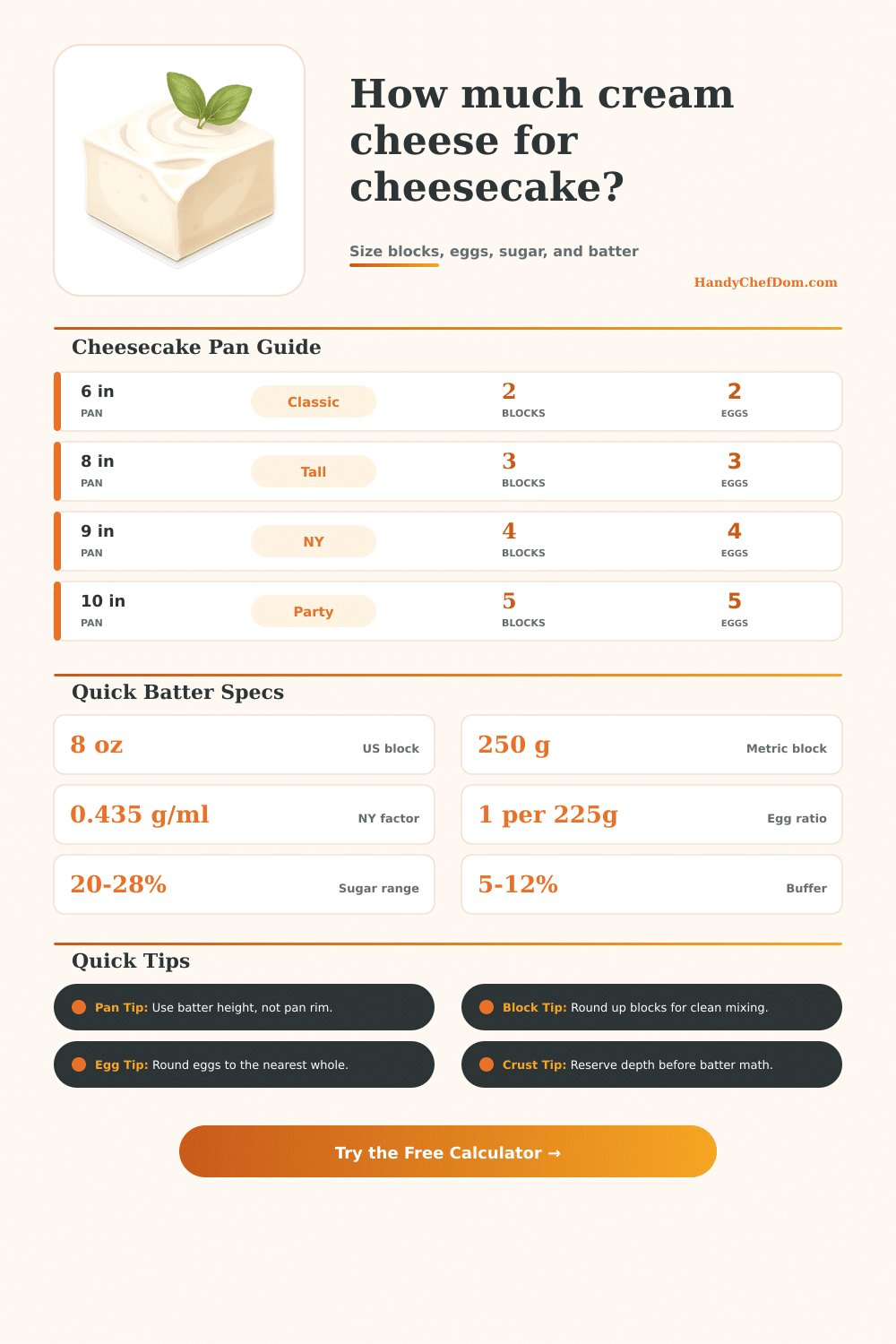
Enter the usable batter height after crust space. The calculator uses cylindrical pan volume, cheesecake style density, cream cheese share, sugar ratio, egg ratio, crust thickness, and a mixing buffer to round blocks realistically.
| Cheesecake Style | Cream Cheese Factor | Sugar Ratio | Egg Ratio |
|---|---|---|---|
| Classic baked | 0.405 g/ml | 22-26% | 1 egg per 225 g |
| New York dense | 0.435 g/ml | 23-28% | 1 egg per 225 g |
| Basque burnt | 0.385 g/ml | 24-30% | 1 egg per 200 g |
| No-bake chilled | 0.360 g/ml | 18-24% | 0 eggs |
| Japanese cotton | 0.245 g/ml | 18-22% | 1 egg per 115 g |
| Mini cheesecakes | 0.390 g/ml | 20-25% | 1 egg per 230 g |
| Cheesecake bars | 0.370 g/ml | 20-24% | 1 egg per 240 g |
| Ricotta blend | 0.300 g/ml | 18-23% | 1 egg per 210 g |
| Pan Size | Usual Height | Cream Cheese | Typical Yield |
|---|---|---|---|
| 6 inch round | 1.6-1.8 in | 16 oz / 454 g | 6-8 slices |
| 7 inch round | 1.7-1.9 in | 20 oz / 567 g | 8 slices |
| 8 inch round | 1.8-2.0 in | 24 oz / 680 g | 10 slices |
| 9 inch round | 1.9-2.1 in | 32 oz / 907 g | 12-14 slices |
| 10 inch round | 2.0-2.2 in | 40 oz / 1134 g | 16 slices |
| 9 x 13 bars | 1.0-1.3 in | 32 oz / 907 g | 20-24 bars |
| Ingredient | Standard Weight | Kitchen Measure | Calculation Use |
|---|---|---|---|
| Cream cheese block | 8 oz / 227 g | 1 US brick | Round up blocks |
| Metric cream cheese | 250 g | 1 tub or block | Metric pack math |
| Granulated sugar | 200 g | 1 cup | Convert sugar cups |
| Large egg without shell | 50 g | 1 large egg | Round egg count |
| Sour cream | 240 g | 1 cup | Dairy addition |
| Heavy cream | 238 g | 1 cup | Basque or no-bake |
| Crust Space | Round Pan Effect | Use Case | Batter Note |
|---|---|---|---|
| 0.15 inch | Thin base | Mini cups | More filling |
| 0.25 inch | Standard base | Classic cakes | Balanced fill |
| 0.35 inch | Thick base | No-bake cakes | Less filling |
| 0.50 inch | Deep base | Bars and slabs | Reduce height |
| 0.75 inch | Very deep | Tall chilled cake | Check rim space |
| 1.00 inch | Crust-heavy | Dessert cups | Small batter |
Cracks in the center of a cheesecake can mean that you didn’t get the cream cheese just right. Recipes typically gives you the exact quantity needed for whatever pan size they’re written for. But what if you want to adjust it? What about using the pan that you already have? Or maybe you want to make something different and serve a bigger group.
This is where a specific calculator help. Crust thickness is factored in, for example, along with things like how tall you want your cheesecakes to be and what size pans they’ll go into. Then there’s the style of cheesecake. For a given height and volume, a denser cheesecake (like New York) take more cheese than one that’s light (like Japanese cotton). And then there’s burnt Basque which sits somewhere in-between, since its higher-than-normal dairy content change the batter behavior pre-bake. These are all factors the calculator takes into account, working backwards from your pan and crust dimensions to find the right amount of cream cheese.
How the Cheesecake Calculator Helps You Cook Better
Adjusting measurements changes style. Changing pan size affect the final texture. That’s where the calculator helps; it keeps the ratios constant. It lets you know what will happen with more or less egg, cheese, or sugar.
Want a little buffer? Add some, but does that push the pan over the edge? You get to make that call, rounding up or down to whole block for simpler mixing. Want to add some buffer? Another thing that gets missed is thickness of crust. Springform cake bases are typically a quarter inch thick. Bars and no-bake items has a thicker crust; those also take up more of the available height. Once that is subtracted automaticly, it will tell you whether there’s enough (or too much) room for your batter to fit inside. The calculator does that math for you, so fill warning stays accurate.
And the proportions of egg and dairy also make a bigger difference then you might think. Adding one more egg to each 225-gram block of cream cheese will increase the set. Decrease the chances of cracks on top, yes. But also increase the overall weight of the batter. Using heavy cream (or sour cream) makes it lighter once more. So if a recipe appears to call for less cheese than that pan size suggests, this could of being why: The cream or sour cream lightens up the batter.
Tweak the percent ingredients in calculator and see the domino effects on final weight. You can also see the number of cream cheese block you should order. There are reference tables on the page that offer quick starting points for common pan sizes. The ratios is behind the weight of ingredients. These tables aren’t intended as substitutes for the calculator, but rather for checking a result (and sometimes for comparing two style side by side).
Because no one’s exact combination of height, crust and pan depth will ever be exactly like any of the examples, you’ll still input your own measurements. But it’s in-between-recipe moments where the true utility shines through: How many people am I cooking for? What size pan do I have? Where did the printed-out recipe come from, and what were they working with?
Running those figures just once takes out the guessing game. No more overbuying cheese, or having a runny cake because you didn’t realize batter might spill over. You won’t end up with a cake that’s way too thin because you didn’t account for your pan size. One calculation makes an experiment go from “risky” to “repeatable.