🥒 Cucumber Calorie Calculator
Estimate cucumber calories, carbs, water, and fiber by cucumber type, peel choice, weight, cups, slices, spears, salad portions, or snack portions.
Choose how you measured the cucumber. The calculator converts slices, cups, spears, salad portions, and snack portions into grams before estimating nutrition.
| Cucumber Type | Calories | Carbs | Best Portion Use |
|---|---|---|---|
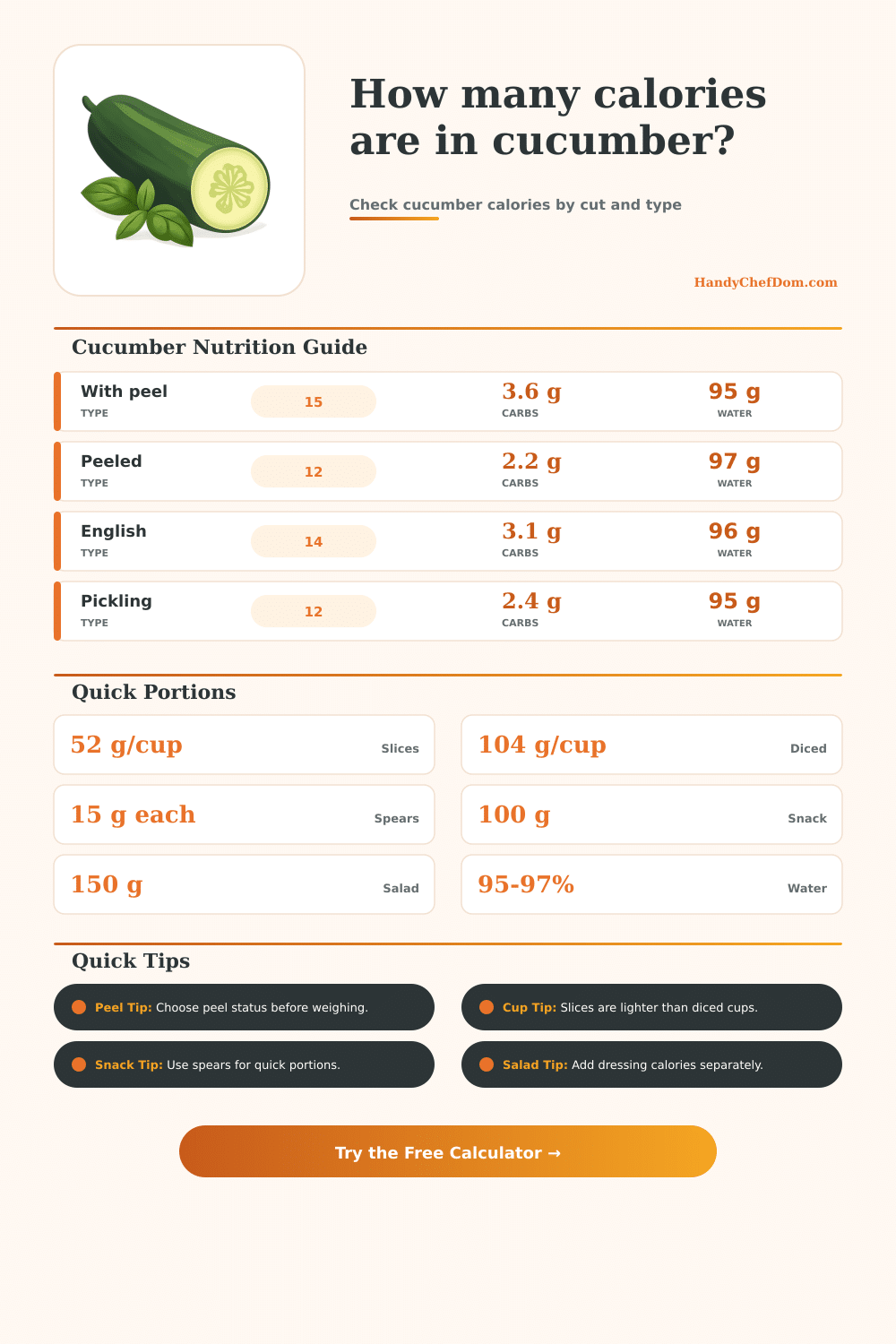
| Garden cucumber with peel | 15 kcal per 100 g | 3.6 g | Snack slices, salads |
| Peeled garden cucumber | 12 kcal per 100 g | 2.2 g | Soft salad bowls |
| English cucumber | 14 kcal per 100 g | 3.1 g | Long thin slices |
| Persian cucumber | 15 kcal per 100 g | 3.3 g | Lunch boxes |
| Mini cucumber | 14 kcal per 100 g | 3.0 g | Whole snacks |
| Pickling cucumber | 12 kcal per 100 g | 2.4 g | Spears and trays |
| Kirby cucumber | 14 kcal per 100 g | 3.2 g | Chunky salads |
| Lemon cucumber | 16 kcal per 100 g | 3.8 g | Colorful plates |
| Measurement | Typical Weight | Approx Calories | Notes |
|---|---|---|---|
| 1 cup sliced cucumber | 52 g | 8 kcal | Thin rounds with peel |
| 1 cup diced cucumber | 104 g | 16 kcal | Small cubes packed loosely |
| 1 medium spear | 15 g | 2 kcal | Long snack spear |
| 10 thin slices | 40 g | 6 kcal | About 3 mm thick |
| 1 snack portion | 100 g | 15 kcal | Light plate serving |
| 1 salad portion | 150 g | 23 kcal | Generous salad base |
| Group Size | Snack Spears | Salad Slices | Diced Cups |
|---|---|---|---|
| 1 person | 100 g | 150 g | 1 cup |
| 2 people | 200 g | 300 g | 2 cups |
| 4 people | 400 g | 600 g | 4 cups |
| 6 people | 600 g | 900 g | 6 cups |
| 12 people | 1.2 kg | 1.8 kg | 12 cups |
| 24 people | 2.4 kg | 3.6 kg | 24 cups |
| Peel Choice | Calories | Fiber | When To Use |
|---|---|---|---|
| Unpeeled | 15 kcal per 100 g | 0.5 g | Most crunch and color |
| Half peeled | 14 kcal per 100 g | 0.6 g | Striped salads |
| Peeled | 12 kcal per 100 g | 0.7 g | Softer texture |
| Trimmed ends | Use waste field | Varies | Remove end pieces |
| Seeded center | Use waste field | Varies | Lower watery volume |
| Ribbon peeled | Half peeled | 0.6 g | Decorative slices |
After you input your type and cut, the calculator do the work for you. You no longer have to translate cups to grams on the fly. You just need to know that density is the key. Thinly sliced cucumbers, with lots of space between those disc for air, come out to about fifty-two grams per cup. Dice them up into tiny cubes, though, and they’ll fill out to almost twice as much (one hundred and four grams) in that same volume.
You might be following a recipe that says “two cups” but doesn’t specify which cut. You might be off by ten percent, just in carbs, depending on whether the veggie fills up or barely reaches that mark inside the measuring container. This is why you choose your measurement method first, then it calculates the numbers so you know you are getting something close to what is actualy in your bowl instead of some vague average.
Why Cutting and Peeling Matter
It is even more complicated: how much peeling is needed? Most simple nutrition label don’t bother with it. Sure, the calorie breakdown between peeled and unpeeled cucumber might be just a few kilocalories per 100g. However, a cucumber’s skin is surprisingly high in fiber compared to its insides. Fiber plays an important role in digestive health and feeling full. You’ll lose some micronutrients plus some structure when you remove the skin (and yes, it will soften the texture too).
The calculator account for this by letting you choose whether or not to include the peel then adjusting the edible portion based on the waste. Want to cut out the seedy middle or bitter ends because you’re going for a mellower flavor profile? Enter how much waste that amounts to, so what you end up eating makes it all the way onto the tally, and not just original piece of produce from which it came.
Cucumbers, like English and Persian types, can be a little odd (they’re sometimes prepackaged and sold with skins still on, and perhaps even waxed), and therefore challenge the usual assumptions about how to treat them. Because their skin is so thin, there’s also far less waste during prep, more edible yield per cucumber compared to those garden cukes that often require aggressive trimming. This seemingly minor preparation detail translate into something more significant when you consider preparing a giant bowl of coleslaw or building a party tray, where every gram of wasted peel reduces your total usable volume. In that context, the comparative numbers of different kinds laid out in reference table on the page aren’t just about calories; they’re about kitchen practicality; how much of each one will you really get?
This is arguably the most overlooked metric here: we tend to think of water as free energy. But hydration is a huge part of the bulk and weight of your meal, without contributing any calories whatsoever. Cucumber have over ninety-five percent water, making it a great tool for volume eating, where you can fill a big plate with minimal caloric impact. This also helps to explain the focus on low-calorie density foods in many diet plans; foods that register practically nothing on the calorie count but still physically take up space in your stomach. Knowing this helps round out the picture of how this vegetable fits into your broader dietary goals.
Total water content is calculated along with the macros, so you get a fuller picture of how this food item fits into your broader dietary goals. So in the end it’s not so much about counting calories as it is about knowing what you’re eating: being aware of your portion sizes to prevent small mistakes from accumulating. So that little mistakes don’t accumulate.
If I’m dicing them up to toss into a complicated salad or just slicing them up for a quick snack, I know whether it’s one cup if they are chopped up finely, diced chunky, or sliced loose. Knowing that, I can control my intake without having to weigh out each and every item, and that makes the whole thing feel more like a manageable part of life instead of an obsessive act. You have the data but also the crunch. It is a kind of bridge from nutritional precision to culinary intuition. This means what you think will happen matches up to what actualy happens when you sit down to eat.