🍋 Lemons Per Cup of Juice Calculator
Estimate how many lemons you need for one cup or more by lemon size, variety, juicer efficiency, pulp loss, seed straining, and kitchen use.
Set the juice target, then tune the lemon type, extraction method, straining loss, and recipe use. The calculator rounds up to whole lemons and shows the expected cup yield after loss.
| Lemon size or variety | Average juice | Lemons per cup | Best kitchen fit |
|---|---|---|---|
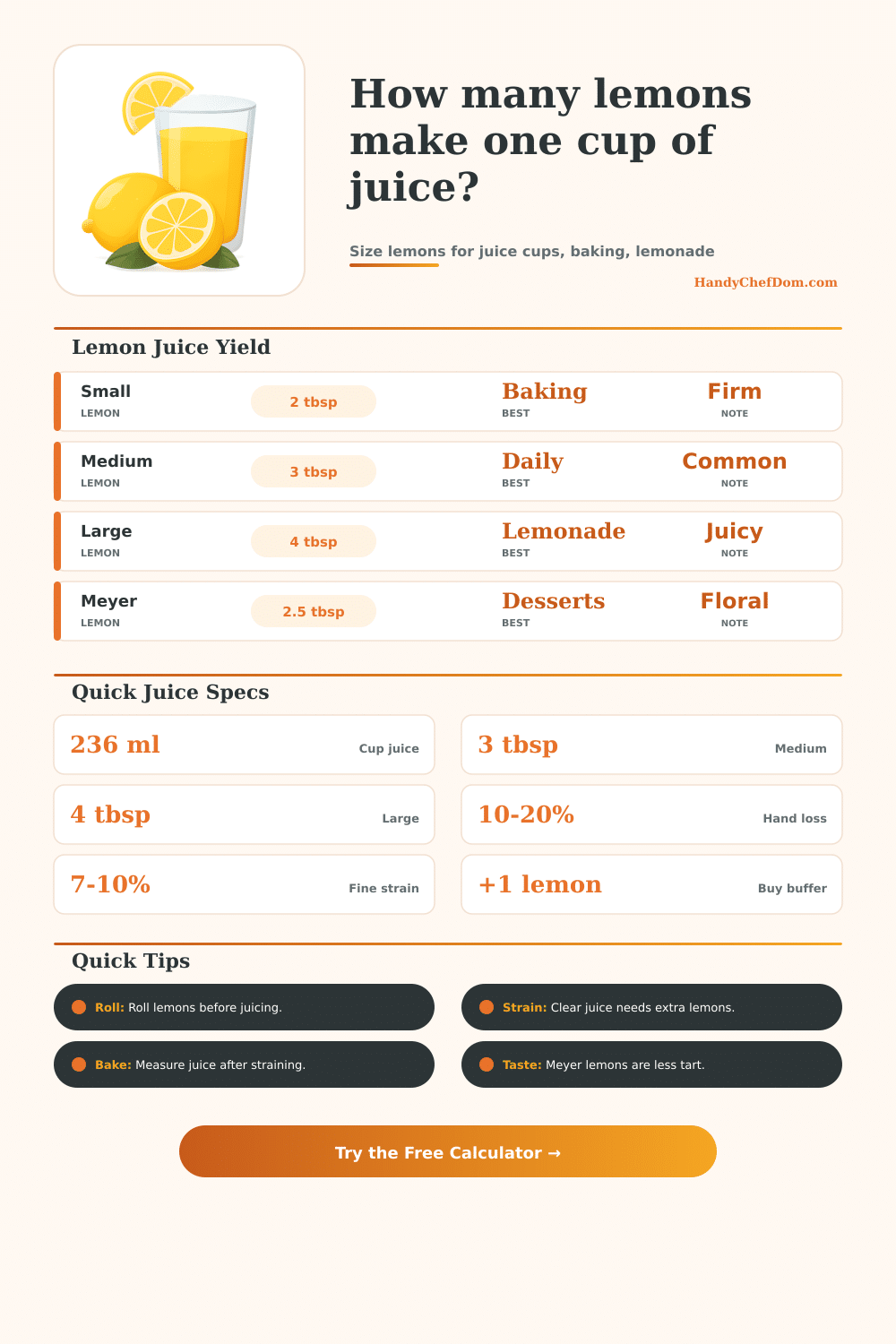
| Small Eureka lemon | 32 ml, about 2 tbsp | 8 to 9 lemons | Small baking batches and garnish-heavy prep |
| Medium Eureka lemon | 45 ml, about 3 tbsp | 6 to 7 lemons | General recipes, dressings, and measured lemon juice |
| Large Lisbon lemon | 58 ml, about 4 tbsp | 4 to 5 lemons | Lemonade, marinades, and larger cup targets |
| Jumbo market lemon | 70 ml, about 4.7 tbsp | 4 lemons | Pitcher prep and fast squeezing |
| Medium Meyer lemon | 38 ml, about 2.6 tbsp | 7 lemons | Desserts, curd, and less tart juice cups |
| Small organic lemon | 30 ml, about 2 tbsp | 8 to 10 lemons | Zest-forward baking where juice is secondary |
| Thin-skin ripe lemon | 52 ml, about 3.5 tbsp | 5 lemons | High-yield cups when lemons feel heavy for size |
| Thick-skin storage lemon | 34 ml, about 2.3 tbsp | 8 lemons | Conservative planning when rind is heavy |
| Ponderosa lemon | 118 ml, about 8 tbsp | 2 lemons | Oversized fruit and specialty backyard harvests |
| Juicer style | Efficiency | Effect on one cup | When to choose it |
|---|---|---|---|
| Hand squeeze | 78% | Needs the most lemon buffer | Small amounts, no tools, quick garnish juice |
| Fork twist | 84% | Saves about half a lemon per cup | Good backup when lemons are already halved |
| Citrus reamer | 90% | Reliable everyday cup estimate | Balanced speed, pulp control, and seed catching |
| Hinged citrus press | 94% | Often reduces the buy count by one | Marinades, cocktails, and weeknight cooking |
| Electric citrus juicer | 97% | Best for multi-cup targets | Lemonade pitchers and freezer juice trays |
| High pressure press | 99% | Maximum juice from firm lemons | Large batches when consistency matters |
| Use case | Calculator buffer | Cup target note | Why it changes lemons |
|---|---|---|---|
| Baking or exact measuring | 0% | Measure after straining | Most recipes need a precise cup, not extra acid |
| Lemonade pitcher | 5% | Add tasting room | Sweetness and dilution often need a splash more juice |
| Marinade with reserve | 12% | Hold back a little fresh juice | Some juice clings to bowls, herbs, or measuring cups |
| Salad dressing | 3% | Small flavor correction | Oil balance may need a final squeeze |
| Cocktail batching | 8% | Plan for tasting pours | Fresh lemon varies in acidity across the batch |
| Lemon curd or filling | 4% | Fine strain before cooking | Seeds and thick pulp are usually removed |
| Freezer juice cubes | 15% | Fill trays completely | Extra covers foam, transfer loss, and cube leveling |
| Pulp and seed setting | Loss used | Texture result | Lemon planning note |
|---|---|---|---|
| Keep pulp, catch seeds | 0% | Cloudy and full | Best yield for lemonade and casual cooking |
| Light strainer | 3% | Some pulp remains | Good default for one cup of all-purpose juice |
| Fine mesh strained | 7% | Smoother juice | Add a lemon when the exact count is close |
| Clear baking juice | 10% | Minimal pulp | Useful for glazes, curds, and clean batters |
| Seedy lemon batch | 5% | Seed catching loss | Accounts for cutting around seed-heavy centers |
| Double strained juice | 12% | Very clear | Most likely to push lemons per cup upward |
How many lemons does it take to make a cup of juice? For that matter, what’s a cup of juice anyway? Lemons differ in size (and even water content), and different recipes typically call for precisely one cup; however you don’t know how many lemon you’ll need to get there. Depending on how you extract juice, you’ll lose some along the way. Too few lemons result in drinks that lack zip, and too many can make things more tart then. Desserts turn out wrong. Use this page’s calculator and let it do the math for you. It factors in the variables for you. You won’t have to guess.
The first clue to estimate amount of juice comes from size. A small Eureka lemon might only give you two tablespoons of juice, while a large Lisbon can easily provides four. If your lemons is on the smallish side (compared to normal), you’ll want another three lemon to compensate. The next indication is density. Go for heavy-for-size. When a lemon feel light, it has thick rind and not much liquid; it’s a waste of volume, since you’re paying for skin rather than juice.
How to Get the Most Lemon Juice
How much liquid extracted depends off your method. Some methods leaves more juice behind in the pulp: hand-squeezing vs. Using an electric juicer. Manual tools. If you’re using a reamer, it will catch roughly 90% of the juice that’s available. Make big batches, and that extra 10% begins to add up. We forget about the limits of our tools. We imagine maximum yield and then we use the easiest method possible. It’ll always come up short on final count.
Finally, straining will decrease the amount of available juice. Using a mesh strainer, you’ll lose some portion of the pulp and seeds. If you’re planning to fine strain, you may end up with 10% less juice. That becomes an issue if you need clear juice, as in cases where you want to bake it into something. Just keep in mind that fine straining can reduces your usable liquid by up to ten percent. When making a marinade, however, there’s no need to strain. Savory applications don’t care about texture. Clear uses such as a glaze or a curd, on the other hand, do. Use the calculator to adjust based off your needs.
Temperature matters: The colder the lemon, the less juice it will give. A cold lemon is firm and holds its shape well. When chilled, it’s more difficultly to squeeze than a room-temperature fruit. Breaking up the internal membranes by rolling the lemon back and forth on the counter releases some of those vesicles and lets go of more juice. These are free actions that make for an even more efficient process. You can gets every last drop out of the fruit.
The type of lemon makes a difference, too. For example, using Meyer lemons will change not only the flavor but the volume as well. Meyers is slightly sweeter than your typical grocery store lemon, but they’re also smaller (and therefore produce less juice per fruit). If using Meyers instead of regular lemons, consider increasing the liquid accordingly. Acidity counts; try to stick to the same level called for in the original recipe. The calculator takes into account variation in intensity. Use it to adjust according to what’s local.
Don’t run out of ingredients. Plan ahead. When I am making something that uses several lemons, I buy more than needed in advance. This way even if it’s not perfect I have a buffer lemon sitting around to save my butt. It doesn’t cost much but it could of been the difference between success or disaster with a recipe. Running out while cooking is such a bummer. Another reason for this method is stress-free cooking, so there is no more stressing over exact amounts. No more running out. Just focus on what you are doing.
This isn’t just math; it’s about respecting ingredients. This is about learning size, method, and temperature. It transforms chaos into control. Your cooking results becomes something you feel confidenty about. Great cooking relies heavily on consistency: it’s what makes it good or not so good. And don’t forget that preparation and weight determine yield. Learning this equation brings precision to your kitchen.