🍞 Dough Volume Calculator
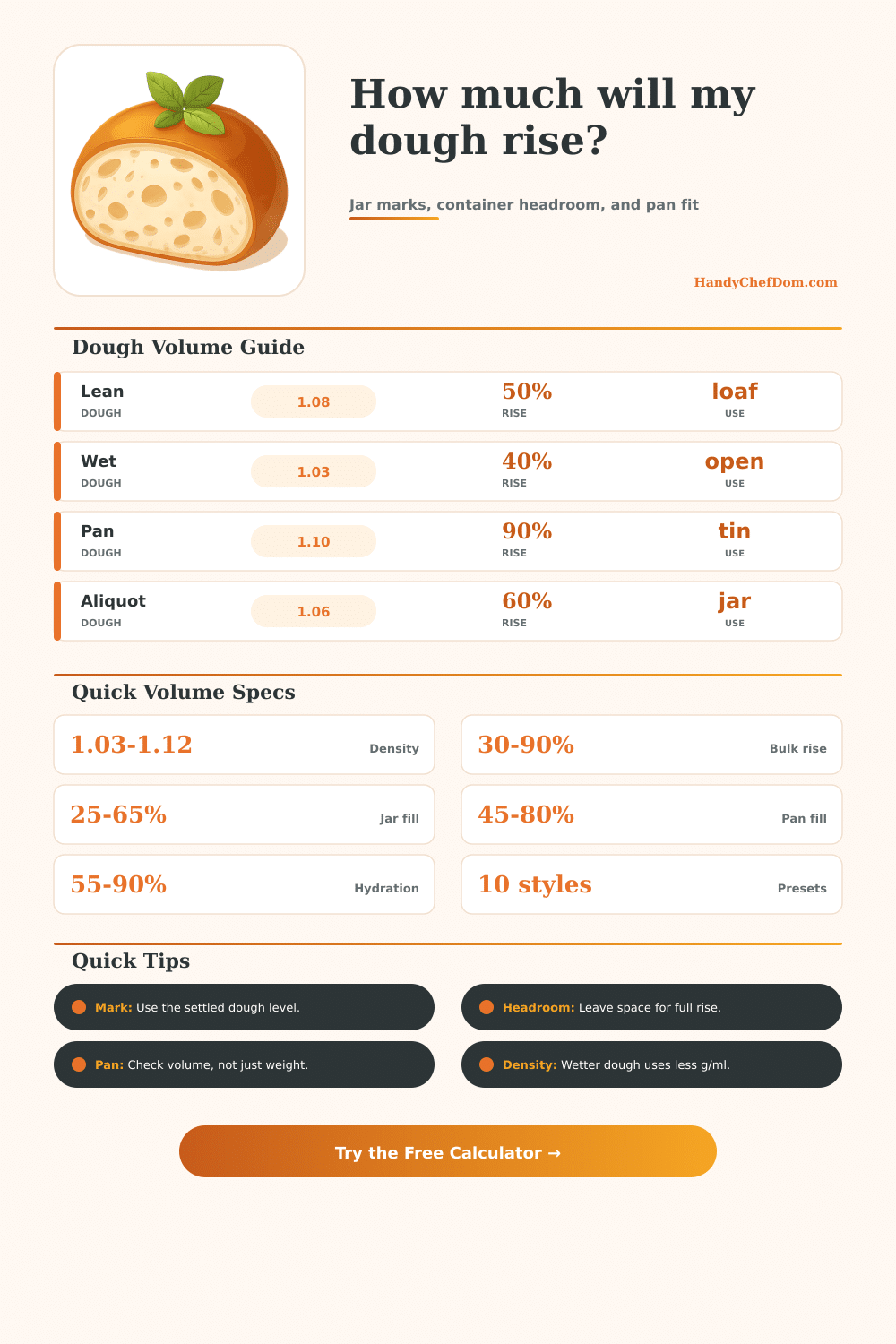
Convert dough weight into starting volume, target expansion, jar height marks, container headroom, and pan fit using dough density, hydration, rise percentage, and real container dimensions.
Use measured dough weight and a realistic dough density. Most bread dough is close to 1.03 to 1.12 g/ml before proofing; wetter doughs occupy slightly more space per gram.
Extra volume created by the selected rise percentage.
Unused container space after target proof volume.
Current rise as a share of your chosen proof target.
Estimated grams per ml from the current dough settings.
Good for 20 to 80 g samples with straight sides and clear height marks.
Works for small doughs or starter-style rise checks with modest headroom.
Useful for a single small loaf if the target rise stays below the rim.
Comfortable for one medium sourdough loaf at typical bulk rise.
Reliable for two-loaf batches and higher proof expansion targets.
Large enough for multiple loaves, folds, and visible volume growth.
A standard sandwich pan often finishes near three-quarters full before baking.
Better for larger pan loaves and formulas with strong final proof expansion.
| Dough type | Common hydration | Planning density | Volume behavior | Best use |
|---|---|---|---|---|
| Stiff bagel or pretzel dough | 50 to 58% | 1.12 to 1.16 g/ml | Compact, slow height change | Small tubs or divided pieces |
| Lean pan loaf dough | 58 to 68% | 1.08 to 1.12 g/ml | Predictable rise and clean pan fill | Sandwich tins and Pullman pans |
| Country sourdough | 68 to 78% | 1.04 to 1.08 g/ml | Visible expansion with rounded edges | Bulk buckets and banneton planning |
| High hydration dough | 78 to 90% | 1.01 to 1.05 g/ml | More volume per gram and flatter spread | Focaccia, ciabatta, open crumb loaves |
| Enriched dough | 55 to 70% | 1.06 to 1.11 g/ml | Depends on sugar, eggs, butter, and mixing | Brioche, rolls, soft sandwich bread |
| Target rise | Best fit | Volume multiplier | Container cue | Planning note |
|---|---|---|---|---|
| 25 to 35% | Warm dough, weak gluten, rye blend | 1.25x to 1.35x | Small height gain, early bubbles | Shape before structure weakens |
| 40 to 55% | Most hearth sourdough bulk checks | 1.40x to 1.55x | Rounded sides and steady jiggle | Balanced target for many free-form loaves |
| 60 to 75% | Cool dough or stronger gluten | 1.60x to 1.75x | Clearly puffy with expanded edges | Requires enough headroom and strength |
| 80 to 100% | Pan loaves and supported dough | 1.80x to 2.00x | Pan approaches final proof line | Usually safer in a pan than free-form |
| 100% plus | Special pan or very sturdy formulas | 2.00x plus | Large volume gain and high rim risk | Use a larger container or lower dough weight |
| Container size | Approx capacity | Good start fill | Target fill limit | Best dough amount |
|---|---|---|---|---|
| Small straight jar | 150 to 250 ml | 25 to 45% | 70% | 20 to 100 g aliquot samples |
| 1 L quart container | 950 to 1000 ml | 25 to 40% | 75% | 300 to 550 g dough at moderate rise |
| 2 L proofing tub | 1900 to 2100 ml | 25 to 45% | 75% | 650 to 1100 g dough for one loaf |
| 4 L dough bucket | 3800 to 4200 ml | 25 to 50% | 80% | 1.4 to 2.2 kg dough batches |
| 8 L rectangular tub | 7600 to 8400 ml | 20 to 45% | 80% | 3 to 4.5 kg dough with fold space |
| Pan or tray | Typical volume | Start dough fill | Proofed fill cue | Volume note |
|---|---|---|---|---|
| 8.5 x 4.5 loaf pan | 1.7 to 2.0 L | 35 to 50% | 65 to 80% | Common 750 to 900 g sandwich loaf |
| 9 x 5 loaf pan | 2.1 to 2.5 L | 35 to 50% | 65 to 80% | Better for 900 to 1050 g loaves |
| Pullman pan | 2.2 to 2.8 L | 40 to 55% | 70 to 85% | Leave room if using a lid |
| Focaccia quarter sheet | 2.5 to 3.5 L | 20 to 35% | 45 to 65% | Wide pans spread volume into a low height |
| Round cake pan | 1.5 to 2.4 L | 25 to 45% | 55 to 75% | Useful for rolls, buns, and round pan bread |
This calculator estimates dough volume from weight, density, dimensions, and target rise. Real dough can shift with mixing, folds, flour absorption, trapped gas, and container shape.
To achieve the correct rise in your bread dough, you must have an understanding of how volume change during fermentation. Most baker typically begin with weighing the bread dough. However, the weight of the bread dough will not necessarily inform you of the volume that the dough will occupy.
The density of the bread dough, the hydration of the bread dough, and the target rise percentage of the dough can affect the volume of the bread dough. Without being able to calculate these variable, you will not have an idea whether or not the container that you are using is of the correct size for the bread dough. The density of the bread dough can have a major impact upon the volume that the dough will occupy.
Pick the Right Container Size for Bread Dough
More specifically, if the dough is wetter, it will have a lower density because more water exist between the particles of the flour in the dough. The wetter dough will occupy more space than stiffer dough of the same weight. Because the hydration, sugar, and fat content in the dough can impact the density of the dough, density is another variable that you must account for when choosing the correct container for your dough.
The rise percentage that you target for your dough will also impact the volume of the dough. The rise percentage will indicate to you the amount that your dough is supposed to rise during the fermentation period. For example, a twenty-five percent rise may be necessary for a batch of dough that is being cooked in a warm kitchen, but a seventy-five percent rise may be required to properly cook a strong country style loaf of bread.
Your target rise percentage will determine the volume of your dough once baked, as well as the height mark that you need to make on the side of the container. You must provide headroom for your dough to rise because, as discussed, dough tends to dome on top of the container and may form large bubble near the top of the dough. Dough will push against the sides of the container more quickly than the center of the dough itself.
Another consideration is the shape of the container for the dough. If using a round jar, the volume of the dough will be concentrated into a tall column of dough. Using a round jar will result in a higher mark of height than if you used a rectangular container in which the dough will spread over a larger area.
The shape of your container will impact the location of the height marks on the container. Pan fit is the last consideration for bread dough. Most bakers will select a loaf pan for their bread dough based off the weight of the dough.
However, the weight of the dough will not ensure that the resulting loaf will have the proper height. The loaf pan that may be appropriate if the dough only reaches a sixty percent rise may be too small if you are aiming for a dough that rises to ninety percent of its original weight. Conversely, a loaf pan that seems too large for the initial weight of the dough may be of the correct size for that recipe once you achieve the target rise percentage of the bread dough.
You should check the volume of the pan against the height of the bread dough so that the dough does not overflow the pan or underfill the pan. Headroom is the amount of space in the container that remains empty above the bread dough. You must provide headroom for the dough to dome.
You must also include headroom for bubbles in the dough to break through the doughs surface. The bread dough must have headroom because if there is not enough headroom, the bread dough may overflow the container. A common mistake with bread dough is to assume all types of bread dough have the same density.
Bread dough can have different densities depending on the type of flour used in the recipe or if butter is include in the bread dough recipe. The rise target should not be based on memory but on the formula for the bread dough. If you change the density of the bread dough, the volume of bread dough must also be changed.
Each batch of bread dough should run through the calculations to determine the proper volume of bread dough. The reference tables shows the different sizes of containers and the amount of bread dough that the containers can hold. These tables will assist in scaling bread recipes.
The tables are not rules to be followed but offer an estimate for the amount of headroom and rise target that can be expected from a batch of bread dough. The math will not account for all the variables involved with bread dough. The type of mixing method used will change the amount of air in the dough.
The folding of the dough will change the distribution of gas throughout the dough. The temperature of the room will change the speed at which the dough rise. Dough must be observed to ensure it does not rise beyond the target height.
The calculator will make a map of the bread dough recipe, but eye must also be used to keep tabs on the dough. Marking the height of the dough once it has settled is the most important habit. Fresh mix of dough may contain alot of air that will collapse during mixing.
The fresh mix of dough may sit higher than the dough once it has settled into its final state. Once the dough has settled, it is a signal for the baker of the target height for the dough. The baker can use this measurement to compare the height of the dough to its target height.
This eliminates guesswork in the baking process. Bread dough should be baked to achieve the desired height and texture of the final loaf of bread. The dough should have enough room to rise and be structured well enough to maintain the desired shape of the bread dough.
Using a calculator for the recipe will make the planning of the bread dough recipe possible and repeatable. Making the planning step of the bread dough recipe repeatable will allow the baker to avoid surprises when baking the bread.