🥚 Egg Julian Date Converter
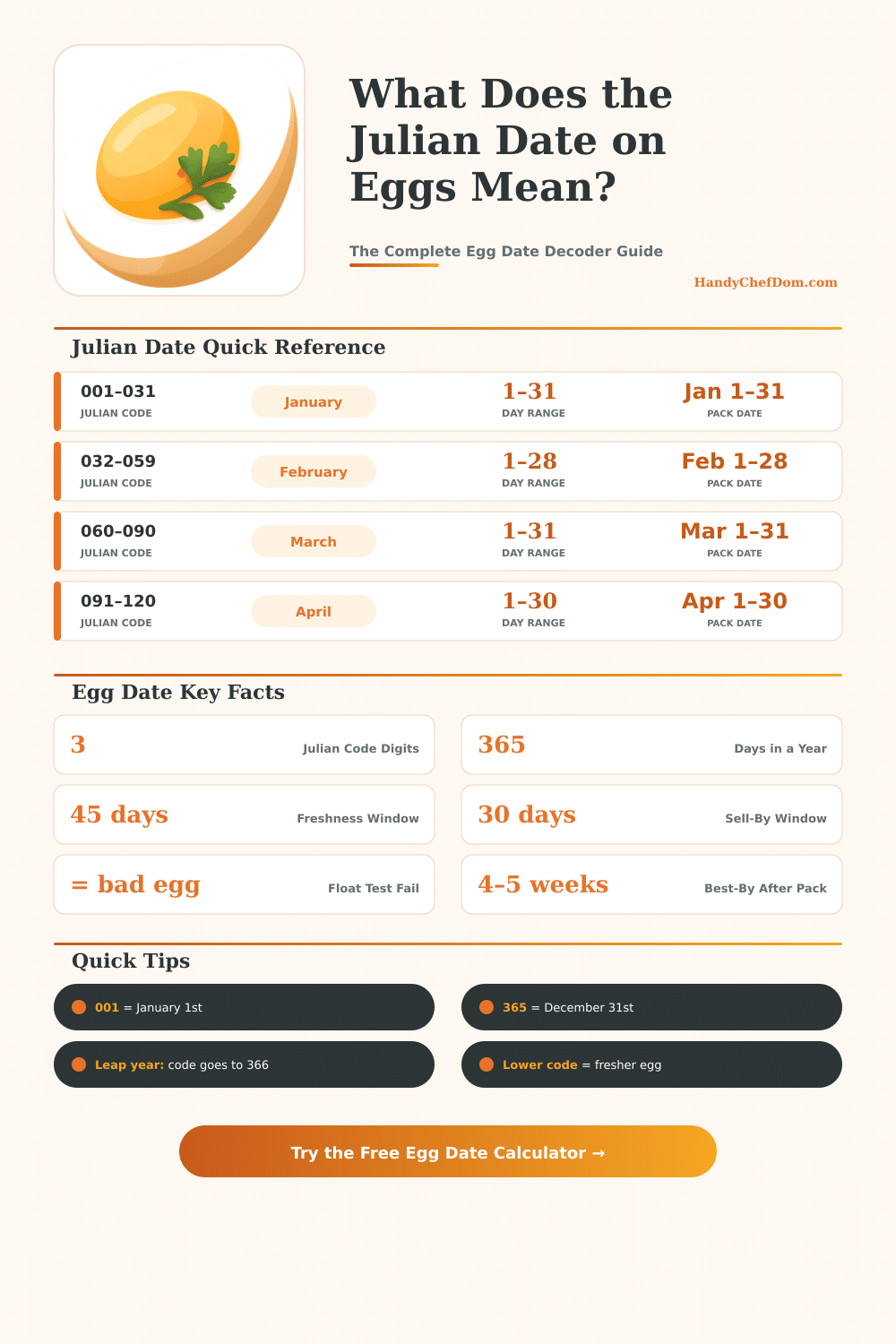
Decode the 3-digit Julian date on your egg carton — find the exact pack date & freshness window
| Julian Code | Month | Date Range | Days in Month |
|---|---|---|---|
| 001 – 031 | January | Jan 1 – Jan 31 | 31 |
| 032 – 059 | February | Feb 1 – Feb 28 | 28 (29 leap) |
| 060 – 090 | March | Mar 1 – Mar 31 | 31 |
| 091 – 120 | April | Apr 1 – Apr 30 | 30 |
| 121 – 151 | May | May 1 – May 31 | 31 |
| 152 – 181 | June | Jun 1 – Jun 30 | 30 |
| 182 – 212 | July | Jul 1 – Jul 31 | 31 |
| 213 – 243 | August | Aug 1 – Aug 31 | 31 |
| 244 – 273 | September | Sep 1 – Sep 30 | 30 |
| 274 – 304 | October | Oct 1 – Oct 31 | 31 |
| 305 – 334 | November | Nov 1 – Nov 30 | 30 |
| 335 – 365 | December | Dec 1 – Dec 31 | 31 |
| Days Since Pack | Freshness Status | USDA Rating | Best Use |
|---|---|---|---|
| 0 – 7 days | 🟢 Very Fresh | Grade AA | Poaching, frying |
| 8 – 21 days | 🟢 Fresh | Grade A | All uses |
| 22 – 30 days | 🟡 Good | Grade A | Scrambling, baking |
| 31 – 45 days | 🟡 Acceptable | Grade B | Baking, hard-boiling |
| 46 – 60 days | 🔴 Use Caution | Below Grade | Float test recommended |
| 60+ days | 🔴 Discard | Not Graded | Do not use |
| Carton Label | Format | What It Means | Required by USDA? |
|---|---|---|---|
| Julian Date | 3 digits (001–365) | Day eggs were packed | Yes (USDA graded) |
| Sell-By Date | Month/Day | Last day for retail sale | Optional by state |
| Best-By / Exp. | Month/Day | Peak quality estimate | Optional |
| Plant Code | P-XXXX | Processing plant ID | Yes (USDA graded) |
You find eggs almost everywhere you look, through various cultures and centuries. Folks and other hominids eat them for millions of years. Although many species have eggs, chicken eggs dominate the global market.
In Southeast Asia they grew them in antiquity, with evidence dating back to around 1500 BC Eggs of duck or ostrich appear on menus, but nothing matches chicken eggs in amount of consumption.
All About Eggs
Nutritionally, eggs surpass their weight. They abound in many vitamins and rank among the best protein sources. That is natural food, that provides many nutrients, ideal for balanced nutrition of adults and children.
Chicken eggs give choline, folate, vitamin D, iodine and B-vitamins together with high protein. Moreover, they provide sulphur and magnesium.
Here where it becomes sprua: one big egg yolk stores around 200 mg of cholesterol, so it belongs to the most concentrated dietary sources. Even so eggs add other elements, that help to lower risk of heart disease. The fat, around 5 grams each egg, mostly is made up of good fats: monounsaturated and polyunsaturated.
In addition, the choline neutralizes possible cholesterol increase from their consumption. If you have heart problems or high cholesterol, keeping to three or four eggs weekly is the best.
Protein in egg white commonly cause allergies. In egg allergy you must avoid whole egg, white and yolk. The trouble is, that you cannot perfectly separate them without a bit of contamination, even if you care.
In the grading station you sort eggs according to weight, not form. Later they pack and label them according to size: peewee, small, medium, large, extra large or jumbo. The shell itself feel rough and grainy in touch, because it has up to 17,000 microscopic pores.
Crystals of calcium carbonate form almost all its parts. Because it is semipermeable, air and humidity can cross those little holes.
Cooking methods for eggs genuinely do not have limits. Fry them sunny side up, over easy or over medium, choose for yourself. Shirred eggs (occasionally called baked) are simply eggs in dish with salt and pepper.
Boiled eggs have two main variants: soft-boiled with liquid yolk or hard-boiled with whole set. Both cook in shell in hot water, later you peel them. Scrambled eggs?
Many ways exist, depending on your mood. Legitimately that makes eggs so great, they answer to every cook method that you try. They fully deserve their fame.