Flour Tortilla Carb Calculator
Estimate total carbs, net carbs, fiber, tortilla grams, toasted chip yield, and scaled wrap batches for flour tortillas and low-carb flour-style wraps.
🌯Choose a Flour Tortilla Scenario
The calculator estimates flour tortilla carbohydrates from grams, diameter, tortilla style, fiber, batch scale, and serving count. Package labels vary, so use the grams-per-tortilla field when your wrap is unusually thick, thin, or high fiber.
📏Flour Tortilla Size and Type Comparison Grid
🧮Serving Size Quick Cards
🍞Nutrition Snapshot for Current Flour Wrap
📋Flour Tortilla Size Reference Table
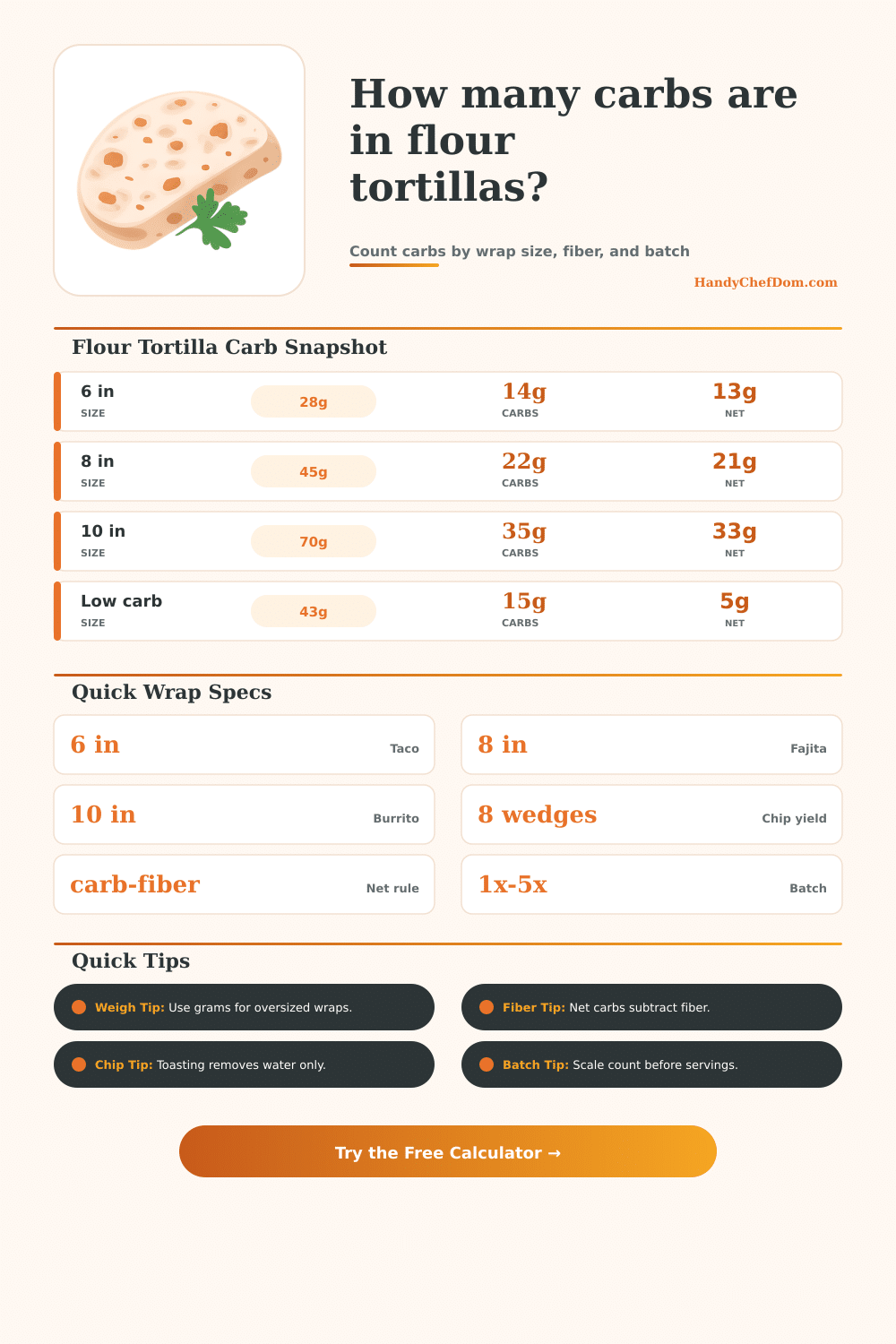
Use these common flour tortilla ranges when you do not have package grams. Larger diameter does not always mean proportionally more carbs because thickness varies by style.
| Format | Typical Diameter | Typical Weight | Estimated Carbs |
|---|---|---|---|
| Street taco flour tortilla | 4.5 to 5 inches | 18 to 25 g | 9 to 13 g total carbs |
| Soft taco flour tortilla | 6 inches | 26 to 32 g | 13 to 17 g total carbs |
| Fajita flour tortilla | 8 inches | 42 to 48 g | 20 to 24 g total carbs |
| Large burrito flour tortilla | 10 inches | 65 to 78 g | 32 to 39 g total carbs |
| Extra-large wrap tortilla | 12 inches | 85 to 105 g | 42 to 53 g total carbs |
🌱Flour Tortilla Type Comparison Table
| Type | Carbs per 100 g | Fiber per 100 g | Best Use |
|---|---|---|---|
| Standard white flour tortilla | 49 g | 3 g | General tacos, burritos, and fajitas |
| Thin homestyle flour tortilla | 47 g | 2.5 g | Lighter tacos where grams are lower |
| Whole wheat flour tortilla | 45 g | 6 g | Higher fiber wraps and lunch rolls |
| Spinach or tomato flour wrap | 46 to 48 g | 4 g | Sandwich wraps with similar carb density |
| Low-carb flour-style wrap | 35 g | 23 g | Net-carb focused wraps |
| Keto high-fiber flour-style wrap | 24 g | 17 g | Small net-carb targets |
🥨Toasted Chip and Strip Conversion Table
| Cut Style | Pieces per Tortilla | Weight Change | Carb Note |
|---|---|---|---|
| Soft wrap | 1 whole tortilla | No change | Carbs equal the label amount |
| Toasted whole wrap | 1 crisp tortilla | About 8% lighter | Carbs stay the same after toasting |
| Six wedge chips | 6 chips | About 10% lighter | Divide tortilla carbs by 6 per chip |
| Eight wedge chips | 8 chips | About 12% lighter | Divide tortilla carbs by 8 per chip |
| Tortilla strips | 12 strips | About 12% lighter | Use for soups, bowls, and salads |
👥Batch Scaling Reference Table
| Scenario | Typical Count | Serving Math | Planning Note |
|---|---|---|---|
| Weeknight soft tacos | 8 tortillas | 2 per person for 4 | Use soft taco or fajita size |
| Burrito bar | 10 to 12 tortillas | 1 per person plus extras | Large wraps add carbs quickly |
| Party pinwheels | 12 wraps | 6 to 8 slices each | Count slices but calculate by wrap |
| Toasted chips | 10 tortillas | 60 to 80 chips | Allow a small breakage percentage |
| Meal prep lunches | 5 wraps | 1 wrap per packed meal | Use per-serving net carbs |
💡Flour Tortilla Carb Tips
Your blood sugar monitor is sitting comfortabley in your pocket. You’re standing in the grocery store aisle looking at a box of white flour tortillas, when your eyes fall on a key word: “Twenty grams of carbohydrates.” That sounds reasonable, except it’s per wrap, meaning all of it, including that thin bit you’ll probably eat first. Most people makes this mistake: thinking each round circle contains the same amount of nutrition. It doesn’t. Burrito wraps weigh much more than a street taco shell; eating wraps one-by-one means overshooting on carbs without realizing it.
To help you with that, the calculator above will run math for you. But knowing why will make you think different, which is what really alters your behavior. Just because something is twice as wide doesn’t mean it’s also twice as thick, in fact, thickness greatly differentiates recipe to recipe and brand to brand. For example, a thin homestyle tortilla has far fewer carbs and calories per inch than a thicker, butter style version, which contains much more dense dough and extra fat. The density is the sneaky factor that messes up your basic “double it” approach.
Why Weighing Is Better Than Guessing
There’s one more wrinkle that many dieters overlook: net carbs. Because fiber doesn’t raise blood glucose like simple starches, you get a better idea of effect on how your body uses energy when you subtract fiber from total carbs. But here’s where things get tricky. A whole wheat wrap may have more fiber, so although there’s still a lot of carbs in each bite, the net number will be lower due to the fiber boost. That’s all a matter of personal insulin sensitivity. For some, the fiber act as a buffer. For others, anything starchy equals a spike, no matter how much fiber surrounds it.
But it’s important to remember that batch cooking adds some variables of its own. Doubling a recipe to prepare meals isn’t simply doubling ingredient list, it’s now doubling your chances at screwing up measuring out portions. What if you’re making wrap pinwheels or chopping them into wedges? The total carb content is the same, but surface area is different. And don’t even think about trying to toast away carbs. They will be crispier, but the carbs won’t be gone. Those starch molecules aren’t going anywhere when you heat up the dough. They’ll just leave behind some of their moisture and shed a bit of weight as they do so. So those eight crunchy chips from a single tortilla have the same nutritional value as eating that whole tortilla in all its chewy glory.
This is where you can get into the nitty-gritty: understanding how the number of grams, not just the general label “low-carb” or “standard” (impacts different foods). For example, while some low-carb tortillas may claim to be keto-friendly with only fifteen grams of carbs per serving, they might also weigh a whopping forty-five grams compared to a standard thirty-gram tortilla. Depending on what you’re filling that thing with, this means you’ll consume a bigger physical volume for maybe the same result. With the calculator, you can switch between profiles and immediately see the net-yield comparison. It explains all the marketing words so you can understand what’s actualy going onto your plate (in numbers).
The best thing you can do for getting the guesswork out of carbs is weigh them. Every package of tortillas tells you how many are inside and how much they weighs. That will give you an exact amount in grams for each one. That’s the number you use for your calculations rather than having to estimate it based off how big they look. That takes the variable away, which is difference in how the tortilla is made. Now it’s no longer a guess but a known quantity.
So when trying to make meals within strict nutritional limits, you don’t have to agonize over whether you’re making good choices. At its core, controlling tortillas comes down to knowing your ingredients and respecting them instead of fearing them. If you understand how they affect your whole day, you don’t have to cut out wraps to reach your goals. For example, knowing that a big old wrap of burrito contains almost thirty-five grams of carbs will alter your approach to the remainder of the meal. Perhaps a more lightweight filler? Some additional veggies to even out the math? It’s all about taking control with knowledge, not restricting yourself based off ignorance.
Next time you grab a bag of wraps, keep in mind: weight says it all, while size is just an illusion. Learning to measure out your portions precisely turns these handy staples into useful weapons for healthy meals. It doesn’t mean that you have to give up what you love to eat, you’ll know the math behind the meal and feel confident enough to enjoy your favorite foods without the anxiety. And isn’t that so much better then a quick fix? You should of known it was all about the numbers.