🥚 Hard Boil Eggs Time Calculator
Calculate egg timing from size, starting temperature, doneness target, altitude, pot diameter, water volume, egg count, and cooling bath time.
Timing is calculated from the moment the water reaches a boil for simmer, steam, and covered-rest methods. Heat-up time is estimated separately from water volume, egg mass, and heat setting.
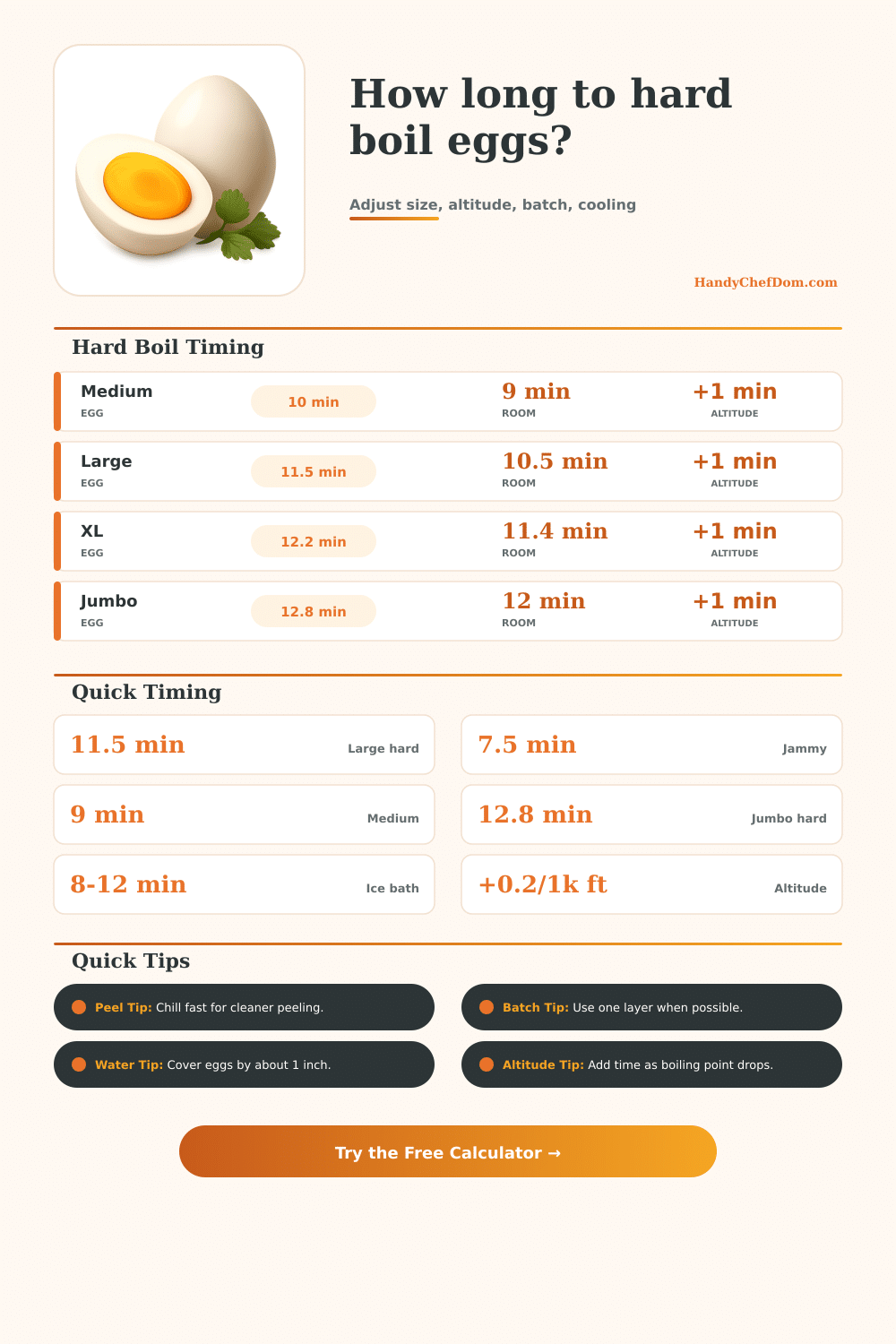
| Egg Size | Typical Weight | Hard Set at Sea Level | Calculator Adjustment |
|---|---|---|---|
| Peewee | About 35 g | 9.8 to 10.5 min | Subtract about 1.4 min |
| Small | About 43 g | 10.3 to 10.8 min | Subtract about 0.9 min |
| Medium | About 50 g | 10.8 to 11.2 min | Subtract about 0.5 min |
| Large | About 57 g | 11.3 to 11.8 min | Baseline timing |
| Extra large | About 64 g | 12.0 to 12.5 min | Add about 0.7 min |
| Jumbo | About 71 g | 12.6 to 13.2 min | Add about 1.3 min |
| Target | Large Fridge Egg | Large Room Egg | Yolk Result |
|---|---|---|---|
| Soft set | 6 to 7 min | 5.5 to 6.5 min | Runny center |
| Jammy center | 7 to 8 min | 6.5 to 7.5 min | Thick and glossy |
| Medium set | 8.5 to 9.5 min | 8 to 9 min | Mostly firm |
| Hard set | 11 to 12 min | 10 to 11 min | Fully firm |
| Extra firm | 13 to 14 min | 12 to 13 min | Drier, sliceable |
| Altitude | Boiling Point | Hard Egg Add-On | Timing Note |
|---|---|---|---|
| 0 ft | 212°F / 100°C | 0 min | Baseline reference |
| 1,000 ft | 210°F / 99°C | About 0.2 min | Small bump |
| 3,000 ft | 206°F / 97°C | About 0.7 min | Noticeable add |
| 5,280 ft | 201°F / 94°C | About 1.2 min | Denver style timing |
| 7,000 ft | 198°F / 92°C | About 1.5 min | Plan extra time |
| 10,000 ft | 192°F / 89°C | About 2.2 min | Use a longer finish |
| Batch | Pot Diameter | Water Over Eggs | Useful Water Range |
|---|---|---|---|
| 2 to 4 eggs | 6 to 7 in | 0.75 to 1.25 in | 1.2 to 1.8 qt |
| 6 to 8 eggs | 8 to 9 in | 1 to 1.5 in | 2 to 3 qt |
| 10 to 12 eggs | 9 to 10 in | 1 to 1.5 in | 3 to 4 qt |
| 14 to 18 eggs | 11 to 12 in | 1 to 1.5 in | 4 to 6 qt |
| 20 to 24 eggs | 12 to 14 in | 1.25 to 2 in | 6 to 8 qt |
Hard boiling eggs require specific timing because several variable affect how hard boiling eggs works. If you dont account for these variables, the yolks may be too soft or too dry and chalky. One of these variable is the size of the eggs.
A jumbo egg contain more mass than a medium egg. Therefore, it take longer to cook a jumbo egg. If you cook the eggs for the same length of time, the larger egg will not cook as good in the center.
What Affects Hard-Boiled Eggs
To compensate for this, you must adjust the timing according to the size of the eggs that you are boiling. Another variable are the starting temperature of the eggs. If you start with eggs directly from the refrigerator, they will take longer to reach the necessary temperature then eggs that have been sitting out at room temperature.
For this reason, you should use eggs that have been sitting out to ensure the best result. The third variable to consider are the altitude at which you are boiling the eggs. The higher the altitude, the lower the boiling point of the water.
You can only get so much heat from the water boiling at a lower boiling point. Therefore, if you are boiling eggs at high altitudes, you must adjust the timing of the boiling of the eggs. The fourth variable to consider is the number of eggs you are boiling and the amount of water in which you are boiling the eggs.
If you put too many eggs into the pot, they may not be cooked even. If you use too little water to cook the eggs, the temperature of the water will drop when you add the eggs into the water. On the other hand, if you use too much water, it will take longer for the water to heat up.
You want to make sure that the eggs are in a single layer, and the water cover the eggs. The fifth and last variable is the cooling of the eggs after boiling. Cooling is necessary to prevent carryover cooking of the eggs.
Carryover cooking occur after you remove the eggs from the boiling water. The heat within the eggs will continue to cook the yolks. To prevent this from happening, you can place the eggs into an ice bath.
This will stop the carryover cooking of the eggs immediate. You should leave the eggs in the ice bath for eight to twelve minutes to ensure that the texture of the yolks is as you have intended. If you do not use the ice bath, the yolks will continue to cook on the counter and may become too firm.
Finally, there are different method to cook the eggs. You can lower the eggs into already boiling water. An alternative method is to start the eggs in cold water and boil the water.
You can also use the steam in the kitchen to cook the eggs or use the residual heat of the pot that has been removed from the stove. Each method will require a different amount of time to properly cook the eggs. The variables of size of the eggs, starting temperature of the eggs, altitude, number of eggs in the pot, cooling of the eggs, and the methods of cooking all interact with each other when hard boiling eggs.
By considering each of these variables, you can ensure that you achieve the best result for your recipe.