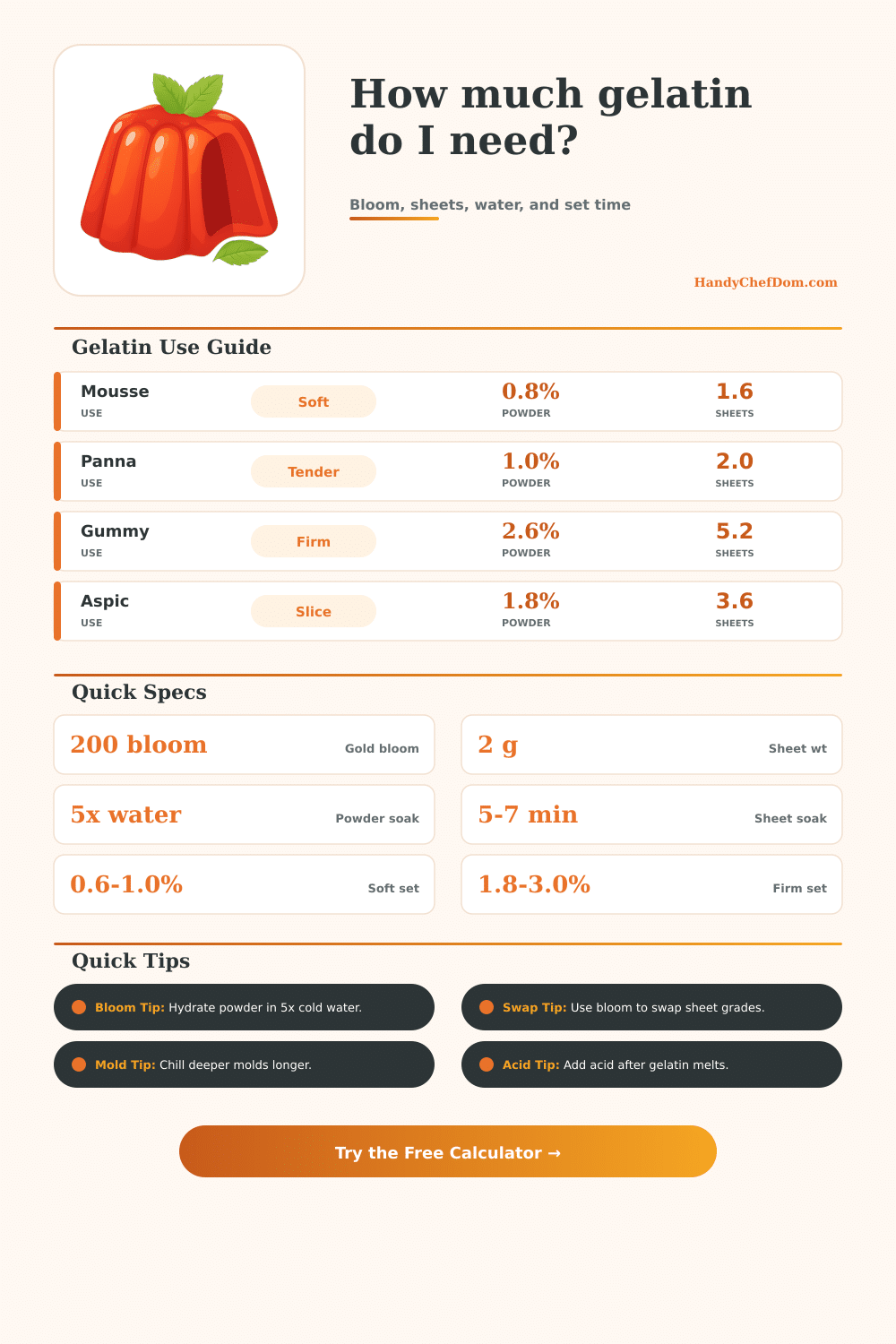
🍮 Gelatin Calculator for Bloom and Sheets
Size powder, sheets, bloom water, firmness, and chill time for creamy desserts, gummies, glazes, gelee, and aspic.
Enter the batch size, gelatin form, bloom strength, texture target, mold depth, and formula modifiers. The calculator adjusts a 200 bloom baseline to your actual gelatin.
| Grade | Bloom | Sheet | Swap |
|---|---|---|---|
| Bronze | 125 | 3.3 g | 1.60x |
| Silver | 160 | 2.5 g | 1.25x |
| Gold | 200 | 2.0 g | 1.00x |
| Plat | 230 | 1.7 g | 0.87x |
| High | 250 | 1.6 g | 0.80x |
| Use | Soft | Tender | Firm |
|---|---|---|---|
| Mousse | 0.6% | 0.8% | 1.1% |
| Panna | 0.8% | 1.0% | 1.3% |
| Gelee | 0.9% | 1.2% | 1.6% |
| Glaze | 1.2% | 1.5% | 1.8% |
| Aspic | 1.2% | 1.6% | 2.0% |
| Gummy | 2.0% | 2.6% | 3.2% |
| Form | Water | Wait | Step |
|---|---|---|---|
| Powder | 4-6x | 5-10 min | Sprinkle |
| Granules | 5x | 8 min | Stir once |
| Sheets | Cold | 5-7 min | Squeeze |
| Gold | Cold | 6 min | Melt in |
| Silver | Cold | 7 min | Melt in |
| Depth | Soft | Slice | Firm |
|---|---|---|---|
| 1 cm | 2 hr | 3 hr | 4 hr |
| 2 cm | 3 hr | 4 hr | 5 hr |
| 3 cm | 4 hr | 5 hr | 6 hr |
| 5 cm | 6 hr | 8 hr | 10 hr |
| 8 cm | 8 hr | 12 hr | 16 hr |
Gelatin is a substance that is used to change the textures of a variety of liquid mixtures; it has the ability to turn a liquid into a solid that can be sliced or spooned. Many people experiences issues with the strength of the gelatin that is used, however, because the amount of that ingredient is often guessed at rather than being measured. In order to ensure that the setting of the gelatin is successful, several factor must be considered, such as the volume of the liquid mixture, the bloom strength of the gelatin, the amount of sugars and fat ingredients in the recipe, and the acidity and depth of the mold in which the gelatin will be set.
The calculator for determining the amount of gelatin to use handles each of these factors mathematically for the user, saving them the time that would be required to create small batch of the recipe in order to find the correct amount of gelatin to use in the recipe. First, the user must decide whether they will use gelatin powder or sheets. Gelatin powder is measured in weight; it must be bloomed in water, and that blooming water is part of the total amount of liquid to be used in the recipe.
How to Use the Gelatin Calculator
Gelatin sheets are counted by the individual leaf; they contain their own water that must be soaked into by the sheet after they has been removed from there packaging. Each type of gelatin will create the same texture, but requires a different method of preparation. If the sheets weigh two gram each, the calculator will provide an amount for the number of sheets to be used in the recipe.
If gelatin powder is to be used, however, the calculator will provide the amount of gelatin in grams. Additionally, not all brands of gelatin are created equal. Gelatin with a higher bloom strength will require less weight than brands with a bloom of 160-bloom, for instance, than brands with a bloom strength of 200-bloom.
However, the calculator will automatically adjust the amount of gelatin if the user makes the choice of the bloom strength of the brand to be used in the recipe. Another decision that the user must make is the texture that will be targeted by the setting of the gelatin. A texture of soft spoon set is used for mousses, which are required to hold their shape on a serving plate.
A clean slice texture is used for products like panna cotta which must hold their shape when being removed from the mold. A firm chew texture is applied to products like gummies or aspic that must be cut into pieces and consume by the diner. Each of these textures will have a percentage of gelatin to total batch weight.
The percentage can be set by the style that is chosen, and the user will automatically adjust it when the texture target is adjusted. Factors like the amount of sugar, fat, and acidity in the recipe will impact the setting of the gelatin. The higher the amount of sugar in the recipe, the more gelatin that will be required to compensate for the interaction between the sugar and the gelatin molecule.
Fats like cream will coat the gelatin molecule, preventing it from setting as strong within the mixture, thus requiring more of the ingredient to be used in the recipe. Other ingredients like acid and alcohol will weaken the structure of the setting of the gelatin. The calculator includes an acidity selector for this ingredient.
While none of these factors alone will impact the setting of the gelatin significantly, they will have an impact on the setting of the gelatin along with other ingredients that has the same effect. For instance, wines contain both sugar and alcohol, and thus will require an extra buffer of gelatin to ensure the setting of the gelatin is still accomplished as desired by the recipe creator. The depth of the mold in which the gelatin will be poured will impact the time in which it sets.
Shallow molds will allow the cold temperature to reach the center of the mold, allowing the gelatin to set in a shorter period of time than a deep mold will permit. Deep molds will require additional hours of chilling to allow the center of the molds to reach the proper temperature to allow for setting of the gelatin. The style of the recipe, texture target, depth of the mold, and the temperature of the fridge in which the mold will be chilled can estimate the amount of time that the gelatin will take to set.
Another factor that must be considered is the blooming of the gelatin. Gelatin powder will need to be allowed to sit in cold water for five to ten minutes to allow for the proper blooming of the product. The same time and treatment must be provided to gelatin sheets before they are added to the warm gelatin mixture.
The gelatin sheets will need to be squeeze to remove the water prior to adding the sheets to the warm mixture. If the blooming is not performed correctly, there will be sections of the mixture that will contain undissolved gelatin that will not contribute to the setting of the product. However, the calculator assumes that the blooming process will be performed correctly with the amount of gelatin indicated in the recipe calculations.
Another possible step in the recipe may be the addition of acid after the melting of the gelatin. If lemon juice or wine is added too early in the recipe, it will dull the setting of the gelatin. However, if the portion of acid is withheld, and that acid is added once the gelatin has melted and the mixture has cooled, the setting of the gelatin will not be affected.
In this case, the amount of gelatin will be set to account for the acid in the recipe if the user selects a medium level of acid or high levels of acid in the product. Although many brands of gelatin are similar in their strength, the bloom rate that is published on the package indicates the strength of the gelatin. For example, a brand of gelatin that is bloomed at 125-bloom is weaker than a brand of gelatin that is bloomed at 230-bloom.
If a user changes brands of gelatin, the user will need to change the bloom value in the recipe to ensure that the amount of gelatin to be used changes to that of the new brand. If this is not done, the product may not set properly or may become rubbery when consumed by the diner. The same rules apply if the recipe is to be scaled up or down in size.
If the recipe is to be doubled, for instance, the percentage of the amount of gelatin will remain the same in the new recipe; however, the amount of other ingredients may need to be adjusted. Finally, the recipe also includes a figure for the amount of gelatin that should of been used in each serving.