🍳 Grams to Ounces Cooking Conversion Calculator
Convert ingredient weights, estimate cups, and compare kitchen package sizes with this grams to ounces cooking calculator.
Use the density style and package size to turn a simple grams-to-ounces conversion into a real cooking estimate.
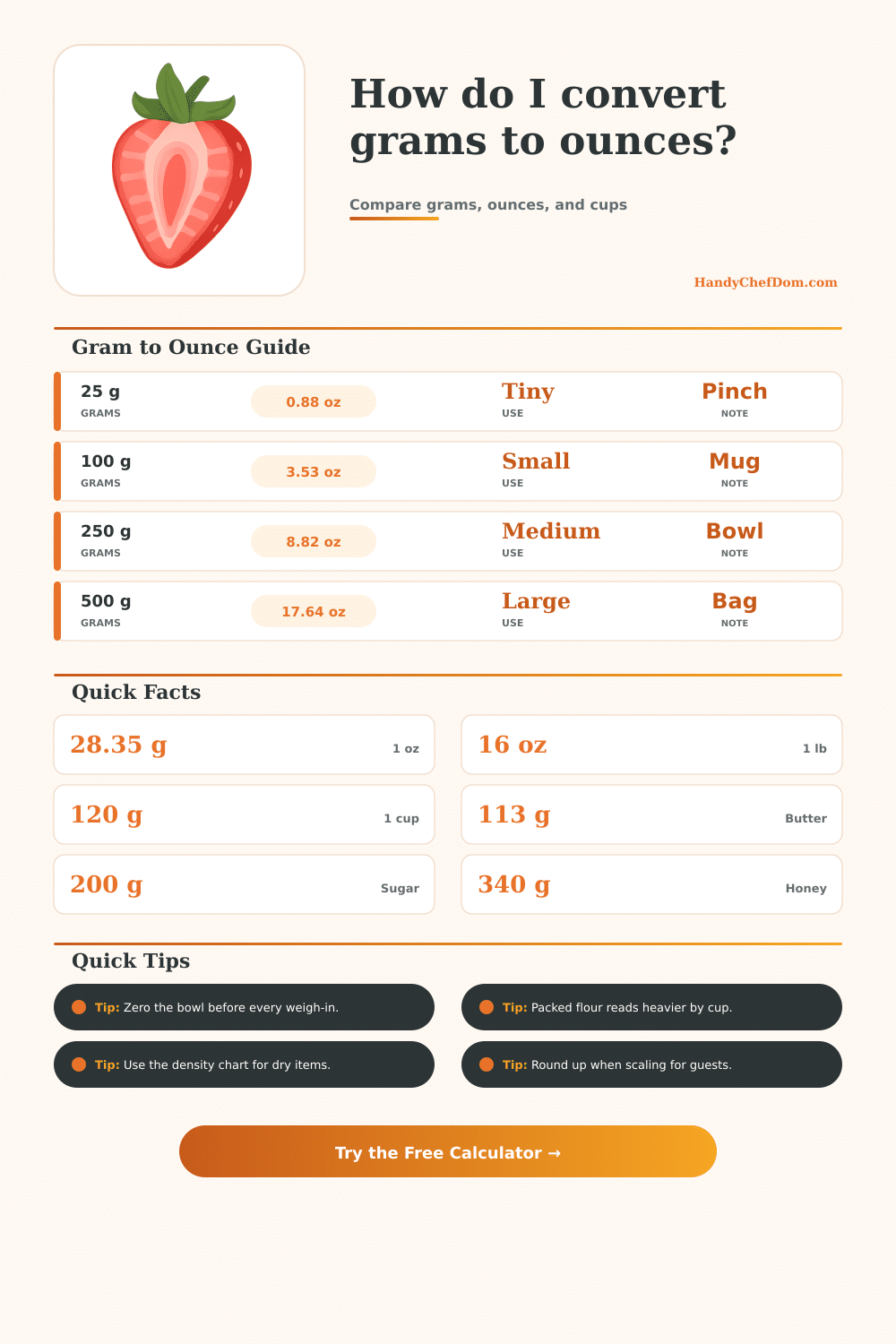
| Grams | Ounces | Use | Note |
|---|---|---|---|
| 25 g | 0.88 oz | Pinch | Tiny batch |
| 50 g | 1.76 oz | Snack | Small prep |
| 100 g | 3.53 oz | Baking | Quick weigh |
| 250 g | 8.82 oz | Mixing | Half bag |
| 500 g | 17.64 oz | Batch | Bag scale |
| 1000 g | 35.27 oz | Bulk | 1 kilo |
| Ingredient | g/cup | oz/cup | Best For |
|---|---|---|---|
| Flour | 120 | 4.23 | Cakes |
| Sugar | 200 | 7.05 | Sweet mix |
| Butter | 227 | 8.00 | Rich dough |
| Water | 236.6 | 8.35 | Liquids |
| Honey | 340 | 12.00 | Syrups |
| Rice | 185 | 6.53 | Dry grain |
| Pack | Grams | Ounces | Count |
|---|---|---|---|
| Butter stick | 113 | 4.0 | 1 |
| Cocoa box | 227 | 8.0 | 1 |
| Honey jar | 340 | 12.0 | 1 |
| Kitchen bag | 454 | 16.0 | 1 |
| Rice bag | 500 | 17.6 | 1 |
| Bulk bag | 1000 | 35.3 | 1 |
| Spoon | Grams | Ounces | Example |
|---|---|---|---|
| 1 tsp water | 5 | 0.18 | Small pour |
| 1 tbsp sugar | 12.5 | 0.44 | Sweet spoon |
| 1 tbsp flour | 7.5 | 0.26 | Dry scoop |
| 1 cup water | 236.6 | 8.35 | Fluid cup |
| 1 cup sugar | 200 | 7.05 | Fine granules |
| 1 cup flour | 120 | 4.23 | Spoon & level |
Converting gram to ounces is a necessary skill for anyone who cooks. Many recipe use grams, but kitchen scales use ounces. In order to follow recipes accurately, its important for cooks to understand how to convert grams to an ounce.
One ounce are equal to 28.35 grams. Using this value, cooks can easily convert grams to ounces. Density is another factor to consider when measuring ingredient.
How to Convert Grams to Ounces
Many ingredients have a different density. For instance, flour has a low density when it is loose, but it will have a high density if it is tightly pack into a cup. Because of this, 100 grams of flour can fill a larger volume than 100 grams of another ingredient that has a high density.
It is important for cooks to take into account the possible difference in density of ingredients. Butter is an ingredient that cooks can measure by weight and volume. A stick of butter weigh 113 grams, which is equal to 4 ounces.
However, if you melt or cream the butter with sugar, the volume will change. Honey is another ingredient whose density matter. Honey is a thick, viscous liquid indicating that it is very dense.
A cup of honey weigh 340 grams, which is equal to 12 ounces. Using volume measurements for honey instead of the weight in grams will lead to the addition of the wrong amount of honey to a recipe. Cooks can reduce waste when measuring ingredients by adding 5 to 10 percent extra of an ingredient.
This allow for spills or inaccurate scooping of ingredients. Using a multiplier allows cooks to scale a recipe up or down in quantity. To double a recipe, cooks should multiply the weight of each ingredient by two.
To halve a recipe, cooks should divide the weight of each ingredient by two. Measuring ingredients by volume can lead to waste and inaccuracies. For instance, 100 grams of flour can weigh 100 grams when cooks spoon the flour into a measuring cup, but it can weigh 150 grams if it is scooped.
Sugar is more consistent, but brown sugar require packing it to a specific weight. Liquids like water have a consistent weight; one cup of water always weigh 236 grams. Different ingredients has a different weight for one cup of that ingredient.
Rice weigh 185 grams for one cup of rice when it is uncooked but will weigh more when cooked. One cup of raw ground beef weigh 225 grams but will weigh less when cooked due to the dripping of the fat from the ground beef. A cup of cocoa powder weigh 100 grams.
Using too much cocoa powder when baking can make a cake taste bitter. Common mistakes cooks can make include improper understanding of density and weight of ingredients. Adding too much flour to pancakes will make them spread too thin on the baking surface.
Packing sugar too tightly into a cookie recipe can make the cookies spread too much on the baking sheet. Using scales to measure ingredients in grams will eliminate these common mistake. Measuring ingredients in grams will allow cooks to be precise in the measurements they use in the recipe.
Cooks should use a kitchen scale to measure ingredients. However, cooks should zero the scale before they weigh the ingredients. This will ensure the weight of the scale is not added to the weight of the ingredient being weighed.
Cooks should round up the measurements for guests who will be eating the recipes. The measurements should be more exact for wet ingredients. Understanding the weight of ingredients in grams and ounces will allow cooks to understand the sizes of packages of ingredients.
A 1000 gram bag of flour is 1 kilogram of flour. The size of packages of ground meat is often 454 grams. If cooks know the weight of the ingredients in grams, they can determine if the package contain enough of the ingredient for the recipe.
Knowing how to convert grams to ounces will allow cooks to bridge the gap between the recipe and the kitchen tool cooks use to measure ingredients.