🥨 Soda Crackers Calorie Calculator
Estimate soda cracker calories, sodium, carbs, fat, protein, servings, sleeves, measured grams, toppings, and target checks from one flexible cracker count.
Count loose crackers, add sleeves, or use measured grams for broken soda crackers. Brand/style values use USDA/FoodData-style cracker averages and current label examples.
| Cracker style | Serving anchor | Calories | Sodium | Carbs |
|---|---|---|---|---|
| Original salted soda crackers | 5 crackers, 16 g | 70 cal | 135 mg | 12 g |
| Premium original label | 5 crackers, 16 g | 70 cal | 135 mg | 12 g |
| Store-brand original | 5 crackers, 15 g | 65 cal | 125 mg | 11 g |
| Unsalted tops soda crackers | 5 crackers, 16 g | 70 cal | 60 mg | 11 g |
| Low sodium soda crackers | 5 crackers, 15 g | 65 cal | 35 mg | 11 g |
| Whole grain soda crackers | 5 crackers, 16 g | 70 cal | 125 mg | 12 g |
| Mini soda crackers | 10 minis, 15 g | 65 cal | 150 mg | 11 g |
| Fat-free style soda crackers | 5 crackers, 15 g | 60 cal | 135 mg | 12 g |
| Count or measure | Original calories | Original sodium | Approx weight | Serving use |
|---|---|---|---|---|
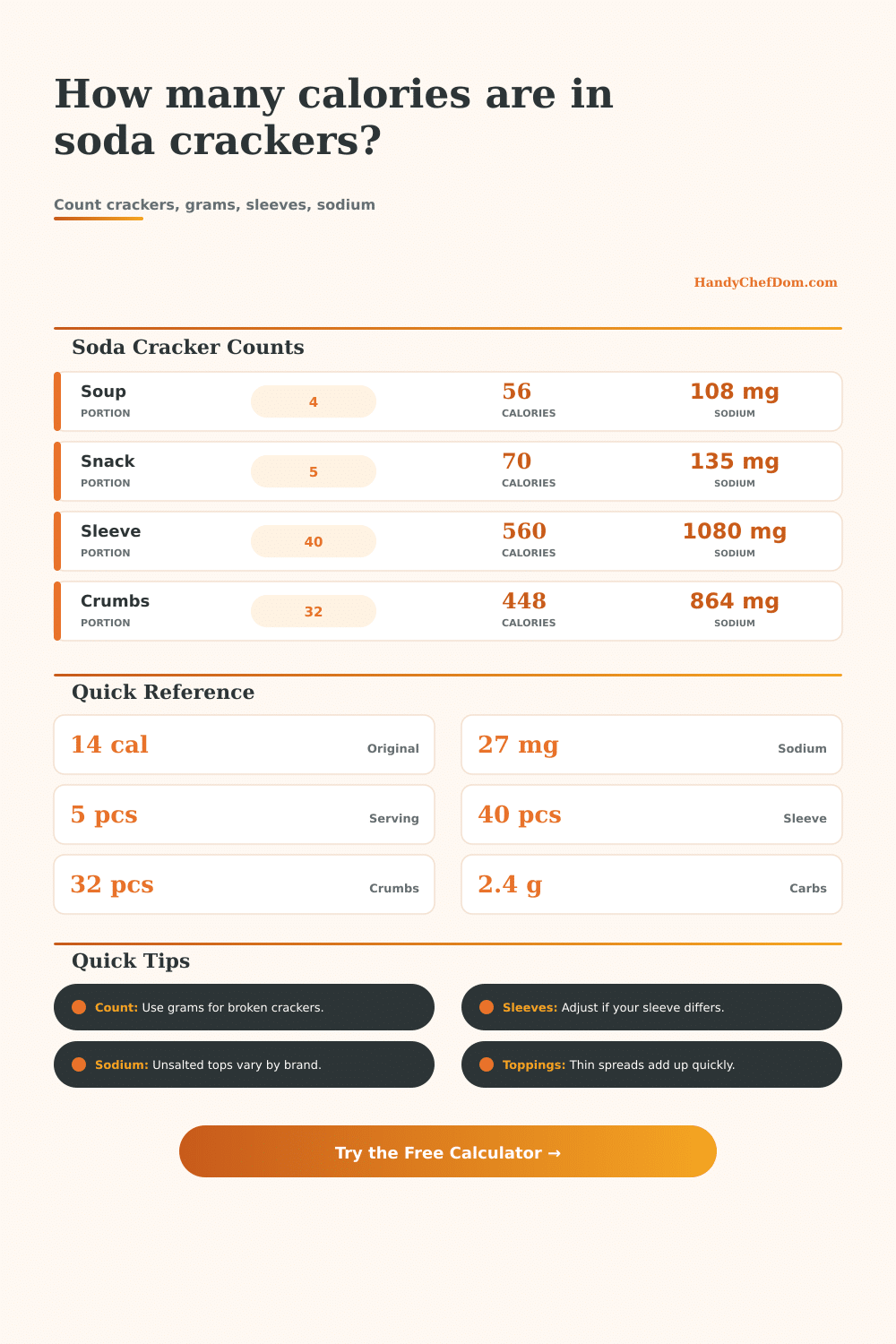
| 1 soda cracker | 14 cal | 27 mg | 3.2 g | Single taste |
| 4 soda crackers | 56 cal | 108 mg | 12.8 g | Soup cup |
| 5 soda crackers | 70 cal | 135 mg | 16 g | Label serving |
| 10 soda crackers | 140 cal | 270 mg | 32 g | Snack stack |
| 20 soda crackers | 280 cal | 540 mg | 64 g | Shared plate |
| 40 soda crackers | 560 cal | 1080 mg | 128 g | One sleeve |
| Topping option | Amount model | Calories added | Sodium added | Best for |
|---|---|---|---|---|
| Plain crackers | None | 0 each | 0 mg | Counting crackers only |
| Light cheese spread | 5 g each | 14 each | 45 mg | Cheese plate side |
| Thin peanut butter | 4 g each | 24 each | 3 mg | Snack stacks |
| Butter dab | 2 g each | 14 each | 1 mg | Rich topping |
| Small jam smear | 4 g each | 10 each | 0 mg | Sweet snack |
| Tuna salad spoon | 8 g each | 16 each | 30 mg | Lunch plate |
| Soup topping only | Crackers only | 0 each | 0 mg | Soup or chili |
| Crumb butter mix | Per cracker eq | 9 each | 1 mg | Casserole crumbs |
| Serving scenario | Crackers each | Original calories | Original sodium | Target note |
|---|---|---|---|---|
| Light soup garnish | 3 to 4 | 42 to 56 | 81 to 108 mg | Usually under 150 calories |
| Label snack serving | 5 | 70 | 135 mg | Good baseline portion |
| Lunch snack stack | 8 to 10 | 112 to 140 | 216 to 270 mg | Watch toppings |
| Cheese plate side | 6 to 12 | 84 to 168 | 162 to 324 mg | Add cheese separately |
| Crumb topping | 16 to 32 | 224 to 448 | 432 to 864 mg | Split by servings |
| Party soup line | 4 per person | 56 each | 108 mg each | Multiply by guests |
These are plain crackers (like soda crackers). These seem like a harmless snack; after all, it’s just some flat squares, right? They don’t seem like they’d matter much to your total food counts. However, there are still quite a few grams of refined carbs and sodium here. When you consume them; even if you’re “just having one”, your body will absorbs this nutrient-dense snack very fast.
Don’t go by “feeling” if something has an impact on your nutrition goals. Use the calculator above for precise numbers to see how much each amount affect your totals. The problem is that most nutrition information for crackers is per serving: five crackers. This means that by default, manufacturers is creating a reasonable-looking label. A handful has approximately seventy calories, not too bad, if it were just a one-off snack. And it contain a medium amount of carbohydrates. Sounds good, right?
Why You Should Count Your Crackers
But people don’t eat exactly five cracker. Sometimes you’ll reach in for six (because it feels like an even number). Other times you’ll smash a dozen into your chili (because they taste better then way). Those tiny increases adds up, and soon there’s no benefit to having low-calorie snack at all.
The key variable nobody talks about is sodium. Depending on if you buy low-sodium, unsalted, or salted versions, a regular cracker will have anywhere from zero to about 27 milligrams of sodium per serving, and a sleeve of crackers (40 crackers) will have about double the calories regardless off brand. But because the cracker provides a savory note that distracts from the salt, it’s easy to hit more than a half-gram of sodium in one pack, which is more than half the daily recommendation for most adults. When you enter how many crackers per serving, the calculator will also let you know if you’re getting them loose or in sleeves. This way, you can see how quickly you could overshoot your goal without even noticing a salty flavor. The slightly umami kick of the cracker itself dulls whatever sodium overload it might be masking.
The style of crackers make a bigger difference than you’d think. A whole grain variety contains just as many calories as white flour versions, but it brings slightly more fiber and a denser texture that can help with satiety. The fat free varieties removes the oil, saving on calories, but then sometimes they add sugar or salt to make them taste good. It’s a trade off. Your calories go down (hurray!), but so do your fat grams…sometimes replaced by sodium milligrams (booo!). With this tool you’ll see what you get in exchange for what.
Want to watch your blood pressure? Switching from salted to unsalted tops doesn’t change the calories, but it does changes everything else. In reality, it gets complicated by toppings. Cheese and other spreads adds many calories which aren’t part of the cracker label’s accounting. These topping are optional yet still matter a lot. The calculator has fields for them so you don’t underestimate how much you’re actualy eating. Six crackers with light cheese is different from six crackers without; the former is a fatter bite, changing what was a dry carb snack into something else. If you’re keeping tabs, then you need to be aware of this change.
For most of us, sodacrackers are background; they’re never the main dish. They’re carrying peanut butter or tuna salad, like bits floating in our soup. Counting depends on the situation. Half a sleeve crushed into a casserole adds crunch and some calories, but spread over 4 servings? It’s diluted. But eaten straight-up-from-the-box-with-coffee? That’s pure intake. Log accordingly. This is why the reference tables breaks down those common situations: You know what you do with sodacrackers; now match that behavior to an appropriate estimate.
Small things matter. But they matter. Do you have to weigh every square? No. Just respect its volume. One sleeve = a lot of cracker. Four crackers = few. Your real habit lies somewhere in-between. Figure out what that number is with the tool and believe the answer. When you name the ghost of your food journal and put a number on it, it goes away. You should of seen that coming.