🥛 Gallon of Milk Weight Calculator
Convert milk gallons, quarts, cups, liters, and batch containers into net milk weight, gross carrying weight, and density-adjusted totals.
Use the milk profile for the closest density, then fine-tune fat percentage, temperature, batch count, and container tare for kitchen inventory, dairy prep, and recipe scaling.
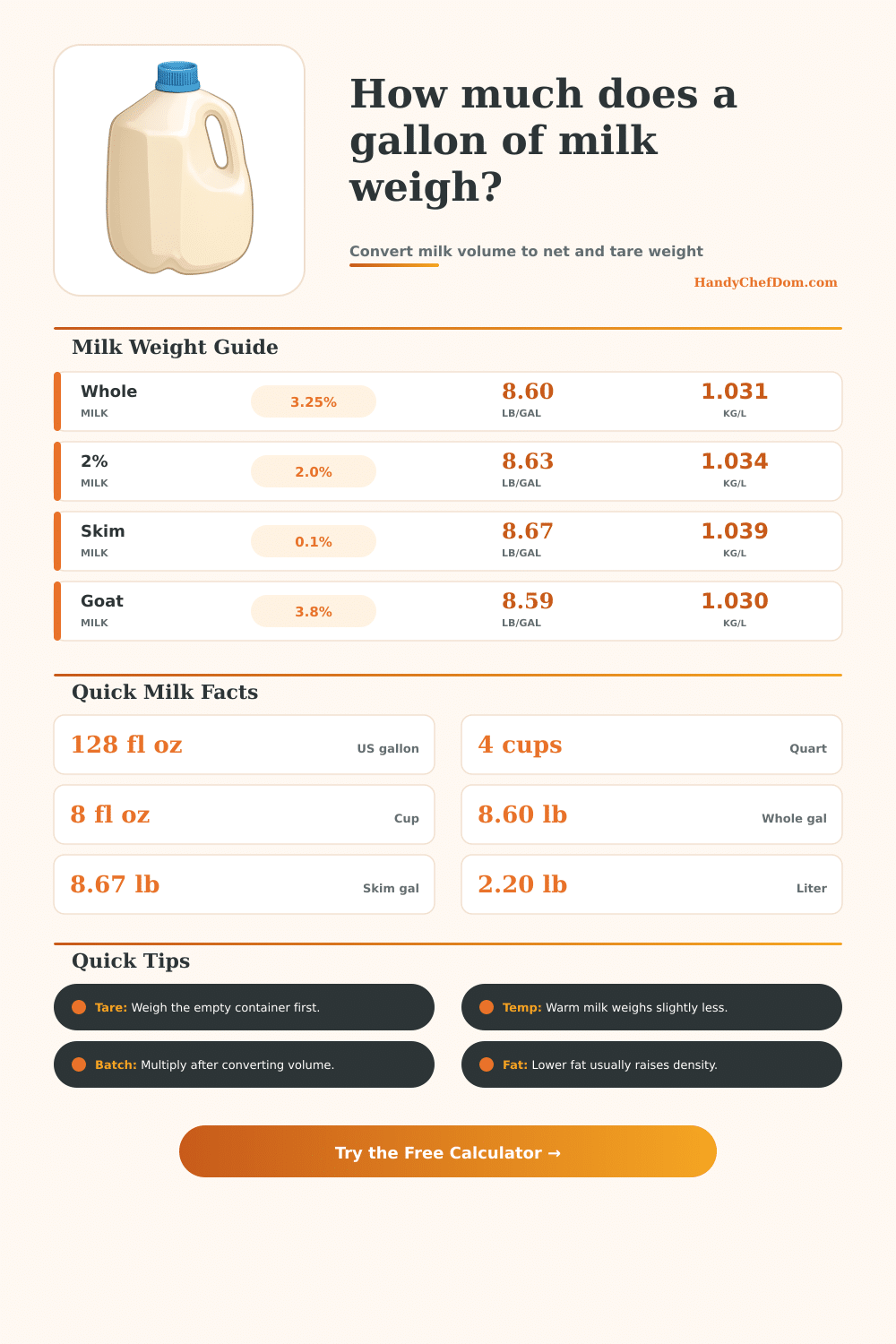
| Milk type | Typical fat | Density kg/L at 20C | Approx lb/gal |
|---|---|---|---|
| Whole cow milk | 3.25% | 1.031 | 8.60 |
| Reduced-fat 2% milk | 2.00% | 1.034 | 8.63 |
| Low-fat 1% milk | 1.00% | 1.036 | 8.64 |
| Skim milk | 0.10% | 1.039 | 8.67 |
| Cultured buttermilk | 1.00% | 1.034 | 8.63 |
| Goat milk | 3.80% | 1.030 | 8.59 |
| Evaporated milk | 6.50% | 1.066 | 8.89 |
| Half-and-half dairy | 11.00% | 1.020 | 8.51 |
| Volume unit | US gallons | US cups | Liters |
|---|---|---|---|
| 1 US gallon | 1.0000 | 16 | 3.7854 |
| 1 US quart | 0.2500 | 4 | 0.9464 |
| 1 US cup | 0.0625 | 1 | 0.2366 |
| 1 US fluid ounce | 0.0078 | 0.125 | 0.0296 |
| 1 liter | 0.2642 | 4.2268 | 1.0000 |
| 1 milliliter | 0.000264 | 0.00423 | 0.0010 |
| Temperature point | Temperature C | Density change | Weight effect |
|---|---|---|---|
| Cold fridge milk | 4C | About +0.0038 kg/L | Slightly heavier |
| Cool prep counter | 10C | About +0.0024 kg/L | Small increase |
| Reference point | 20C | 0.0000 kg/L | Profile density |
| Warm kitchen milk | 30C | About -0.0024 kg/L | Small decrease |
| Steamed milk prep | 60C | About -0.0096 kg/L | Lower density |
| Hot dairy mix | 75C | About -0.0132 kg/L | Use exact tare |
| Container | Common fill | Typical tare | Whole milk gross |
|---|---|---|---|
| Plastic gallon jug | 1 gallon | 0.13 lb | About 8.73 lb |
| Paper half-gallon carton | 0.5 gallon | 0.08 lb | About 4.38 lb |
| Paper quart carton | 1 quart | 0.04 lb | About 2.19 lb |
| Glass quart bottle | 1 quart | 1.00 lb | About 3.15 lb |
| Stainless dairy can | 5 gallons | 7.00 lb | About 50.0 lb |
| Mixing pitcher | 2 quarts | 0.75 lb | About 5.05 lb |
Milk weight is an important measurement for many peoples. The weight of the milk will determine how much effort you will have to use when you are carrying the milk, as well as how much space you will have to reserve for the milk. The weight of milk isnt a constant measurement for all individuals.
The weight of milk can change based off the fat content of the milk, as well as the temperature at which the milk is measured. For instance, milk with a lower fat content than other milk will contain more water per volume of that milk. Because water is more dens than fat, milk with lower fat content will weigh more than milk with higher fat content.
How to Measure the Weight of Milk
Additionally, the weight of milk can also change with the temperature of the milk. Milk that is measured at a colder temperature will weigh more than milk that is measured at a higher temperature. Thus, because the density of the milk can change, the weight of that milk will change with the density of that milk.
One way to calculate the weight of the milk is to use a volume to weight conversion tool. Conversion tools allow individuals to select the type of milk that they is using. Additionally, the conversion tool can ask for the fat percentage of the milk.
Once the individual has selected the type of milk and the fat percentage of that milk, the tool will ask for the volume of the milk that will be measured for its weight. The tool will provide the weight of the milk to the individual, as well as the gross weight of that milk. The gross weight is the weight of the milk and its container.
The weight of the container is referred to as the tare weight. This weight must be accounted for in order to determine the total weight of the milk and container. Containers of plastic milk jugs will have a small tare weight.
However, milk that comes in glass bottle or stainless steel cans will have a higher tare weight. If you dont account for the tare weight, then the total weight of the milk will not accurate reflect the true weight of that milk. Thus, the tare weight must be accounted for in the volume to weight conversion tool.
The accurate weight of the milk and container is another important measurement that must be known. The weight of the milk is important if the milk is to be moved, for example. The temperature of the milk will impact the accuracy of the milk measurements.
If milk is moved from one location to another, the density of the milk will change with the change in the temperature of the environment. The volume to weight conversion tool can account for this change. However, if the temperature of the milk is not accounted for, errors will accumulate in the weight measurements.
These errors in the measurement of the milk will become a problem in the management of large quantity of milk. Another reason to calculate the weight of the milk is for the batching of recipes that contain milk. When preparing recipes, the amount of milk that is needed for each recipe will be small.
However, when preparing many batches of that same recipe, the volume of milk that is required will be large. The batching function of the conversion tool will allow the individual to multiply the volume of the milk that will be used for the batches. The tool will then report the weight of the milk in the container and the weight of all of the milk that will be prepared for the batches.
This information can be used to determine how many trips are require to transport all of the milk that will be used for the batches. In order to accurately calculate the weight of the milk, a baseline can be established with the conversion tool. The variables in the real world are often not consistent.
For instance, milk may come in a range of temperatures. Additionally, various types of milk containers is used by suppliers of that milk. Some milk batches may contain different types of milk than others.
Thus, the baseline that is established through the conversion tool is a start, but the weight of the milk can be verified on a scale. The weight of milk can be verified on a scale to ensure that the conversion tool is correctly calculating the weight of the milk. By calculating the weight of the milk, rather than guessing the weight of the milk, individuals will be able to make more better plans for their shopping for milk and the storage of that milk.
Additionally, individuals will understand how different types of containers will change the weight of the milk. Other factors that will be understood are the effect that the volume of milk will have upon the strain upon an individual’s arms. Knowing the weight of the milk will allow the individual to better plan their shelf space for milk, and to avoid the problems of purchasing too much or to little milk.
Thus, the ability to translate the volume measurements of milk to its weight will allow individuals to make certain decisions regarding the storage and transport of milk.