🍋 Limes Carb Calculator
Estimate total carbs, net carbs, fiber, lime count, juice, zest, wedges, edible yield, and per-serving lime carbohydrates for drinks, marinades, dressings, and recipes.
Use count mode for whole limes, juice mode for measured tablespoons or cups, wedge mode for garnishes, and combined mode when a recipe uses lime juice plus zest.
| Lime Form | Typical Amount | Total Carbs | Fiber |
|---|---|---|---|
| Key lime, edible portion | 1 small lime, about 44 g | 3.7 g | 1.0 g |
| Small grocery lime | 1 small lime, about 55 g | 5.8 g | 1.6 g |
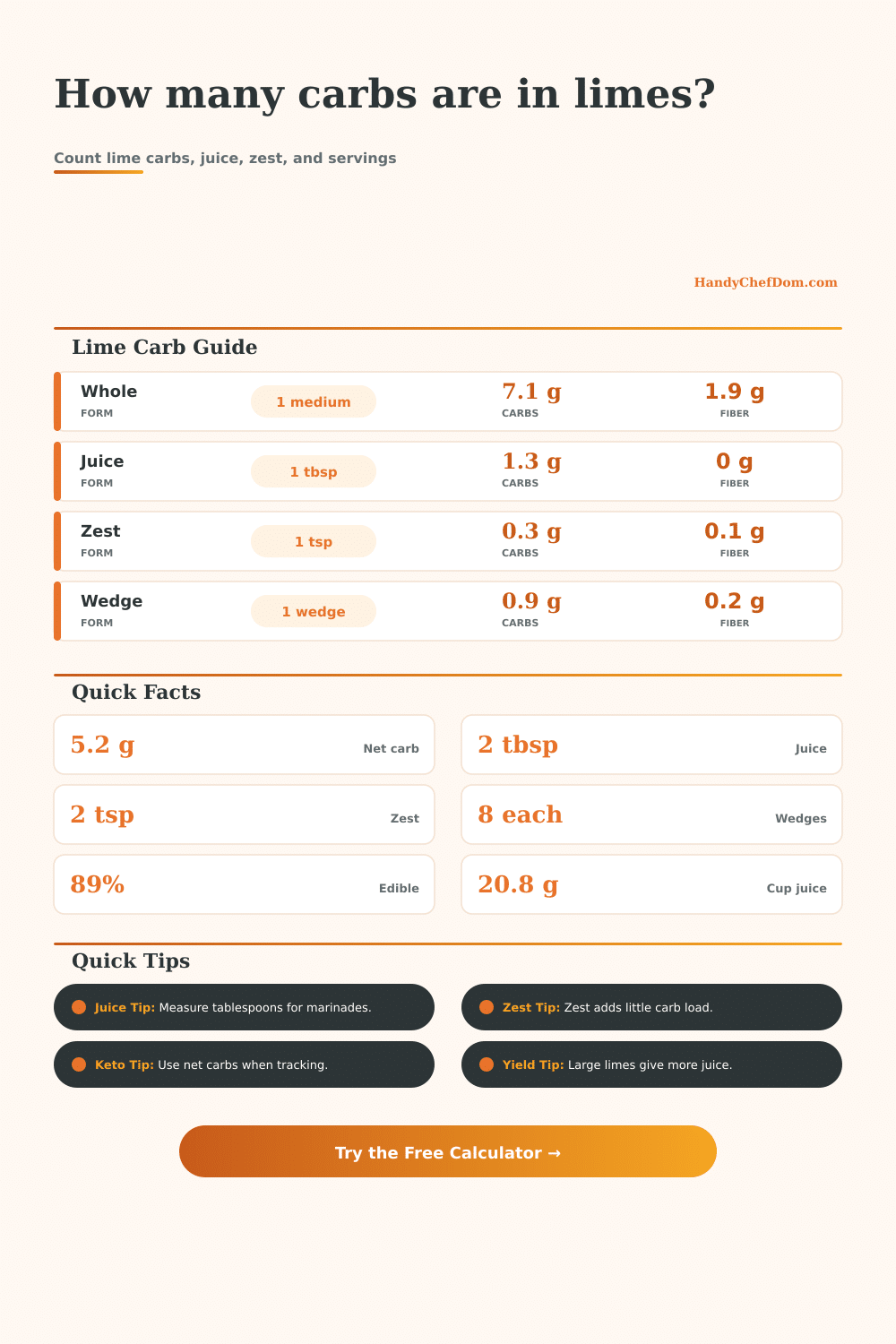
| Persian lime, medium | 1 medium lime, about 67 g | 7.1 g | 1.9 g |
| Large grocery lime | 1 large lime, about 100 g | 10.6 g | 2.8 g |
| Fresh lime juice | 1 tablespoon, 15 ml | 1.3 g | 0 g |
| Fresh lime zest | 1 teaspoon, about 2 g | 0.3 g | 0.1 g |
| Lime Size | Whole Weight | Juice Yield | Zest Yield |
|---|---|---|---|
| Key lime | 0.9 to 1.3 oz | 1 to 2 tsp juice | 1/2 to 1 tsp zest |
| Small lime | 1.5 to 2 oz | 1 to 1.5 tbsp juice | 1 to 1.5 tsp zest |
| Medium Persian lime | 2 to 2.5 oz | 2 tbsp juice | 2 tsp zest |
| Large lime | 3 to 4 oz | 3 tbsp juice | 2.5 to 3 tsp zest |
| Very juicy lime | 3.5 oz or more | 3 to 4 tbsp juice | 3 tsp zest |
| Dry older lime | Any size | 25% less juice | Normal zest yield |
| Recipe Use | Common Lime Amount | Carb Tracking Method | Serving Note |
|---|---|---|---|
| Water or sparkling drink | 1 wedge or 1 tbsp juice | Track juice if squeezed fully | Often under 1.5 g total carbs |
| Guacamole or salsa | 1 to 2 tbsp juice | Divide by servings | Carbs spread across the bowl |
| Marinade or sauce | 2 to 6 tbsp juice | Use consumed portion | Use light adjustment if drained |
| Ceviche or salad | 1/4 to 1/2 cup juice | Track all juice | Acid stays in the final dish |
| Dessert filling | 1/4 to 1 cup juice | Track juice plus zest | Divide across finished slices |
| Taco garnish tray | 1 wedge per taco | Use wedge count | Not every wedge may be eaten |
| Measured Quantity | Fresh Lime Equivalent | Total Carbs | Net Carbs |
|---|---|---|---|
| 1 teaspoon juice | About 1/6 medium lime | 0.4 g | 0.4 g |
| 1 tablespoon juice | About 1/2 medium lime | 1.3 g | 1.3 g |
| 2 tablespoons juice | About 1 medium lime | 2.6 g | 2.6 g |
| 1/4 cup juice | About 2 medium limes | 5.2 g | 5.2 g |
| 1/2 cup juice | About 4 medium limes | 10.4 g | 10.4 g |
| 1 cup juice | About 8 medium limes | 20.8 g | 20.8 g |
Sometimes, you’re three ingredients into a low-carb meal and there’s a wedge of lime sitting on the counter, and then you realize: “How much of a carb is this?” Sound familiar? I see it all the time. You have a hunk of avocado that needs cutting with some bright acid, or a light vinaigrette that could use something to boost its brightness. But you’re watching your numbers, and you don’t need more than your allotted carb count for the day.
Here’s the issue: Limes can vary greatly from one to the next. Some will be dry; others, juicy. It’s a gamble, and it’s risky business if you’re counting your carbs.
Why Use a Lime Carb Calculator?
To make all this work, you just enter your parameters into calculator (the one up top). It does conversions for you so you don’t have to know them. You don’t need to remember how many grams of carbs is in a teaspoon of zest compared to a tablespoon of juice.
The tool lets you choose whether you are counting whole fruits, measuring liquid by the cup, or simply tossing in a few wedges for garnish. And since real-life cooking rarely happens with equal and precise portions, the options let you be flexible: Are you measuring the liquid by cups? Or are you throwing a couple of the wedges into a stew for decoration? The tool lets you choose whether you are counting whole fruits, measuring liquid by the cup, or simply tossing in a few wedges for garnish.
Whatever your process, the inputs gives you some room to represent that instead of locking you into exact servings that aren’t really close to what’ll wind up on your plate anyhow.
The zest and the pulp: Most folks underestimate how much carb load comes from these two parts. Lime juice isn’t just acidity; it’s got some naturaly sugars, which can really add up if you’re juicing limes for a big batch of marinade or vinaigrette. Zest brings in all the flavor while contributing almost zero carbs. A teaspoon of zest will have little-to-no impact on your overall carb count for the day. Use it liberally for that zesty kick, without the sugar, and you’re good to go. It is a small detail, but it makes a huge difference in seasoning.
That’s another thing making it tricky. Different limes aren’t all equally productive. One big Persian lime from the supermarket has far more juice; and therefore also more carbs, then a small, fragrant key lime. When you’re making a pie with key limes, for instance, you may need to use more fruit to reach a certain level of liquid. This can throw your carb count off if you’re simply tallying up the number of “limes.” To help close this divide between fantasy-recipe and reality, the tool allows you to specify both size and variety. That way, you’ll account for any variances in moisture and density from fruit to fruit. It is about being precise in the real world, not with fantasy recipes.
The other variable is fiber. If you’re on some sort of dietary plan (such as a low-carb diet), then total carbs minus fiber equals net carbs. But since you remove most of the fiber by squeezing and straining your lime juice, the juice has a higher net carb impact relative to its total carbs compared to eating fruit whole. The juice have a greater net carb impact compared to its total carbs.
To address this, the calculator splits out these two numbers so you can view both sides. You might track total carbs for general awareness, or net carbs if you’re going for stricter tracking. When you have a tight limit in mind, this difference can make a big difference.
So in the end, it’s not so much a matter of strict counts but rather just knowing where the carb sugar might be lurking. Whether you’re whipping up a fancy dessert or a simple salad dressing, knowing the carb origin allows for better decisions. Is this lime bright enough for this dish to justify its carb cost? Is it in balance? Are you aware? Knowing what you’ve got gives you control over the lime. It is no longer a mysterious ingredient, but one squeezed knowingly into the pot, with each drop adding precisely what you want. Should of used more zest!