Spinach Magnesium Calculator
Estimate magnesium from raw leaves, cooked spinach, frozen spinach, cups, grams, servings, or package yield using USDA-style food data.
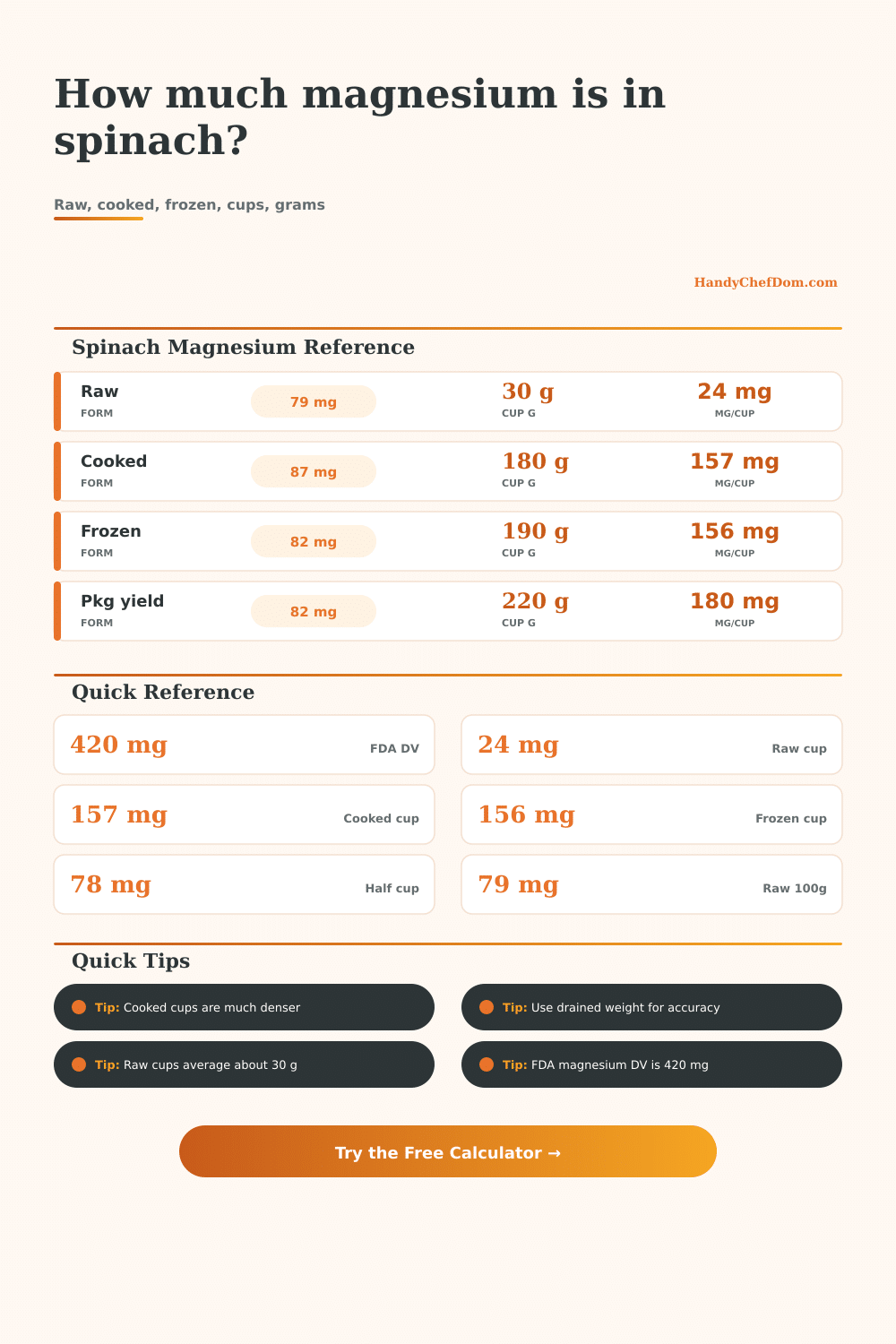
| Spinach Form | Magnesium | Typical Measure | Mg Per Measure |
|---|---|---|---|
| Raw fresh spinach | 79 mg per 100 g | 1 raw cup, 30 g | 23.7 mg |
| Raw baby spinach | 79 mg per 100 g | 1 loose cup, 30 g | 23.7 mg |
| Raw packed spinach | 79 mg per 100 g | 1 packed cup, 45 g | 35.6 mg |
| Cooked boiled drained | 87 mg per 100 g | 1 cooked cup, 180 g | 156.6 mg |
| Cooked half-cup side | 87 mg per 100 g | 1/2 cooked cup, 90 g | 78.3 mg |
| Frozen cooked drained | 82 mg per 100 g | 1 cooked cup, 190 g | 155.8 mg |
| Frozen half-cup side | 82 mg per 100 g | 1/2 cooked cup, 95 g | 77.9 mg |
| Frozen 10 oz package yield | 82 mg per 100 g | 220 g cooked yield | 180.4 mg |
| Measurement | Grams Used | Best For | Calculator Basis |
|---|---|---|---|
| 1 raw loose cup | 30 g | Salads, smoothies | Raw cup |
| 1 raw packed cup | 45 g | Pressed leaves | Packed raw cup |
| 1 cooked cup | 180 g | Boiled drained spinach | Cooked cup |
| 1 cooked half-cup | 90 g | Side portions | Cooked half-cup |
| 1 frozen cooked cup | 190 g | Thawed cooked spinach | Frozen cup |
| 1 frozen cooked half-cup | 95 g | Frozen serving | Frozen half-cup |
| 10 oz package yield | 220 g | Cooked drained frozen package | Package yield |
| Reference Group | Daily Amount | Cooked Cups To Reach | Raw Cups To Reach |
|---|---|---|---|
| FDA Daily Value | 420 mg | 2.7 cups | 17.7 cups |
| Adult men | 400-420 mg | 2.6-2.7 cups | 16.9-17.7 cups |
| Adult women | 310-320 mg | 2.0 cups | 13.1-13.5 cups |
| Teen boys | 410 mg | 2.6 cups | 17.3 cups |
| Teen girls | 360 mg | 2.3 cups | 15.2 cups |
| Children 9-13 | 240 mg | 1.5 cups | 10.1 cups |
| Data Point | Value Used | Reference Type | Calculator Use |
|---|---|---|---|
| Raw spinach magnesium | 79 mg per 100 g | USDA FoodData Central | Raw grams and cups |
| Cooked spinach magnesium | 87 mg per 100 g | USDA FoodData Central | Cooked grams and cups |
| Frozen cooked spinach | 82 mg per 100 g | USDA FoodData Central | Frozen portions |
| FDA Daily Value | 420 mg | FDA Nutrition Facts Label | %DV card |
| Adult recommended amount | 310-420 mg | NIH ODS magnesium fact sheet | Target selector |
| High source guide | 20% DV or more | FDA %DV guidance | Result interpretation |
Maybe you’re aware: spinach is healthy food. It’s cheap, leafy green goodness perfect for a saute pan or blender. But when you see nutrition information online, it doesn’t necessarly show what actualy lands on your dinner table.
Here, we have a before-and-after snapshot of cooked versus uncooked spinach. The cooked version pack the nutrients into a smaller space, or density. This multiplies the amount of magnesium present by a factor of 6 or more. Use our calculator (above) to get the math done for whatever serving size you choose. You won’t have to guess how many minerals is in that smoothie.
Why Cooked Spininsh Is Better For You
For example: Magnesium helps regulate blood pressure, aids in nerve signaling, and supports muscle function. The FDA’s daily reference value is 420 milligrams for adults. Put that in perspective. That number feels abstract until you translate it into actual food. Take raw spinach. One loose cup have approximately 24 milligrams of magnesium, weighing roughly 30 grams. So you’d have to consume almost eighteen cups of raw salad each day just to hit your target. It is hardly something most people can eat during a single meal.
But cooking also alters nutrition pretty massively. Boiling or steaming makes spinach wilt dramaticly. Leaves collapse; water exits the cells. Boiled or steamed spinach is around 180 grams per cooked cup. There are approximately 157 milligrams of magnesium in that cooked cup. That’s enough to get nearly half way to meeting your day’s needs with only two cups cooked.
To account for this change in weight, the calculator allows you to select whether you’re eating spinach raw, cooked or frozen, adjusting the underlying density to match real life. The way I use it: Cooking changes the weight of fresh ingredients, but frozen foods like spinach also behave differently in your kitchen because they are often sold by volume and yield by weight after cooking and draining. When shopping for frozen bags, most is sold by volume. However, they weigh out by weight once drained and cooked. So a 10-ounce package cooks down to roughly 220 grams of cooked spinach. This translates into roughly 180 milligrams of magnesium. This is enough to pack into a sauce or quiche or lasagna, but doesn’t add huge bulk to your belly. In other words, one bag contains a concentrated dose.
The tool asks you to specify package yield to close the gap between what’s on sale at the grocery store and what ends up inside your body. In most diets, consistency is more important than precision. Most of us don’t weigh our greens on the kitchen scale with each meal; we don’t keep one out to remind ourselves. Knowing the ballpark though can help you strike a better balance between meals. Someone who eats primarily raw salads probably gets much lower levels of magnesium then a person who regularly steams some greens.
That’s illustrated nicely in the reference tables that come with the calculator. These tables shows that cooked foods have more nutrients per unit volume because water weight falls out of the picture. Hydration also plays a role in mineral levels. Soils where spinach is grown vary greatly in their mineral composition. Even among soils with similar compositions, harvest time, rainfall, and how it was grown (farming practices) affect the resulting nutrient content. These figures are averages from the USDA for typical conditions. In your bag, there may be a bit less magnesium than this; but the percentage of change will still hold true. Whether you use freshly-picked market spinach, or frozen stock, cooking will concentrate whatever nutrients is present.
This part is all about knowing what you’re measuring. When it comes to leafy greens, volume is a misleading measure. Weight is not. Depending on how you will be cooking with the ingredient, the app lets you toggle between grams or cup measures so the tool knows what you want to track. Use the weight input if you plan to do some meal prep and weigh your food. Stick to the volume presets if you’re eyeballing portion sizes with a normal cup measuring device. Either way, based off what you put into the app, it will let you know where you are relative to your daily target.
Eating only processed food leaves you far short of the magnesium you need. When you mill out whole grains, most of those minerals go with it. One of the remaining top options in nature is dark leafy greens. It’s okay if you hate spinach (though why would you?!), but this applies to many other green things too. Chard, kale, and collards all has different densities, but the concepts still apply to all of them. I used spinach because it wilts consistently.
For those who are efficient: Cook your greens! While raw leaves work wonders for volume and crunch, cooking (or even freezing) them will give you even more magnesium per bite. Use the calculator to get a clear picture of just how many servings it’ll take to close the gap. Now that you’ve got the math down, no more guesswork… Let’s eat with intent. Your body would of thanked you for adding more minerals to the mix.