🥩 Meatball Calorie Calculator
Estimate calories, protein, fat, and sodium from meatball count, meatball size, cooked weight, meat blend, sauce, and serving style.
Use count and size for quick estimates, or switch to cooked weight when the batch has already been weighed. Sauce is calculated separately so sauced and plain meatballs stay distinct.
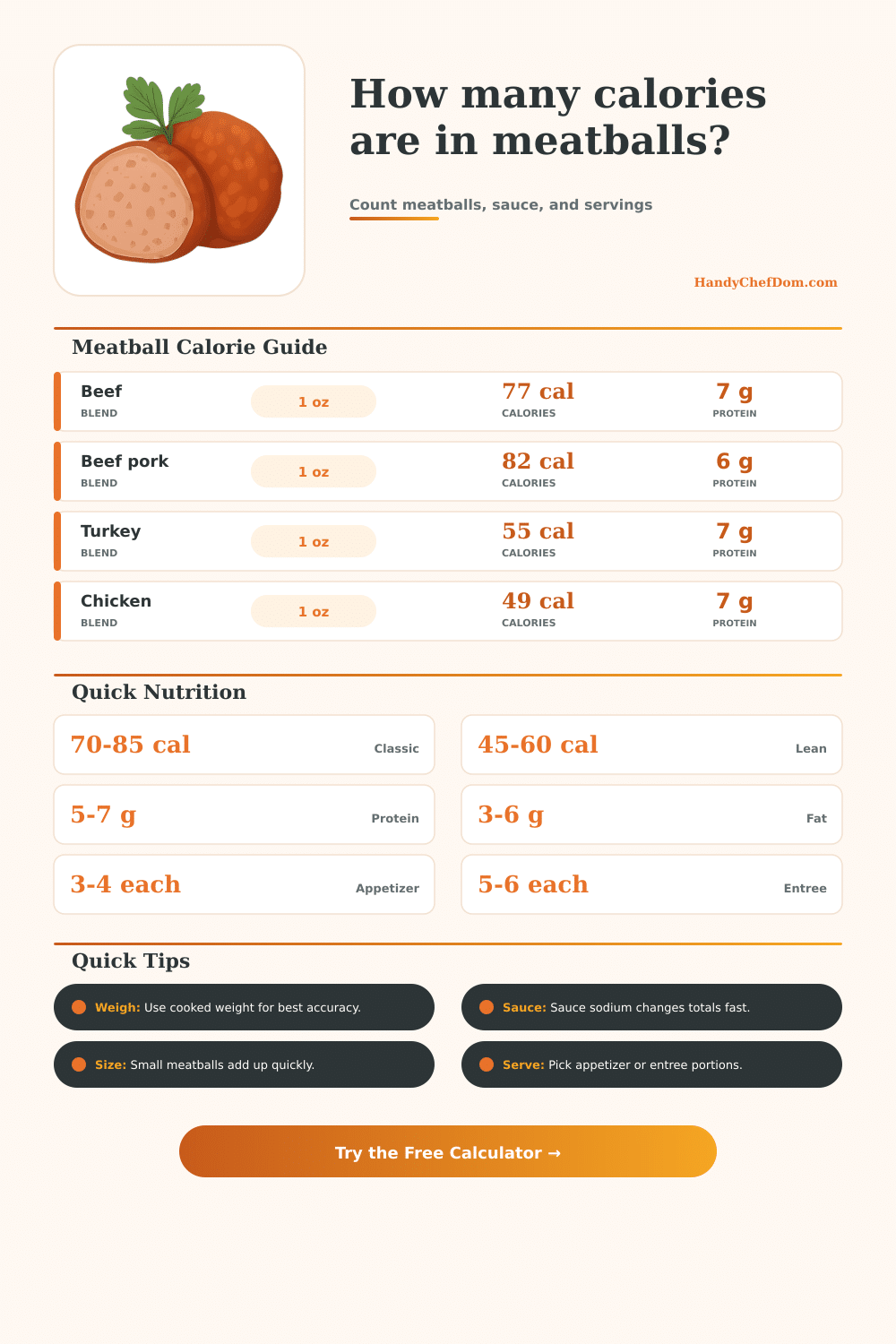
| Meat blend | Calories per oz | Protein per oz | Fat per oz | Sodium per oz |
|---|---|---|---|---|
| Lean beef meatballs | 77 kcal | 7.2 g | 4.8 g | 66 mg |
| Beef and pork blend | 82 kcal | 6.4 g | 5.8 g | 72 mg |
| Italian beef blend | 86 kcal | 6.5 g | 6.0 g | 83 mg |
| Turkey meatballs | 55 kcal | 7.4 g | 2.3 g | 68 mg |
| Chicken meatballs | 49 kcal | 7.0 g | 1.9 g | 62 mg |
| Swedish style blend | 80 kcal | 6.1 g | 5.4 g | 90 mg |
| Lamb meatballs | 89 kcal | 6.2 g | 6.8 g | 70 mg |
| Plant based meatballs | 62 kcal | 5.6 g | 3.2 g | 112 mg |
| Sauce option | Calories each | Protein each | Fat each | Sodium each |
|---|---|---|---|---|
| No sauce | 0 kcal | 0 g | 0 g | 0 mg |
| Marinara coating | 8 kcal | 0.3 g | 0.2 g | 55 mg |
| BBQ glaze | 15 kcal | 0.1 g | 0 g | 70 mg |
| Teriyaki glaze | 14 kcal | 0.2 g | 0 g | 120 mg |
| Swedish cream sauce | 18 kcal | 0.3 g | 1.4 g | 65 mg |
| Buffalo sauce | 7 kcal | 0 g | 0.5 g | 135 mg |
| Brown gravy | 12 kcal | 0.2 g | 0.6 g | 95 mg |
| Serving style | Meatballs each | Best for | Portion note | Count example |
|---|---|---|---|---|
| Tasting portions | 2 | Small bites | Light sample | 24 makes 12 |
| Appetizer servings | 3.5 | Party tray | Shared plate | 28 makes 8 |
| Meal prep servings | 4.5 | Lunch bowls | Moderate | 18 makes 4 |
| Entree servings | 5.5 | Dinner plate | Hearty main | 22 makes 4 |
| Meatball size | Cooked oz each | Cooked g each | Common count | Nutrition effect |
|---|---|---|---|---|
| Cocktail mini | 0.5 oz | 14 g | 3 to 5 bites | Low each |
| Small | 0.75 oz | 21 g | 3 to 4 bites | Moderate |
| Classic | 1.25 oz | 35 g | 4 to 6 bites | Standard |
| Large | 2 oz | 57 g | 2 to 3 bites | Higher each |
| Jumbo | 3 oz | 85 g | 1 to 2 bites | Meal sized |
Meatballs are a complicated part of our everyday diet. For most, they’re just some protein block. But they can differ greatly. They depend on what type of meat go into them, how much salt is snuck in the sauce, and how big or small the portion are. Depending on whether you ate 12 tiny appetizer-sized bites out of the same pot or three large dinner portions, that’s a massive difference in calories.
When you enter all of your own variables into the calculator, math gets done for you, no need to guess at conversions, no more inaccurate tracking.
Understanding Meatball Calories
Start with the protein. How lean? Is there a lot of fat marbling? Rich Italian sausage and pork blends will increase calorie count, due to added fat. If calories is important to you, poultry makes a big impact. Chicken and turkey meatballs keeps protein content high, which is good, but they also drops the total number of calories, which is even better. Check the chart below (on page) for a clear breakdown of each protein choice and how many calories they provides.
This isn’t about deprivation; it’s about making food choices that support your goals.
Sauce is also a silent killer for meatballs’ nutritional value: A light marinara covering doesn’t add many calories, but contributes to sodium, which quickly stacks up. Sweet BBQ glaze or heavy cream will contribute fat and sugar (with little nutritional benefit). When people log their meal, it’s easy to forget about the sauce. They figure the meat do all the work! This tool separates out the contribution of the meat versus the sauce, helping you understand where you’re getting your nutrition. Knowing how caloric or salty a serving is lets you adjust your day to match (for example, avoiding salt shakers on your side dish).
Ingredient selection is only one part of the equation; portion size are equally important. Cocktail-sized meatballs can be eaten without thought and, before you know it, you’ve downed a plate’s-worth of protein and fat. The calculator also allows for defining portions by context: How many meatballs do you plan to serve per person? Maybe a few on a tray as an appetizer? Or 10+ on a hearty dinner plate? The calculator eliminates the temptation to treat small bites like “free” food (because), while they’re packed with nutrition, they aren’t zero calories. Going from “balls” to “total cooked batch” weight erases all guesswork.
Homemade meatballs comes in every possible size and density, which makes weighing far more accurate than counting. However, there’s another element of this which everyone forgets: how you cook the thing. Simmered and fried food will tend to hold onto liquid fats surrounding the meatballs; roasting will render out most of the fat. Does your batch gets served up with the accumulated juice around it, or does it get drained? Take that into consideration when using the tool as a meal-prep planner.
And those little adjustments are accounted for in the calculator through a confidence buffer setting, one which gives wiggle room for imperfect precision from your kitchen scale. It is just enough to make the data seem realistic, instead of strictly theoretical. It is a tiny detail but it is still important.
At the end of the day, this all comes down to knowing the density of foods. You need to know what ingredients goes into a dish and how they will affect the dish as a whole. You need to know which pieces are worth more then others and when you hit your limit. Meatballs help you define clear serving limits, separate the sauce weight from the meat quality and take some of the variables out of this chaotic looking meal. When you know precisely what’s going into your bowl, you’re able to enjoy it free of guessworks mental overhead, and you begin to notice trends in eating behavior that would be impossible with just numbers alone.
Numbers aren’t restrictive; they provide clarity, and with those numbers nailed down, enjoying them becomes so much simpler.
You should of known meatball math is tricky. Making the data feel naturaly easy makes it better. It can be a luxurius experience when you know your totals. Actually, seeing how much fat is in sausages could of helped too.