Mirin Substitute Calculator
Replace mirin with cooking-wine, vinegar, and sweetener blends tuned for glaze thickness, marinade balance, noodle sauce brightness, and simmered dish depth using one consistent scaling model.
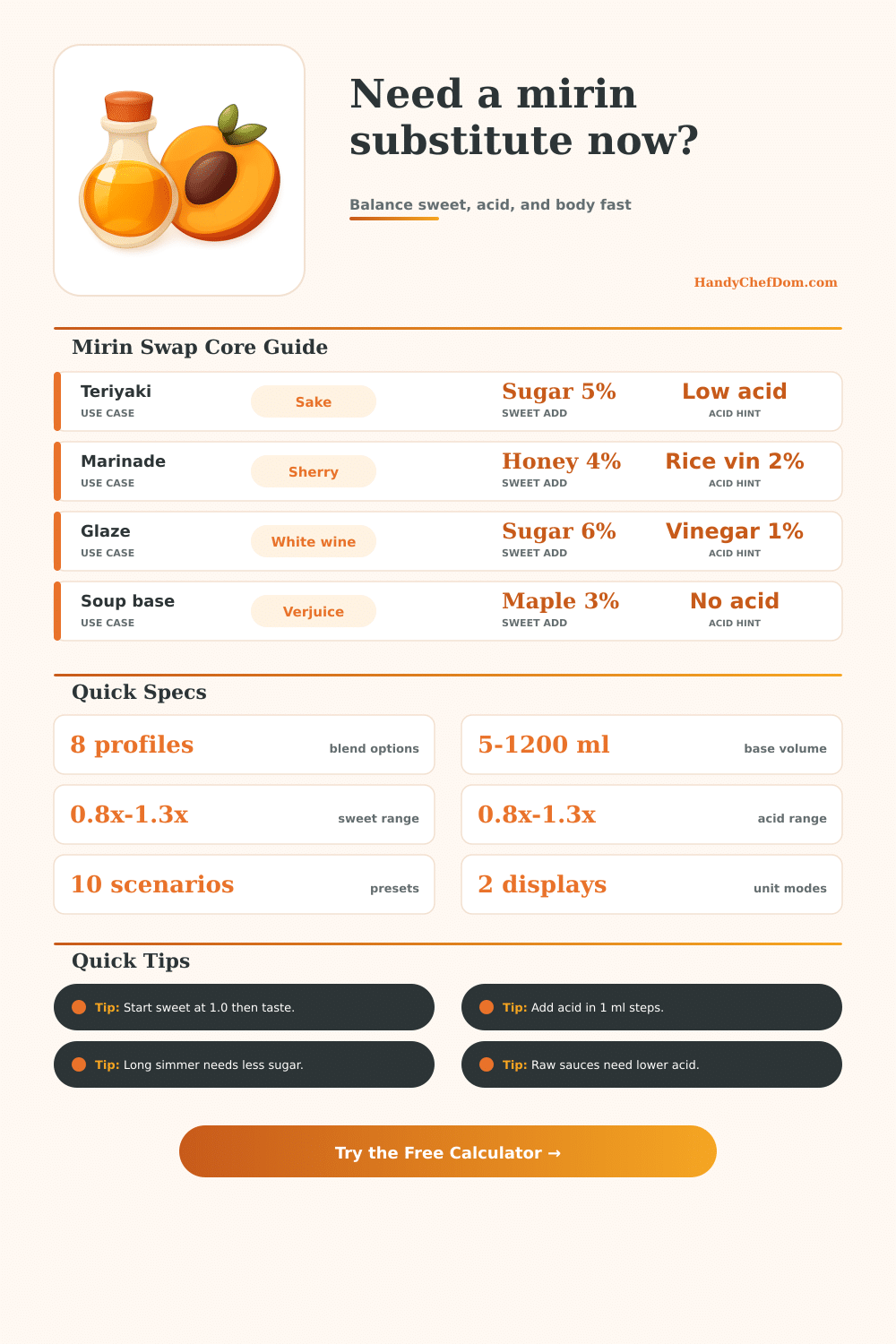
Choose the dish style first, then choose a substitute profile. The model balances sweet, acid, and umami support so your mirror glaze, pan sauce, or simmered broth stays closer to mirin behavior.
| Profile | Base share | Sweet share | Acid share |
|---|---|---|---|
| Sake + sugar | 80% | 14% | 6% |
| Dry sherry + honey | 78% | 15% | 7% |
| White wine + sugar | 79% | 13% | 8% |
| Rice vinegar + sugar + water | 46% | 18% | 16% |
| Dry vermouth + syrup | 74% | 16% | 10% |
| Cider vinegar + maple | 60% | 19% | 13% |
| White grape + vinegar | 66% | 22% | 12% |
| Stock + molasses + vinegar | 63% | 17% | 11% |
| Use case | Sweet need | Acid need | Body need |
|---|---|---|---|
| Teriyaki glaze | 1.20x | 0.90x | 1.10x |
| Protein marinade | 0.95x | 1.20x | 0.95x |
| Stir-fry sauce | 1.00x | 1.05x | 1.00x |
| Soup or broth | 0.85x | 0.90x | 1.15x |
| Dipping sauce | 1.10x | 1.10x | 0.90x |
| Braising liquid | 0.85x | 0.95x | 1.25x |
| Noodle tare | 1.15x | 1.00x | 1.05x |
| Quick pickle | 0.80x | 1.30x | 0.80x |
| Mirin target | Total blend range | Sweetener range | Acid range |
|---|---|---|---|
| 1 tbsp (15 ml) | 14 to 17 ml | 2 to 4 ml | 1 to 3 ml |
| 1/4 cup (60 ml) | 57 to 69 ml | 8 to 16 ml | 4 to 11 ml |
| 1/2 cup (120 ml) | 114 to 138 ml | 16 to 31 ml | 8 to 22 ml |
| 1 cup (240 ml) | 228 to 276 ml | 32 to 62 ml | 17 to 44 ml |
Mirin are a liquid that contains sweetness, acidity, and alcohol. Mirin is used in cooking because the sweetness, acidity, and alcohol in mirin all contribute to the develop of flavors in the dish. If chefs finds themself out of mirin, they can use a substitute for mirin.
However, the substitute for mirin might not contain the same elements of sweetness, acidity, and alcohol as mirin. The balance of sweetness, acidity, and alcohol is important for determining the behavior of sauces or glazes when heat. The calculator allow chefs who are out of mirin to select the type of dish they are creating and the profile of the substitute for mirin they wish to use.
How to Make a Mirin Substitute
The type of dish being create is important for determining the amount of sweetness and acidity that should be used in the substitute for mirin. For instance, teriyaki glazes requires alot of sweetness whereas quick pickles require lesser sugar and more acidity. Thus, choosing the correct type of dish is crucial to finding the proper ratio of sweetness and acidity for the substitute for mirin.
The profile for the substitute for mirin will determine the amount of alcohol and umami that will be contained in the substitute. For instance, one substitute profile that contain ingredients similar to mirin is sake and sugar. Another substitute profile is stock and molasses, which will substitute the alcohol component of mirin with umami and savoriness.
Lastly, grape juice and vinegar does not contains alcohol, which could be an important component of the dish, but can be used if the dish is being prepared for young child. The ratios for the substitute will be adjusted so that it taste the same as mirin. Sweetness and acidity must be balanced in a substitute for mirin.
If the sweetness is increased, the glaze will become more stickier. However, if the sweetness is increased in a marinade, the meat could end up tasting too sweet. If the acidity is increased, the dipping sauce will have more acidity, but increasing the acidity too much will make the sauce taste thinly.
The sweetness and acidity for the substitute will be adjusted according to the type of dish being created. The heat that will be applied to the sauce will affect the substitute for mirin. If the dish does not require long cooking times, the alcohol in the substitute will remain.
However, if the dish will be cooked for a long time, like a braise, the alcohol will evaporate from the substitute. The alcohol and body of the substitute can be adjusted in the calculator based off the amount of heat that will be applied to the dish. The reference tables shows the division of the total amount of the substitute for mirin into the base liquid, sweetener, and acid components.
Different types of dishes requires different amount of these components. For instance, noodle tare requires more sweetness and acidity. Braising liquid requires more body than sweetness because the braising liquid will be evaporated during cooking.
Common mistakes with mirin are using only sugar or honey instead of mirin. In this case, the sauce will taste flatly. Using the same amount of acid in all sauces is another mistake.
Marinades can contain more acid because the meat will buffer the acidity. However, glazes will contain lesser acid because the glaze will evaporate during cooking. Using the substitute for mirin calculator will allow chefs to find an appropriate starting point for the substitute.
However, chefs should always taste the sauce while cooking and adjust for differences in the ingredients. Ingredients like soy sauce or honey will contain different amounts of salt and sweetness than the substitute for mirin calculator assume. Thus, chefs should add extra acid or sugar to the sauce in small amount, as opposed to adding large amount of acid or sugar that could make the sauce too acidic or too sweet.
The goal is not to make a substitute for mirin that tastes like mirin, but instead to create a liquid that will make the dish taste complete. If the match scores for the substitute for mirin is high, then the flavor of the sauce will taste good. However, if the match scores are low, it means one component of the sauce are too strong, so chefs can taste the sauce and adjust the sweetness, acidity, or body of the sauce.