Lemon Vitamin C Calculator
Estimate vitamin C from lemon count, measured juice, peeled fruit weight, zest, serving size, and daily value targets.
| Source Item | Vitamin C Basis | Kitchen Amount | Calculator Use |
|---|---|---|---|
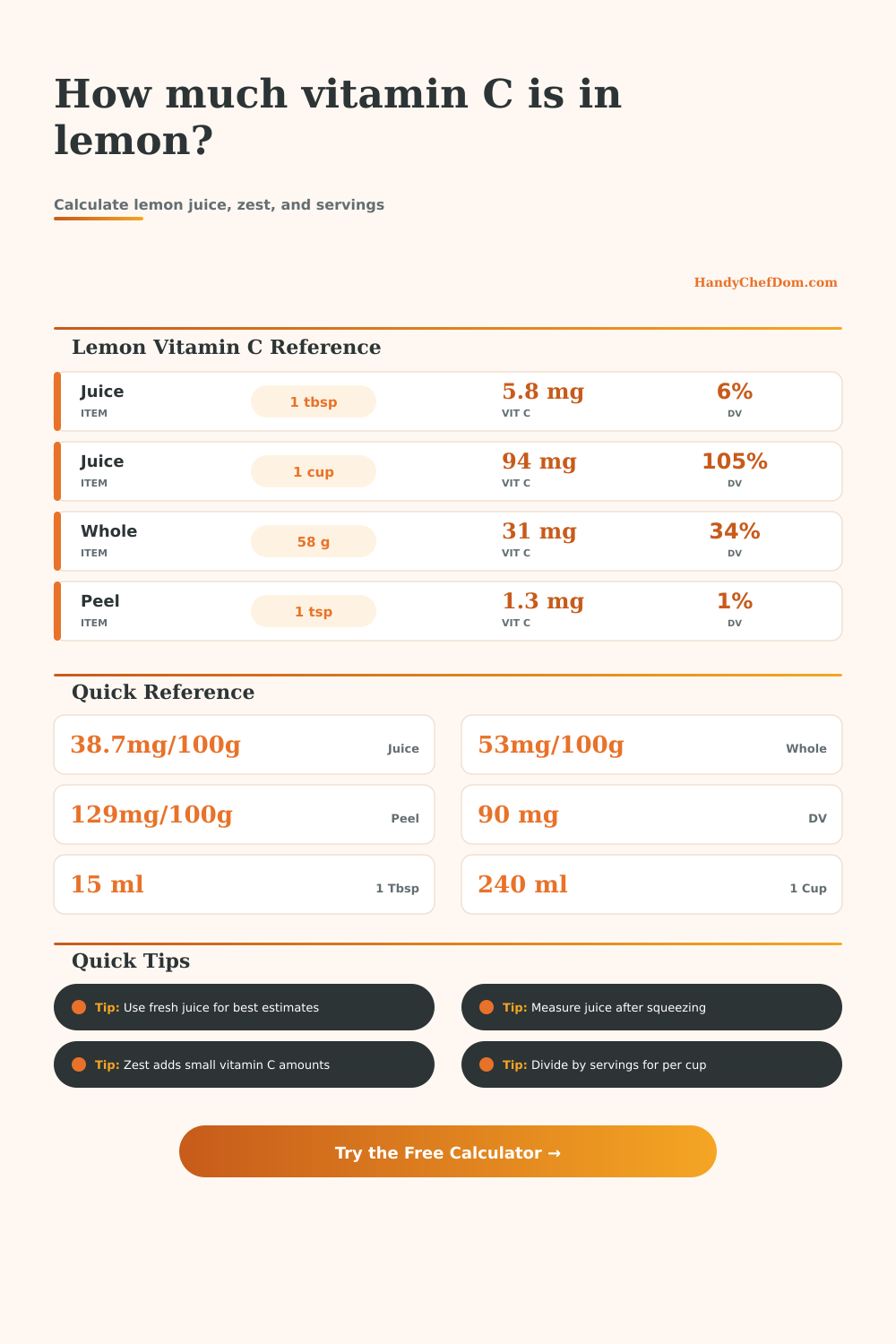
| Raw lemon juice | 38.7 mg per 100 g | About 5.8 mg per tbsp | Measured juice and lemon-count estimates |
| Peeled raw lemon | 53 mg per 100 g | About 31 mg per 58 g lemon | Whole peeled fruit or blended lemon |
| Raw lemon peel/zest | 129 mg per 100 g | About 1.3 mg per tsp | Small additions from fresh zest |
| Adult Daily Value | 90 mg per day | FDA label reference | Default percent DV calculation |
| Lemon Profile | Peeled Weight | Juice Yield | Zest Yield |
|---|---|---|---|
| Small lemon | 58 g | 30 ml | 3 g |
| Medium lemon | 84 g | 45 ml | 4 g |
| Large lemon | 108 g | 61 ml | 5 g |
| Meyer lemon | 76 g | 38 ml | 4 g |
| Thin-peel lemon | 90 g | 56 ml | 3 g |
| Amount | mL | Vitamin C | 90 mg DV |
|---|---|---|---|
| 1 teaspoon | 5 | 2.0 mg | 2% |
| 1 tablespoon | 15 | 5.8 mg | 6% |
| 2 tablespoons | 30 | 12.0 mg | 13% |
| 1/4 cup | 60 | 23.9 mg | 27% |
| 1/2 cup | 120 | 47.8 mg | 53% |
| 1 cup | 240 | 95.6 mg | 106% |
| Reference Group | Target | 1 Medium Juice | 1 Peeled Small Lemon |
|---|---|---|---|
| FDA adult Daily Value | 90 mg | 20% | 34% |
| NIH adult women RDA | 75 mg | 24% | 41% |
| NIH adult men RDA | 90 mg | 20% | 34% |
| NIH pregnancy RDA | 85 mg | 21% | 36% |
| NIH breastfeeding RDA | 120 mg | 15% | 26% |
| Scenario | Lemons | Juice | Zest | Total C | Per Serving | 90 mg DV |
|---|---|---|---|---|---|---|
| Tea splash | 0.3 | 15 ml | 0 g | 4.5 mg | 4.5 mg | 5% |
| One lemon water | 1.0 | 45 ml | 0 g | 17.9 mg | 17.9 mg | 20% |
| Two lemons juiced | 2.0 | 90 ml | 0 g | 35.9 mg | 17.9 mg | 40% |
| Salad dressing | 1.3 | 60 ml | 1 g | 25.2 mg | 6.3 mg | 28% |
| Family pitcher | 4.0 | 180 ml | 0 g | 66.0 mg | 11.0 mg | 73% |
| Meal prep bottle | 6.0 | 270 ml | 0 g | 91.5 mg | 9.1 mg | 102% |
| Zesty dessert | 2.0 | 45 ml | 8 g | 28.2 mg | 3.5 mg | 31% |
| Event batch | 18.0 | 810 ml | 0 g | 297.1 mg | 8.3 mg | 330% |
The next time you’re standing in the kitchen, staring at some slightly wrinkly-looking but not-quite-old lemons, you might wonder whether they’ll do anything for your health as ingredients for a salad dressing or other healthy tonic. Know this: Cooks is sometimes mistaken about how much different types of citrus contribute to our diets. A handful of lemons are not the same thing as a glassful of orange juice, but it isn’t quite that simple either.
Once you plug in your own yield, the calculator figures out the rest: It spares you from having to guess whether you’re getting as much fruit from those fruits as you believe you are. Most folks overestimate how much juice they’re getting from their fruit. They look at an entire lemon and assume all the vitamin C is in every squeeze, without accounting for weight of pith or peel. That’s where many folks go wrong.
Why Measuring Lemon Juice Is Important
While yes, the majority of the nutrition are in the flesh, the ratio of nutrients to flesh differs wildly depending on stage of ripeness and variety of fruit you’re working with. For example, Meyer lemons is softer and sweeter. Because of this, your measurements will differ in both concentration and volume different than standard hardier Eureka type found in most grocery stores.
The other variable here are freshness. Time, heat, exposure to air, these all diminish the stability of vitamin C. If you squeeze out a lemon immediately, you’ve retained almost all of its power. But if you leave that juice in a container without a lid on your counter for a day or two there will be some detectable loss. This degradation over time is taken into account by the tool, so instead of thinking your fruit remains in perfect condition indefinitely, you can dial it back based off how long it’s been sitting around. And when you want exact health levels, it matters. Perhaps yesterdays fresh-squeezed juice has lost power, down to just eighty-five percent; since you sliced it up.
But size does matter, more than we care to admit. While I estimate that there are maybe forty-five milliliters in a medium-sized lemon, a large one might be pushing sixty-plus. When making meals for the week, do not assume all lemons provides equal amounts of juice. If you do, your food will end up underseasoned or off track from its nutritional goal. The range is illustrated by reference tables on the page, which demonstrate how one cup of lemon juice contain over double the recommended daily amount for an adult. It’s a lot of nutrient density packed into a tiny fruit.
Zest gets counted as a garnish, but it deserves its own space. The peel’s not worth counting toward vitamin C because there isn’t nearly enough to make a real difference. However, counting it does helps you get a clearer sense of how much you’re eating. Sure, it’s primarily about taste; that’s why you add it, right? But by considering it, you’ll be less likely to fool yourself into thinking that all the value come from the inside of the fruit and none from the outside.
That’s where the per-serving math come in. How does it break down? Is a cup of lemon water equal to an ounce? Or is it a fraction of an ounce? Six ounces? More importantly, is it enough to meet whatever goal you’re shooting for? For example, you want 90 milligrams of Vitamin C today and drinking a whole pitcher of lemon water won’t get you there, you’d be consuming maybe 20% of your goal with this splash alone. So you would of have to drink more then just your morning lemon water to be confident you hit the mark.
All in all, though, lemons can be used for both health and cooking. They adds a bright note to perk up any dull dish, and they also work on your bodys immune support system. The key is to think of them as something you would measure rather than just throwing them into everything. With that perspective, it’s easier to get a feel for how much one lemon will provide to make better food decisions. You’ll know just how much of that tart oomph goes into whatever you’re serving, no more guesswork, and that makes even this most basic of staples a trusted tool in our everyday wellness collection.