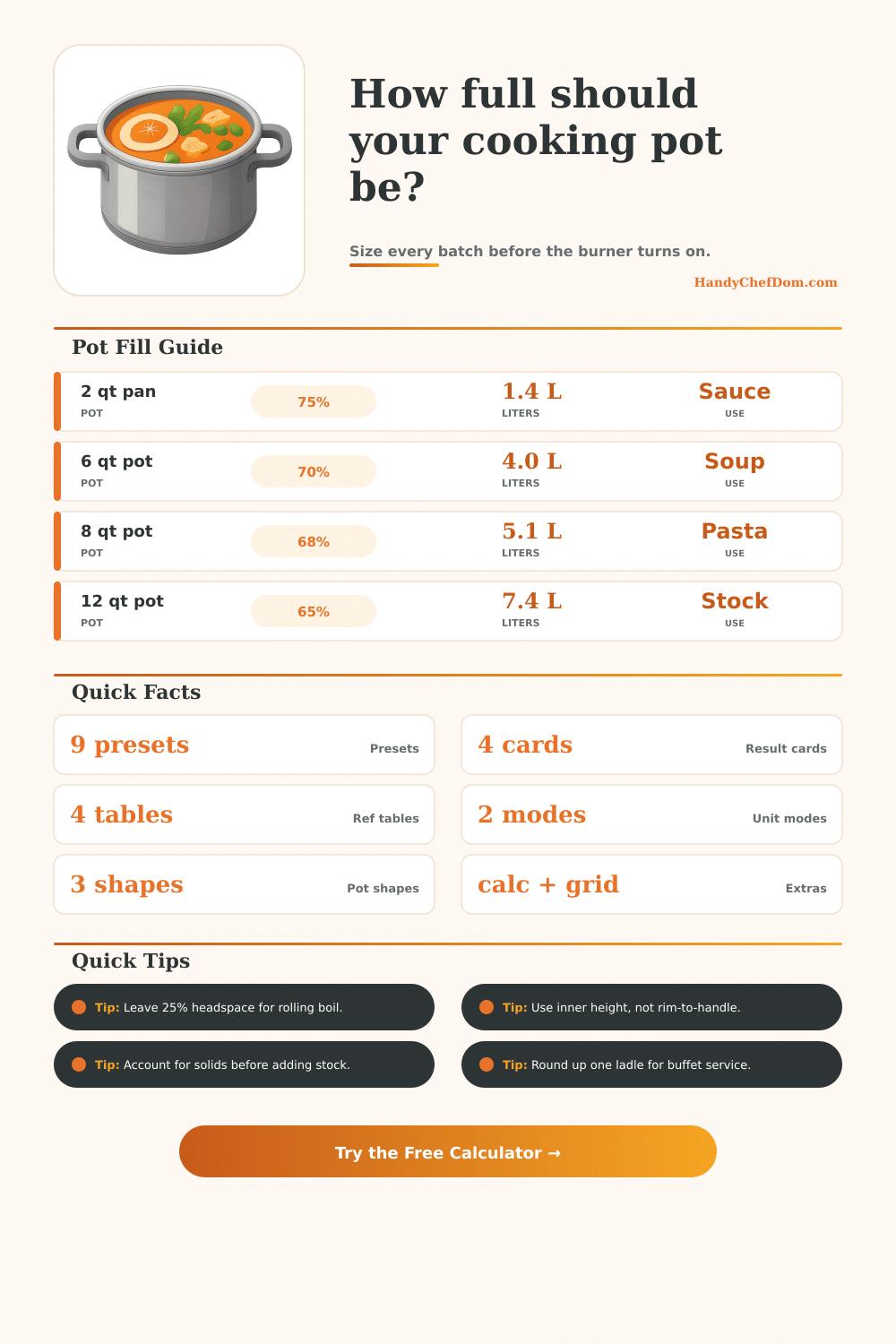
Cooking Pot Volume Calculator
Estimate safe, usable batch volume by pot geometry, headspace, and ingredient displacement so your stove stays clean and your servings stay predictable.
Frustum mode uses top and base diameters for tapered stockpots. Set simmer headspace and solids displacement to match soup, pasta, and stew behavior.
| Nominal size | Liters | Typical use | Servings cue |
|---|---|---|---|
| 2 qt | 1.9 L | Pan sauces | 2 to 4 |
| 3 qt | 2.8 L | Curry for two | 3 to 5 |
| 4 qt | 3.8 L | Weeknight soup | 4 to 6 |
| 6 qt | 5.7 L | Chili batch | 8 to 10 |
| 8 qt | 7.6 L | Pasta boil | 10 to 12 |
| 12 qt | 11.4 L | Bone broth | 14 to 18 |
| 16 qt | 15.1 L | Seafood boil | 18 to 24 |
| 20 qt | 18.9 L | Catering stock | 24 to 30 |
| Cooking task | Fill cap | Headspace | Why |
|---|---|---|---|
| Clear broth | 70-75% | 15-20% | Skim and stir |
| Pasta boil | 65-70% | 20-25% | Foam control |
| Beans/stews | 60-70% | 20-25% | Starch expansion |
| Jam making | 70% | 15-20% | Bubbling sugar |
| Milk soups | 55-65% | 25-30% | Fast frothing |
| Bone stock | 65-70% | 20% | Long simmer |
| Seafood boil | 60-65% | 25% | Add-in surges |
| Rice congee | 60-68% | 22-28% | Starch rise |
| Ladle | Milliliters | Cup approx | Best for |
|---|---|---|---|
| 2 oz | 60 ml | 1/4 cup | Sauce finish |
| 4 oz | 120 ml | 1/2 cup | Soup bowls |
| 6 oz | 180 ml | 3/4 cup | Stew service |
| 8 oz | 240 ml | 1 cup | Buffet line |
| 10 oz | 300 ml | 1 1/4 cup | Chowder |
| 12 oz | 360 ml | 1 1/2 cup | Hearty bowls |
| 16 oz | 475 ml | 2 cups | Meal prep tubs |
| 24 oz | 710 ml | 3 cups | Family shares |
| Unit | Equivalent | Kitchen cue | Exact note |
|---|---|---|---|
| 1 qt | 0.946 L | 4 cups | US liquid qt |
| 1 gal | 3.785 L | 4 qt | US gallon |
| 1 L | 1.057 qt | 4.23 cups | Metric liter |
| 1 cup | 236.6 ml | 8 fl oz | US cup |
| 1 fl oz | 29.57 ml | 2 tbsp | US fluid oz |
| 1 in3 | 16.39 ml | Cube inch | Volume bridge |
| 1000 ml | 1.0 L | Metric base | Standard SI |
| 231 in3 | 1 US gal | Pan geometry | Capacity check |
A pot have a maximum capacity and a functional capacity, but these two measurement is not the same. The manufacturer measure the maximum capacity by measuring the liquid volumes of the pot to the absolute brim of the pot. This represent teh theoretical maximum capacity that the manufacturer rate the pot at.
However, if a person measured the liquid volume of the pot to the brim, the liquid would spill over when heat were applied to the pot. Filling a pot to it’s theoretical maximum would cause the liquid to overflow the pot when the water molecules moved or when the water boiled. Therefore, a person must understands that the functional capacity of a pot will always be less than the theoretical capacity of that same pot.
Maximum and Functional Capacity of a Cooking Pot
The shape of the pot determine the maximum amount of liquid that the pot can hold. Many pots has a tapering shape such that the top of the pot is wider than the bottom of the pot. People can assume that the pot is in the shape of a cylinder to simplify cooking task.
However, the tapering of the pot change the way in which the volume of liquid is calculated for that pot. Using the formula for the volume of a cylinder will overestimate the volume of the liquid the pot can hold. This overestimation could eventually result in the liquid overflowing the pot.
Headspace is an empty space in the pot between the food in the pot and the rim of the pot. If the liquid in the cooking pot bubble violently or produces foam, more headspace is required. For example, any type of water that contain starchy food will produce foam that rise to the top of the cooking pot.
Any type of sugar-based liquid will also produce bubbles that rise in the pot. If there isnt enough headspace in the cooking pot, the liquid will overflow the cooking pot. Therefore, a person must adjust the amount of headspace according to the type of food being cooked.
Displacement is the process in which solid ingredient increase the volume of the liquid in the cooking pot. Solid ingredients such as carrots and beef will push the water level in the cooking pot to a higher measurement. If a person fills a cooking pot to 80% of its capacity with water and then adds solid ingredients to the pot, the solid ingredients will push the water level to a point where it overfills the cooking pot.
A person should of calculate the volume of the solid and liquid ingredients to ensure that the cooking pot does not overflow. The functional capacity of the cooking pot can be used to plan the portion of the food for a group of people. If a person know the functional capacity of a cooking pot, that person can calculate the number of serving of food that can be prepared.
This information can help a person to determine whether two cooking pots are needed to cook all of the food for the group of people or whether one cooking pot is sufficient. With this information, a person can also calculate how many milliliters of food each person will recieve from the cooking pot. Calculating the portion size of the food based off the functional capacity of the cooking pot allow for the recipe to be properly planned.
To accurately measure the capacity of the cooking pot, one must measure the inner dimensions of the cooking pot. The outside diameter of the cooking pot will include the metal thickness of the cooking pot and the flare of the cooking pots rim. Measuring the outside of the cooking pot is an incorrect measurement of the cooking pot’s capacity.
One must measure the inside wall of the cooking pot from inside wall to inside wall of the cooking pot. By measuring the inner dimensions of the cooking pot, the measurements of the liquid volume that can be prepared and the amount of liquid that solid food ingredients will displace will be more accuratey.