🥩 Reverse Sear Prime Rib Calculator
Estimate pull temperature, low oven timing, sear finish, carryover, rests, guest portions, and slice yield for bone-in or boneless prime rib.
Enter the roast details you know. The calculator estimates a low-roast window and a pull temperature that leaves room for rest carryover plus the final sear.
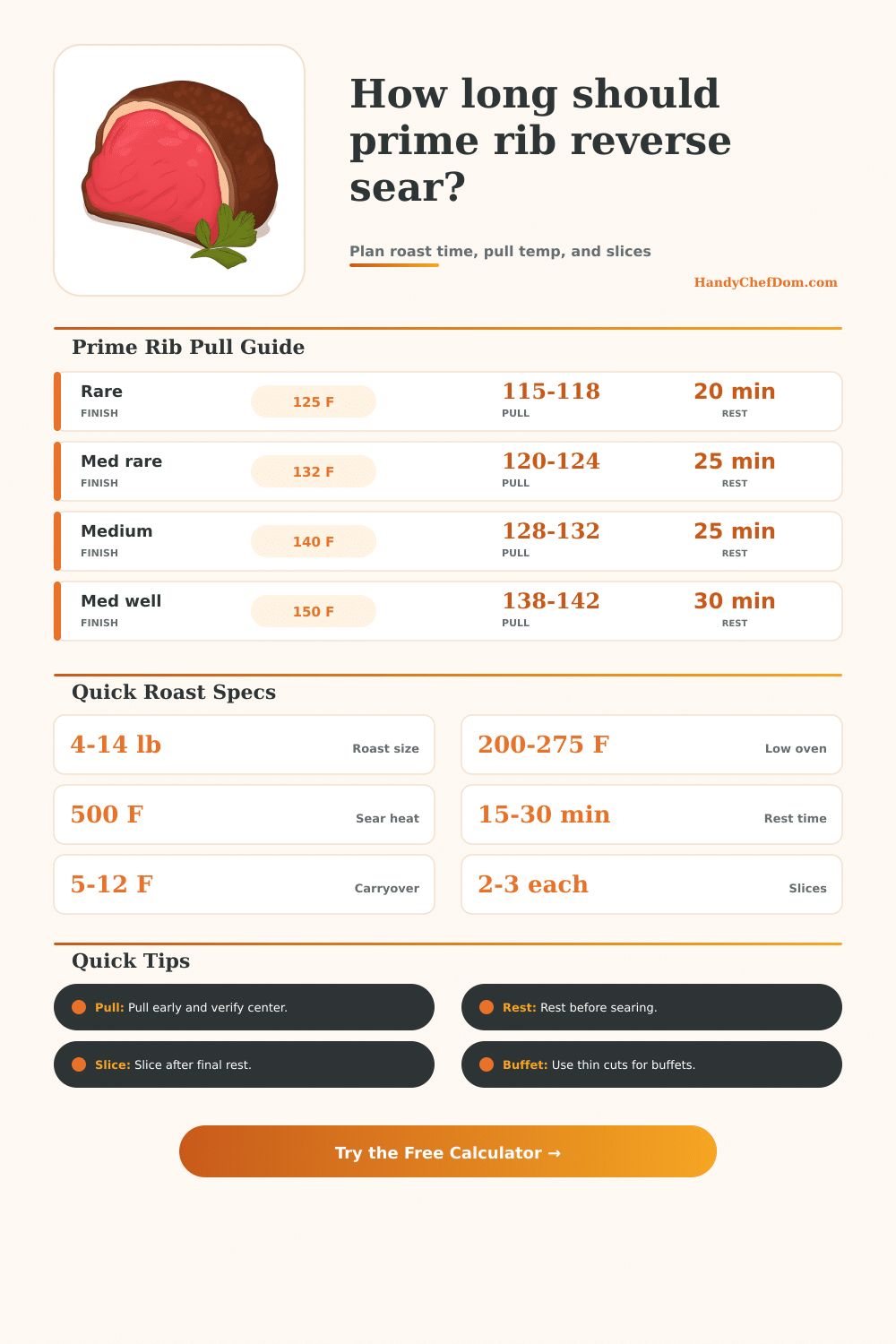
| Doneness | Finish Temp | Typical Pull | Center Look |
|---|---|---|---|
| Rare | 125 F / 52 C | 115 to 118 F | Deep red center |
| Medium rare | 130 to 135 F / 54 to 57 C | 120 to 124 F | Warm red center |
| Medium | 140 to 145 F / 60 to 63 C | 128 to 132 F | Warm pink center |
| Medium well | 150 to 155 F / 66 to 68 C | 138 to 142 F | Slight pink center |
| Well | 160 F / 71 C | 148 to 152 F | Little pink |
| Low Oven | Rare | Med Rare | Medium |
|---|---|---|---|
| 200 F / 93 C | 35-42 min/lb | 38-46 min/lb | 42-50 min/lb |
| 225 F / 107 C | 28-34 min/lb | 30-38 min/lb | 34-42 min/lb |
| 250 F / 121 C | 24-30 min/lb | 26-34 min/lb | 30-38 min/lb |
| 275 F / 135 C | 20-26 min/lb | 23-30 min/lb | 26-34 min/lb |
| Cut Style | Raw Per Guest | Cooked Yield | Planning Note |
|---|---|---|---|
| Bone-in standing rib | 1 lb | 60-65% | Classic holiday roast with bones |
| Boneless prime rib | 0.6-0.75 lb | 76-82% | Easy slicing and compact portions |
| Boneless ribeye roast | 0.6-0.75 lb | 75-80% | Even shape, faster heat transfer |
| Cap-on rib roast | 0.8-1 lb | 65-72% | Rich cap and visible seam fat |
| Sear Setup | Temperature | Time Range | Best Use |
|---|---|---|---|
| Hot oven | 500 F / 260 C | 8-12 min | All-around crust after resting |
| Very hot oven | 550 F / 288 C | 5-8 min | Fast color with less center rise |
| Grill sear | 500 F / 260 C | 6-10 min | Smoky edges and browned fat |
| Broiler finish | High broil | 3-6 min | Small roasts watched closely |
The reverse sear method for prime rib allow a person to have better control over the doneness of the roast. While traditional roasting methods requires the use of high heat from the beginning of the cooking process, the reverse sear method use low heat throughout most of the cooking stage. More specifically, the method uses a low-temperature oven stage to heat the interior of the roast to the target temperature, followed by a high heat sear to cook the exterior of the roast.
Because the method cooks the interior first in the reverse sear method, the roast will have an even color from the edge to the center of the roast. A calculator can assist in determining the specific timing and temperature requirements of the reverse sear method for cooking a prime rib roast. Variables that affect the cooking time of a prime rib roast includes the weight of the roast, the cut of the roast, and the state in which the roast is thawed.
How to Cook Prime Rib with the Reverse Sear and a Time Calculator
For instance, a calculator will take into account the weight of the roast; a four pound roast will require more cooking time then a twelve pound roast. The type of cut of the roast may also require adjustments to the cooking time. For instance, a roast that includes bone will retain more heat than a boneless roast, thus requiring different cooking time.
Finally, the thaw state of the roast will also impact cooking time; a roast that is frozen will require more time than a thawed roast. Additional variables to consider in a reverse sear recipe for a prime rib roast are the target doneness of the roast, the pull temperature, carryover heat, and sear gain. The target doneness for the roast will dictate the pull temperature for the roast; the pull temperature is the temperature at which the cook removes the roast from the oven.
The calculator will take into account the carryover heat and sear gain for the roast; if the roast is pulled too late, the internal temperature will be too high, but if the roast is pulled too early, the internal temperature may be too low once the roast has rested. The low oven temperature will affect the cooking speed of the roast. A 200-degree oven will heat the roast more slowly than a 275-degree oven.
However, the 200-degree oven will provide a more gentle rise in temperature from the edge to the center of the roast. Similarly, a 275-degree oven will cook the roast to the desired temperature more quickly than a 200-degree oven. However, there is a greater margin for error with a 275-degree oven.
The calculator will use the low oven temperature that a person intends to use to adjust the cooking time. The cook will sear the roast to a high temperature for a short period of time. This will provide a crust to the roast and will add some heat to the roast.
Additionally, the reverse sear method can be used for roasts of any size. The reverse sear method includes resting the roast before and after the sear. If the roast is not rested before the sear, the crust may not form evenly.
Additionally, if the roast is not rested after the sear, the roast may be messy when carved. Guest count and the desired thickness of the slices of prime rib will impact cooking time with the reverse sear method. A calculator will determine how many slices of prime rib can be obtained from the roast, and how many slice will be provided to each guest.
Thus, the calculator will determine whether thick or thin slices should be provided to each guest. Additionally, the number of guests will also impact the math; a buffet may allow for more guests to be fed with the same prime rib roast than a seated dinner. Yield will have an impact upon cooking time.
For instance, a bone-in prime rib will lose more weight than a boneless prime rib. Thus, there will be fewer edible portions of the roast from a bone-in cut of prime rib; the bones and the trim is discarded. A calculator will account for the different yields of each cut of prime rib to determine how many slice will result from the roast; this accounts for the possibility of a person running out of meat during the meal.
Using these percentages will ensure that the person has enough prime rib for each guest. The shape of the roast will impact cooking time. Additionally, the pan in which the roast will be cooked will also impact cooking time.
A roast that is long and narrow will cook to the desired temperature faster than a short and thick roast of the same weight. Additionally, a roast will absorb more heat if it is cooked in a dark roasting pan compared to a light roasting pan. A calculator will provide a range of cooking times rather than a specific number of minutes for the roast will cook; the roast should be prepared in such a way that it can be checked for doneness during the cooking process.
Another reason that the reverse sear method is reliable is that the method considers the separate heating of the center and exterior of the roast. More specifically, the low cooking temperature heats the center of the roast without overcooking the exterior of the roast. Additionally, the high heat sear will cook the exterior of the roast.
Thus, the method accounts for both the carryover heat and the sear gain of the roast to ensure that the roast will reach the desired internal temperature.