🥔 Raw Potato to Cooked Weight Calculator
Estimate potato cooked weight from raw weight using variety, method, peel loss, trim, moisture loss or gain, serving size, and planning buffer.
Choose planning mode to work from raw potatoes, cooked target to work backward, or servings mode to estimate how much raw potato to start with.
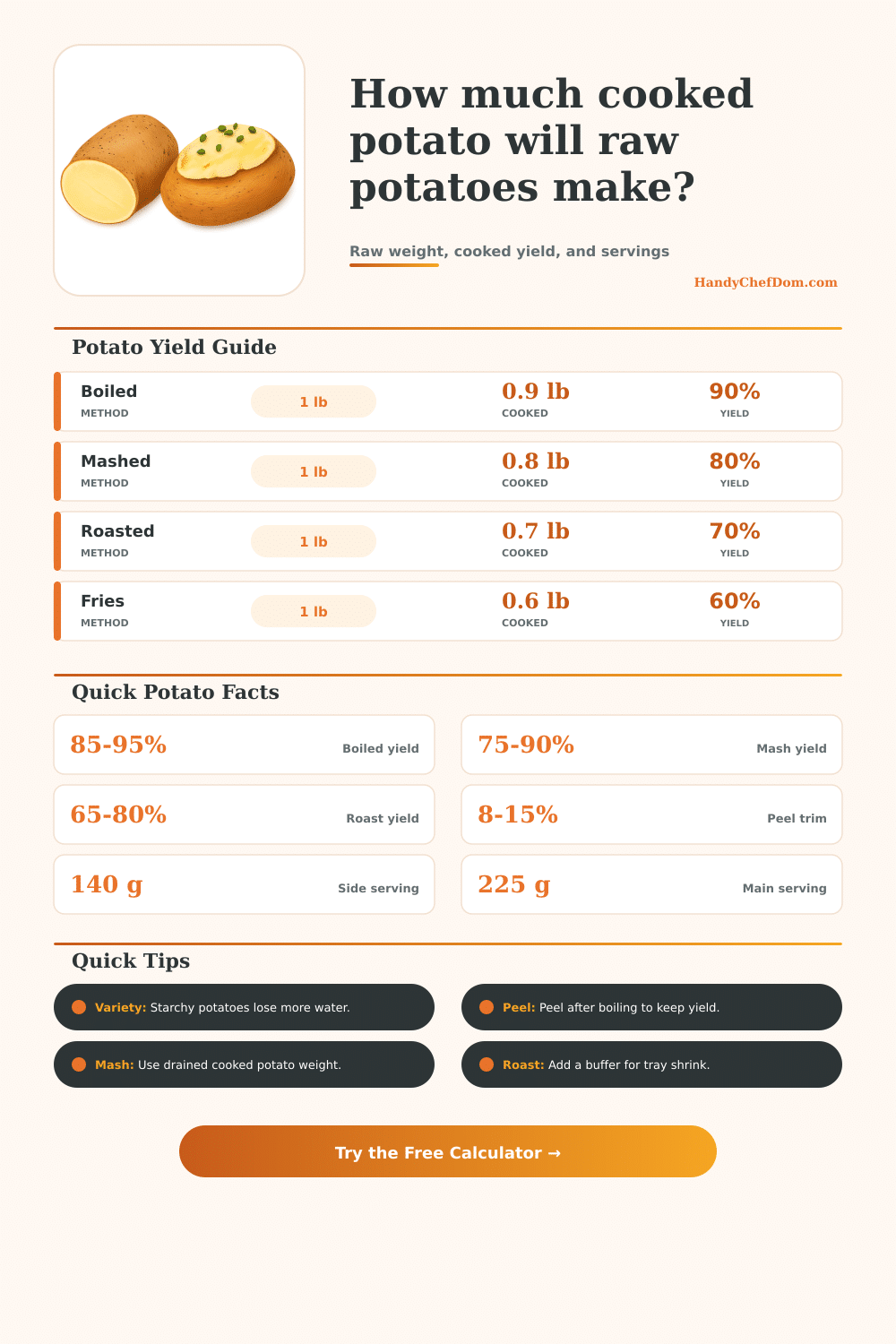
| Cooking method | Typical cooked yield | Moisture change | Best planning use |
|---|---|---|---|
| Boiled, drained | 85% to 95% | Small loss or slight gain | Simple sides, salad prep, mash base |
| Steamed | 88% to 96% | Low water loss | Accurate cooked potato batches |
| Mashed base | 75% to 90% | Drain and steam-off loss | Weigh before dairy additions |
| Roasted chunks | 65% to 80% | Moderate evaporation | Crisp tray potatoes and wedges |
| Baked whole | 75% to 88% | Interior steam loss | Potato bars and stuffed potatoes |
| Fries or chips | 50% to 68% | High water loss | Fried, air-fried, or oven fries |
| Skillet hash | 60% to 75% | Pan evaporation | Breakfast potatoes and meal prep |
| Gnocchi potato base | 70% to 82% | Dry potato flesh wanted | Dough planning before flour |
| Potato variety | Best methods | Cook behavior | Yield note |
|---|---|---|---|
| Russet or Idaho | Baked, mashed, fries | Starchy and fluffy | Loses more moisture when dry-cooked |
| Yukon Gold | Boiled, mashed, roasted | Creamy, medium starch | Reliable all-purpose yield |
| Red potato | Boiled, salad, steamed | Waxy and firm | Holds water and shape well |
| White potato | Boiled, gratin, mash | Balanced texture | Similar to Yukon but slightly lighter |
| Fingerling | Roasted, steamed | Dense and waxy | Skin-on yield is usually high |
| Baby potato | Boiled, roasted | Tender and compact | Low trim loss when kept whole |
| Sweet potato | Baked, roasted, mashed | Moist, sweet flesh | Soft texture can reduce usable scoop |
| Mixed potatoes | Roasts, salads, sides | Average behavior | Use a buffer for uneven sizes |
| Raw potatoes | Boiled cooked | Mashed base | Roasted cooked |
|---|---|---|---|
| 1 lb raw | 0.9 lb cooked | 0.8 lb cooked | 0.7 lb cooked |
| 2 lb raw | 1.8 lb cooked | 1.6 lb cooked | 1.4 lb cooked |
| 5 lb raw | 4.5 lb cooked | 4.0 lb cooked | 3.5 lb cooked |
| 10 lb raw | 9.0 lb cooked | 8.0 lb cooked | 7.0 lb cooked |
| 15 lb raw | 13.5 lb cooked | 12.0 lb cooked | 10.5 lb cooked |
| 25 lb raw | 22.5 lb cooked | 20.0 lb cooked | 17.5 lb cooked |
| Servings | Cooked side target | Raw for boiled | Raw for roasted |
|---|---|---|---|
| 4 servings | 1.25 lb cooked | 1.4 to 1.6 lb raw | 1.8 to 2.1 lb raw |
| 8 servings | 2.5 lb cooked | 2.8 to 3.2 lb raw | 3.6 to 4.2 lb raw |
| 12 servings | 3.75 lb cooked | 4.2 to 4.8 lb raw | 5.4 to 6.3 lb raw |
| 20 servings | 6.25 lb cooked | 7.0 to 8.0 lb raw | 8.9 to 10.4 lb raw |
| 35 servings | 10.9 lb cooked | 12.1 to 14.0 lb raw | 15.6 to 18.2 lb raw |
| 50 servings | 15.6 lb cooked | 17.4 to 20.0 lb raw | 22.3 to 26.0 lb raw |
When planning to use potato in a meal, it is important to understand how the weight of those potatoes may change during the preparation process. The raw weight of the potatoes will not necessarily be the same then the weight of the potatoes that will be cooked and served; the potatoes will lose some of their moisture and mass during the cooking and peeling process. If these variables is not accounted for, it is possible that the cook will find themself without enough food to serve to there guests.
The weight of the potatoes may change as a result of the way in which they are cooked. For instance, methods like boiling will retain the moisture within the potatoes, but methods like roasting or frying will cause those potatoes to lose some of their moisture (which will evaporate as steam). As a result, the weight of the roasted potatoes will be less than the weight of the boiled potatoes.
How Potatoes Change Weight When Cooked
Furthermore, different cooking methods will have different weights associated with them (which you can account for by using the calculator provided here), which allows cooks to determine the raw weight of the potatoes that is required to account for the specific cooking method that the cook will use in the preparation of the potatoes. Beyond the cooking methods, other factor that may contribute to the weight of the potatoes include the need to peel them, the type of potatoes that are used, and even the texture that is desired for the cooked potatoes. For instance, if the potatoes are to be peeled prior to being cooked, the weight of the potatoes will be less than if the potatoes are to only be peeled after they have been cooked.
Additionally, different types of potato has different amounts of starch within them. Russet potatoes have a high starch content (as do other potatoes of similar types), so they tend to lose more moisture than other types of potatoes. Waxy potatoes, like red potatoes, retain their moisture and shape during cooking.
Thus, cooks must decide the variety of potatoes that will be used, and recognize that each type will impact the weight of the potatoes. Similar to texture, the weight of the potatoes may need to be accounted for if they are to be prepared differently (like mashed potatoes versus gratin potatoes). Additionally, the portion size of the potatoes may impact the weight of the potatoes that are needed for the meal.
For instance, individual portion of potatoes are different in weight to portions that are provided at a buffet table. Accordingly, cooks must calculate how many serving will be needed for the specific type of event, then adjust the potatoes to provide enough food for each person that will be served. Furthermore, cooks can purchase additional portions of potatoes when preparing potatoes for large group of individuals; this so called “planning buffer” accounts for the fact that some potatoes may be lost during the cooking process, and that not all potatoes are the same in weight.
Many cooks make mistake with potatoes when preparing meals. For instance, cooks may buy the correct weight and type of potatoes for a recipe for mashed potatoes, but they may find themself with insufficient potatoes due to not accounting for the weight that will be lost during the peeling process. Additionally, cooks may use the weight calculation for boiled potatoes when preparing roasted potatoes; this type of mistake could lead to having insufficient potatoes to serve to each guest.
The calculator that is provided here can help cooks to avoid these type of mistakes. The calculator will help cooks to understand how the raw weight and cooked weight of the potatoes may change and how different cooking methods and type of peeling will impact the raw weight of the potatoes that are purchased. Thus, cooks can use this calculator to more accurately shop for potatoes to ensure that the weight of the raw potatoes that are purchased will provide the amount of cooked potatoes that is desired to be served.
Through understanding how the weight of the potatoes changes during the cooking process, cooks will be able to prepare meal that contain the same amount of potatoes as they initially intended to serve.