🥚 Recipe Halving Calculator
Halve recipes with practical rounding for fractions, eggs, pan size, cook time, seasoning, leavening, and final batch yield.
Enter the original recipe size and the scale you want. The calculator converts one ingredient amount, splits eggs, adjusts leavening and seasoning, compares pan area, estimates cook time, and shows final yield.
| Original Amount | Half Amount | Spoon Shortcut | Best Use |
|---|---|---|---|
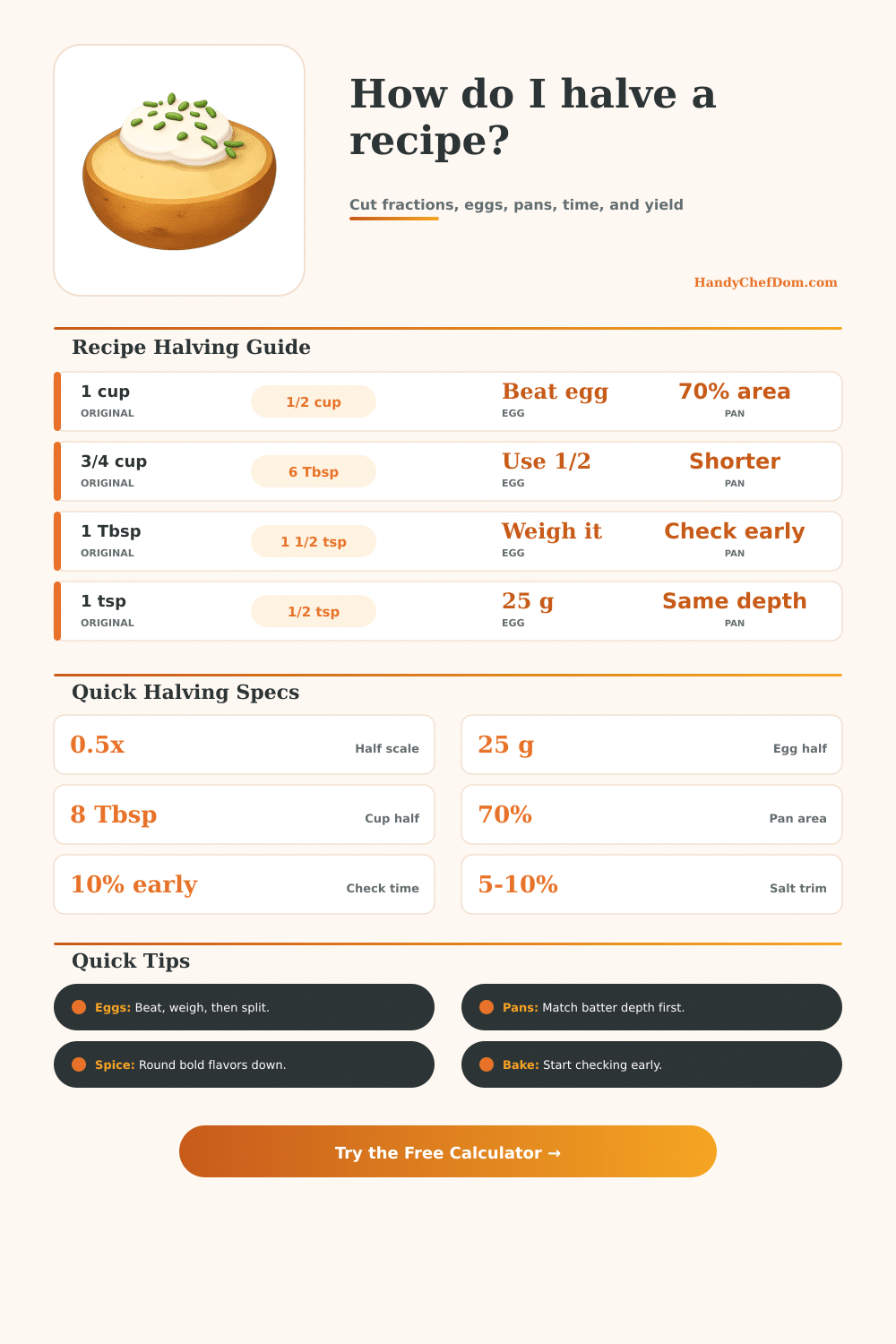
| 1 cup | 1/2 cup | 8 tablespoons | Flour, sugar, liquid |
| 3/4 cup | 3/8 cup | 6 tablespoons | Sugar, oats, chopped items |
| 2/3 cup | 1/3 cup | 5 tablespoons plus 1 teaspoon | Liquids and batters |
| 1/2 cup | 1/4 cup | 4 tablespoons | Butter, oil, milk |
| 1/3 cup | 1/6 cup | 2 tablespoons plus 2 teaspoons | Small dry measures |
| 1/4 cup | 1/8 cup | 2 tablespoons | Nuts, chips, sauces |
| Original Fraction | Half Fraction | Decimal | Kitchen Note |
|---|---|---|---|
| 1 tablespoon | 1 1/2 teaspoons | 0.5 Tbsp | Use for oil, vinegar, soy sauce |
| 1 teaspoon | 1/2 teaspoon | 0.5 tsp | Easy spoon measure |
| 3/4 teaspoon | 3/8 teaspoon | 0.375 tsp | Use 1/4 plus 1/8 teaspoon |
| 1/2 teaspoon | 1/4 teaspoon | 0.25 tsp | Common spice split |
| 1/4 teaspoon | 1/8 teaspoon | 0.125 tsp | Pinch measure works |
| 1/8 teaspoon | 1/16 teaspoon | 0.063 tsp | Use a small pinch |
| Egg Situation | Half Batch Move | Weight Guide | Texture Note |
|---|---|---|---|
| 1 large egg | Beat egg and use half | About 25 g | Best for cakes and muffins |
| 2 large eggs | Use 1 large egg | About 50 g | Cleanest split |
| 3 large eggs | Use 1 1/2 beaten eggs | About 75 g | Beat first for even mix |
| 1 yolk | Use half beaten yolk | About 9 g | Richness changes quickly |
| 1 egg white | Use half beaten white | About 15 g | Foam recipes need precision |
| Egg wash | Make less or save extra | As needed | Does not need exact scaling |
| Pan And Time Change | Half Batch Guideline | Time Effect | Check Cue |
|---|---|---|---|
| Same pan, half batter | Much thinner layer | Check 20% to 35% early | Edges set quickly |
| Half pan area | Similar batter depth | Check 5% to 15% early | Center behaves normally |
| 70% pan area | Slightly thinner layer | Check 10% to 20% early | Top sets sooner |
| Muffins or cupcakes | Reduce filled wells | Similar time | Springy tops |
| Loaf to mini loaf | Divide batter evenly | Shorter time | Crack looks dry |
| Soup or sauce pot | Use smaller pot | May reduce faster | Watch thickness |
This calculator uses practical kitchen rounding and common large-egg, spoon, pan-area, and bake-time rules. For delicate baking, weigh small ingredients whenever possible.
When a person decide to halve a recipe, a person may think that all that has to be done is to halve the recipe according to the mathematics of the recipe. However, halving the recipe involve more than mathematics. For example, a halving of the recipe involve changes to the volume of ingredients, changes to the chemistry of the ingredients, changes to the way that the ingredients will cook in the heat of the kitchen, and changes to the taste of the ingredients.
Each of these factors can change if the recipe is halved. To address these changes in a halved recipe, the recipe calculator may be of some assistance to a person who wishes to halve the recipe. The recipe calculator ask a person to input the original yield of the recipe and the target yield that the person desires from halving the recipe.
How to Halve a Recipe
Based off these inputs, the calculator will provide a scale factor for the ingredients in the recipe. The calculator also understands the type of recipe that is being halved, as each type of recipe have different requirements for ingredients. Additionally, the recipe calculator can also suggest portion of eggs for the recipe, as well as provide cooking time suggestions for the halved recipe.
By utilizing the recipe calculator, a person can avoid error that can result from halving the recipe. The recipe calculator also requires some inputs from the person that intends to halve the recipe. For instance, the person must select the type of recipe that will be halved.
Additionally, a person must select their preference for how the ingredients should be rounded in the halved recipe. A pan dimension must also be provided to the recipe calculator. The pan dimensions will allow the recipe calculator to compare the dimensions of the pan that will be used in the halved recipe to the pan dimensions for the original recipe.
If the size and dimensions of the pan are different than the original recipe, then the thickness of the ingredients will change, which will affect the cooking time for the food. Another ingredient that often cause problems for cooks who attempt to halve the recipe is the ingredient: eggs. Eggs contain both fat and water, and splitting an egg will change the texture of the recipe that utilizes that egg.
Additionally, splitting an egg in half may cause problems for those cooks who are attempting to utilize half of an egg. Using half of an egg may make it difficult to maintain the proper ratio of white to yolk for that recipe. To avoid this problem, cooks should beat the egg before measuring the weight of the beaten egg.
The recipe calculator can assist cooks in measuring the eggs correctly, as the recipe calculator will provide the number of grams for each halved portion of egg. Using grams to measure the eggs ensures that the amount of eggs added to the recipe are accurate. Another area of concern for cooks who are halving recipes is the portion of seasoning that is to be included in the recipe.
Cooks may be concerned that halving the recipe will lead to the seasoning becoming too strong. For instance, salt and strong spices may become more intense when the recipe is halved. To counteract the strong taste of these seasonings, the recipe calculator allows cooks to select a strength for the seasoning.
Based upon the selected strength of seasoning, the recipe calculator will reduce the amount of seasoning that is to be used in the halved recipe. The amount of seasoning will be reduced to avoid the seasoning from being too strong in the halved recipe. However, it is still important for cooks to taste the food to make sure that the seasoning is accurate.
Another factor that can impact the halving of a recipe is the pan that is to be used in the recipe. Pans will not automatically change sizes just because the recipe is to be halved. Using the wrong size pan may lead to the depth of the food changing.
If the pan in which the food is to be cooked is too large for the food, the depth of the food will be too thin. Thin food will lose its moisture faster then food of another depth. Additionally, if the pan is too small for the food, the depth of the food will be too deep.
Deep food may require longer cooking times than food of another depth. The recipe calculator will allow cooks to enter the dimensions of the pan that will be used in the halved recipe. Based upon the dimensions of the pan that will be used, the recipe calculator can alert cooks as to whether or not the depth of the food will change.
Another factor to consider when halving a recipe is the loss of yield that can occur with halving the recipe. When halving a recipe, it is possible for some of the ingredients to be lost to evaporation, trimming of ingredients, or to become crumbs left in the bowl. The loss of these ingredients does have an impact upon the total number of servings of the halved recipe.
For instance, if an ingredient is lost due to evaporation, then fewer servings of that ingredient can be prepared than if the ingredient were not lost. The recipe calculator allows cooks to input the percentage of the ingredient that can be lost. Based upon this loss percentage, the recipe calculator will show the yield of the halved recipe that can actualy be prepared after the loss of ingredient.
The number of servings that are indicated on the recipe calculator may not the same as the number of servings that are actually plated. Finally, there are tables located next to the recipe calculator that provide more information to cooks who are halving recipes. These tables include conversions for cups and spoons, as well as tables that list the weights of eggs and the cooking times for pans of different sizes.
These tables allow cooks to quickly reference information that may be needed for the halved recipe without utilizing the recipe calculator altogether. For instance, the tables will help cooks to find the number of tablespoons that are in a certain amount of a cup. These tables are not a replacement for cooks knowledge of recipes, but they help to make it easier for cooks to find the information that they need.
Regular use of both the recipe calculator and the reference tables will help cooks understand how the ingredients react when the size of the recipe changes.