🫒 Olive Oil Calorie Calculator
Calculate calories and fat from olive oil measured by teaspoons, tablespoons, cups, grams, drizzle portions, marinade absorption, or saute retention.
Choose how the oil is used. Drizzle mode treats the entered amount as per serving; marinade and saute modes apply the counted oil percentage.
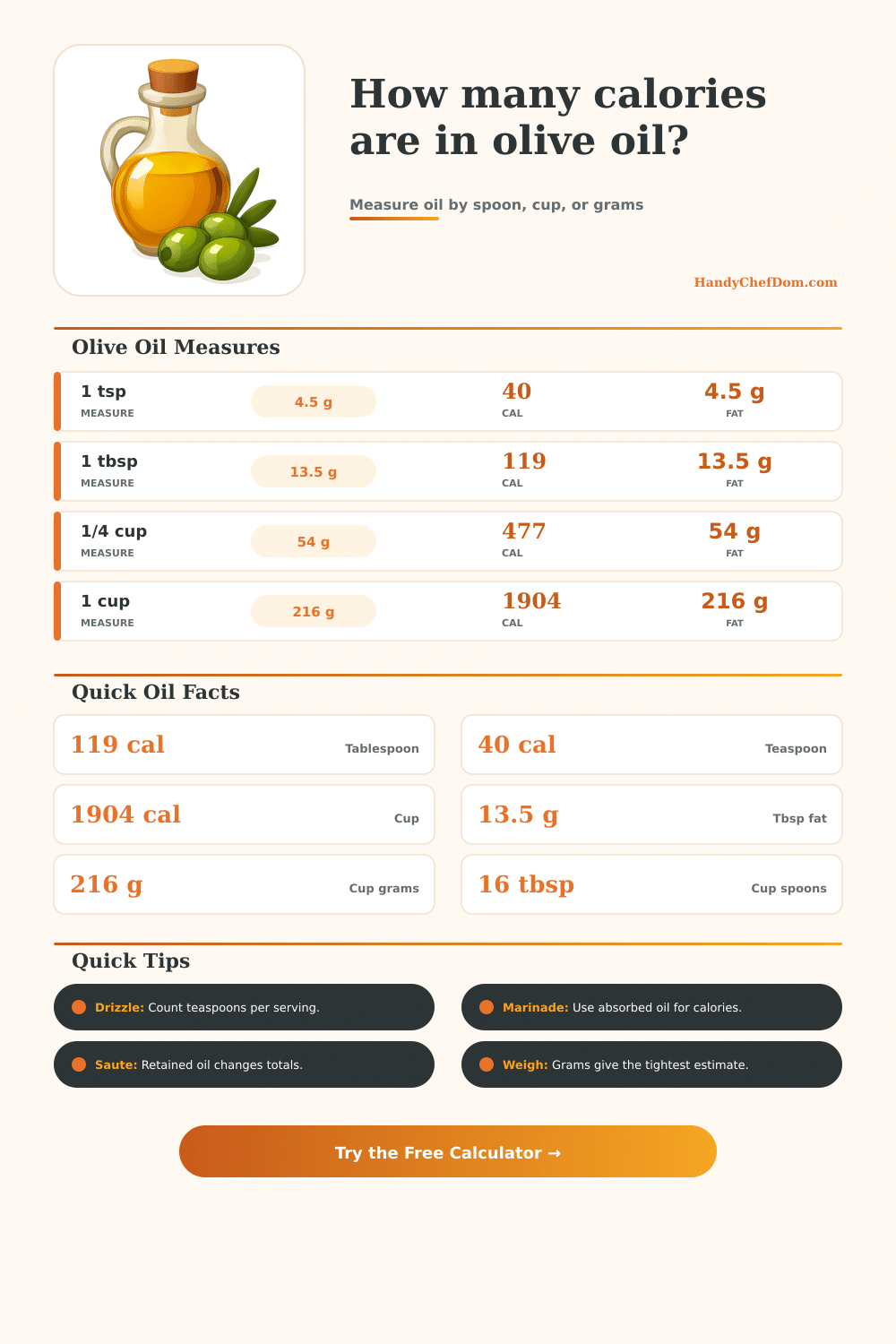
| Measure | Tablespoons | Approx Grams | Calories | Total Fat |
|---|---|---|---|---|
| 1 teaspoon | 0.33 tbsp | 4.5 g | 40 cal | 4.5 g |
| 2 teaspoons | 0.67 tbsp | 9 g | 79 cal | 9 g |
| 1 tablespoon | 1 tbsp | 13.5 g | 119 cal | 13.5 g |
| 2 tablespoons | 2 tbsp | 27 g | 238 cal | 27 g |
| 1/4 cup | 4 tbsp | 54 g | 477 cal | 54 g |
| 1/2 cup | 8 tbsp | 108 g | 952 cal | 108 g |
| 1 cup | 16 tbsp | 216 g | 1904 cal | 216 g |
| Use Style | Typical Input | Counted Oil | Best Unit | Calculator Note |
|---|---|---|---|---|
| Light drizzle | 1 tsp each | 100% | Teaspoons | Count per plate |
| Generous drizzle | 2 tsp each | 100% | Teaspoons | Works for bowls |
| Salad dressing | 1 tbsp each | 100% | Tablespoons | Divide by servings |
| Marinade | 1/4 cup batch | 25-60% | Cups | Use absorbed rate |
| Saute pan | 1-2 tbsp pan | 60-90% | Tablespoons | Lower if oil remains |
| Meal prep | 10 g each | 100% | Grams | Scale is precise |
| Servings | Light Drizzle | Moderate Oil | Generous Oil | Calories Range |
|---|---|---|---|---|
| 1 serving | 1 tsp | 2 tsp | 1 tbsp | 40-119 |
| 2 servings | 2 tsp | 4 tsp | 2 tbsp | 79-238 |
| 4 servings | 4 tsp | 8 tsp | 4 tbsp | 159-476 |
| 6 servings | 2 tbsp | 4 tbsp | 6 tbsp | 238-714 |
| 8 servings | 8 tsp | 16 tsp | 8 tbsp | 317-952 |
| 12 servings | 4 tbsp | 8 tbsp | 12 tbsp | 476-1428 |
| Olive Oil Label | Calories/Tbsp | Fat/Tbsp | Grams/Tbsp | Use Note |
|---|---|---|---|---|
| Extra virgin | 119 | 13.5 g | 13.5 g | Finishing and salads |
| Virgin | 119 | 13.5 g | 13.5 g | Everyday drizzle |
| Pure olive oil | 119 | 13.5 g | 13.5 g | General cooking |
| Light olive oil | 120 | 13.6 g | 13.6 g | Milder flavor |
| Pomace olive oil | 120 | 13.6 g | 13.6 g | High-volume prep |
| Garlic infused | 119 | 13.5 g | 13.5 g | Flavor drizzle |
| Chili infused | 119 | 13.5 g | 13.5 g | Finishing heat |
| Lemon olive oil | 119 | 13.5 g | 13.5 g | Fish or greens |
Olive oil. It’s a kitchen free-pass. You splash it around in the pan or drizzle it over your salad. Who cares how much you’re using? It tastes good so it must be fine. Olive oil is healthy fat. It tastes better then butter. But here’s the thing: whether you use extra virgin olive oil or avocado oil, calories are still calories.
One tablespoon contain about 119 calories, a concentrated wallop of energy, which, without care, adds up fast. That’s not the problem with the oil, exactly. The problem is the hidden amount that builds up as you cook by feel. When you plug in your specific situation, the calculator will handle the math for you (i.e., no guessing on absorption rates and conversions). Nutrition labels can tell you what’s in the bottle, but not how much actualy ends up on your plate.
Why You Should Measure Your Olive Oil
When you saute vegetables, some oil will stick to the pan. If you marinate your meat, only a fraction of the liquid will actually be absorbed by the meat. The rest of it will drain away and sits there unused. If you count every drop that you poured, you’re overestimating how much you’ve consumed. If you count nothing then you’re underestimating. The trick is understanding what’s realy getting measured.
Why does that matter? Because olive oil is an energy-dense food. The fat in it have around nine calories per gram, meaning a little change in the amount will translate into a big difference in total energy. Four and a half grams (or just one teaspoon) doesn’t sound like much, right? Just forty calories. But when you douse a salad lightly then repeat that four times…well, those two tablespoons adds up fast. Almost five-hundred calories from your dressings alone, all before you even begin on the cheese or bread.
For instance, there’s an option to enter if you’re using a marinade, versus directly pouring oil over your protein, etc. That will factor into the way the tool figures out how much oil you’ll retain. If you’re cooking in a saute pan, you can specify that only 60% of the oil is absorbed by the food, with the rest remaining in the skillet. By reducing that number you have a better idea of what your body is actualy absorbing. It is a small detail, but it is important if you’re trying to track your oil consumption closely.
While the caloric difference between light olive oil and extra virgin is minimal, it’s negligible; different varieties of olive oil will also be subtly different in taste and density. But when it comes to the fat, there’s nothing to write home about; everything else aside, on label may change, but off the bottle, they’re remarkably similar. Pure or refined oils has a higher smoke point (meaning they’re better for high-heat cooking), whereas extra virgin has a fruiter taste and contains more polyphenols (making it best used at the end of a dish). Either one wouldn’t burn any fewer calories than the next.
When you’re meal prepping, precision matters. Why rely on cups, which change depending on how tightly you pack them and size of your spoon? What about a close guess with a digital scale that stays consistent over time? With a digital scale, you know exactly what you have. You can weigh out ten grams per container and know exactly where you are. In a kitchen setting, cups is messy estimates. Cup size varies by brand. It also depends on the cup’s shape and even how level you hold your hand.
It’s laid out nicely in the reference tables on the page so you can quickly check things without having to run through an entire calculation. For example, a quarter cup contains about 477 calories. That’s quite a big chunk of someone’s daily allowance. Having these reference numbers side by side realy helps change your idea of what a small and large measurement looks like. The mind thinks in spoons; it consumes in cups.
This one goes for olive oil. Olive oil is an amazing product. It is rich in flavor and good for your heart. No need to fear it. Respect its power, measure it, account for what stays behind, and enjoy the rest without guilt. When you know exactly how much fuel you’re applying, you can get into the kitchen and prepare food with confidence instead of confusion.