🐖 Roast Pork Leg Cooking Time Calculator
Estimate pork leg roast time, pull temperature, crackling finish, resting minutes, carved yield, and servings from the exact roast you are cooking.
Enter the raw pork leg weight and the finish you want. Times are planning estimates; a thermometer reading at the thickest point should decide the final pull.
A tied boneless roast usually heats evenly and gives the cleanest carving yield.
The bone slows the center slightly and reduces the edible carved percentage.
Crackling planning adds hot finish time while still protecting the target center.
A thick leg can lag behind the per-pound estimate, so probe before the window ends.
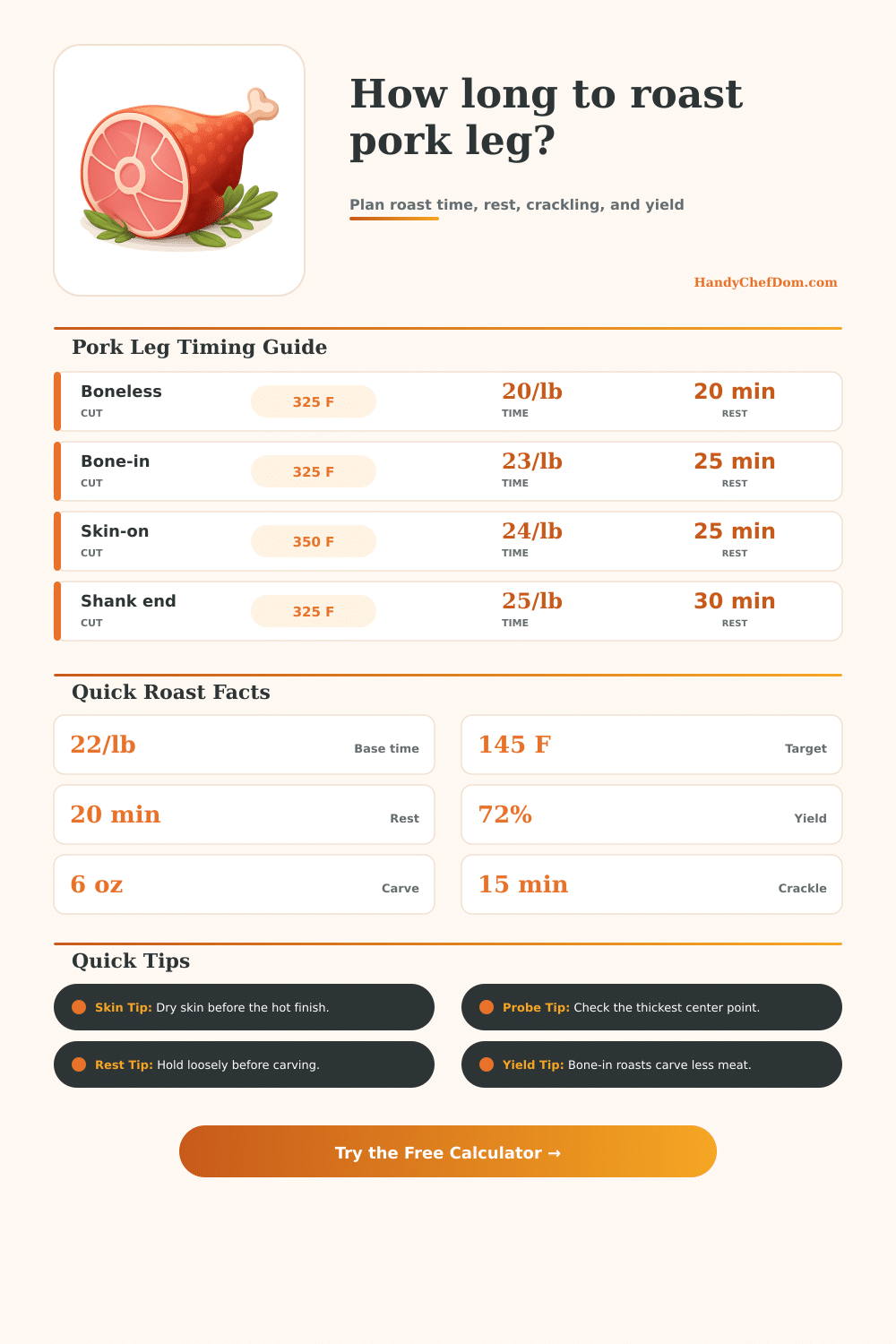
| Roast setup | Suggested oven | Base minutes per lb | Planning note |
|---|---|---|---|
| Boneless leg, skinless | 325°F / 165°C | 18 to 21 | Fastest carving roast |
| Boneless leg, skin-on | 325°F to 350°F | 20 to 23 | Add a hot finish for rind |
| Bone-in leg roast | 325°F / 165°C | 22 to 25 | Start checks before the estimate |
| Shank-end leg | 325°F / 165°C | 24 to 27 | Thicker end needs a longer window |
| Butterflied rolled leg | 350°F / 175°C | 16 to 19 | Flatter shape heats faster |
| Final internal target | Pull estimate | Carryover allowance | Common use |
|---|---|---|---|
| 145°F / 63°C | 140°F / 60°C | 5°F | Juicy sliceable leg |
| 150°F / 66°C | 145°F / 63°C | 5°F | Balanced roast slices |
| 155°F / 68°C | 149°F / 65°C | 6°F | Firmer family roast |
| 160°F / 71°C | 154°F / 68°C | 6°F | Fully firm slices |
| 165°F / 74°C | 158°F / 70°C | 7°F | Very firm finish |
| Yield factor | Typical setting | Edible meat from 6 lb | Serving note |
|---|---|---|---|
| 80% | Lean boneless | 4.8 lb | Best for clean slices |
| 74% | Boneless skin-on | 4.4 lb | Allows rind and shrink |
| 68% | Bone-in leg | 4.1 lb | Bone reduces carving meat |
| 62% | Shank end | 3.7 lb | More bone and uneven trim |
| 72% | General planning | 4.3 lb | Useful default estimate |
| Guest count | Light 4 oz | Standard 5 oz | Hearty 6.5 oz |
|---|---|---|---|
| 4 guests | 1.3 lb carved | 1.6 lb carved | 1.9 lb carved |
| 6 guests | 1.9 lb carved | 2.3 lb carved | 2.9 lb carved |
| 8 guests | 2.5 lb carved | 3.1 lb carved | 3.9 lb carved |
| 12 guests | 3.8 lb carved | 4.7 lb carved | 5.9 lb carved |
| 16 guests | 5.0 lb carved | 6.3 lb carved | 7.8 lb carved |
Calculator estimates are planning guides. Actual timing changes with oven cycling, roast shape, thermometer placement, pan depth, and how chilled the pork leg is when it enters the oven.
Roasting a pork leg can be dificult because the pork leg can become dry or rubbery if it isnt cooked proper. While you can purchase a high-quality pork leg and season it well, if any of the other factors work out incorrect, the pork leg will be a fail. A cooking calculator will help to determine the proper time to cook your pork leg based off the type of pork leg that you have.
The weight of the pork leg are one of the factors that will influence the cooking time. A three pound boneless pork leg will cook at a faster rate per pound then a ten pound bone-in pork leg. Furthermore, a pork leg with more pound will retain heat differently in the center of the meat as compared to a smaller pork leg.
How to Use the Pork Leg Cooking Calculator
Additionally, the bone-in the pork leg will change how the pork leg cooks. The cooking calculator will ask for the style of the pork leg (boneless or bone-in) to ensure that it adjusts the cooking time appropriate to avoid cooking the pork leg too early or too late. The skin on the pork leg will change the cooking plan.
Pork leg with skin will require a high heat stage to allow the skin to crackle which is a step separate from roasting the pork leg. The cooking calculator will account for this high-heat stage in the total cooking time to ensure that the center of the pork leg does not reach the target temperature while crackling the skin. Skinless pork leg will have a shorter cooking schedule as determined by the cooking calculator.
The starting temperature of the pork leg will impact the cooking time. Pork legs that come from the refrigerator will need to cook longer than pork legs that have been out at room temperature for thirty minute. The cooking calculator will factor in the starting temperature of the pork leg.
The shape of the pork leg will also impact the cooking time as pork legs with thickness will cook different than thin rolled pork legs. The cooking calculator will adjust the time for the pork leg to account for the shape of the pork leg. The target temperature for the pork leg will impact the cooking time for the pork leg.
A lower target temperature will allow you to remove the pork leg from the oven earlier as the carryover cooking will allow the pork leg to reach the target temperature. A higher targeted temperature will result in firmer pork leg slice but will take longer to cook the pork leg to the target temperature. The cooking calculator will display the pull temperature for the pork leg to ensure that you do not roast the pork leg to the target temperature as the pork leg will continue to cook while resting.
The pork leg must be rested after it is roasted. A moderate pork leg should rest for twenty to twenty-five minute but a large pork leg with bone will take more time to rest. The cooking calculator will factor in the resting time for the pork leg so that you know when the pork leg will be done roasting.
The yield for the pork leg is the amount of edible pork leg after it is carved. A bone-in pork leg will have a lower yield than a boneless pork leg. The cooking calculator will account for the desired yield for the pork leg so that you dont have less pork leg than you calculated.
A realistic yield will ensure that there is enough meat for all that will eat the roasted pork leg. The oven temperature and the shape of the pork leg will interact to influence the cooking time for the pork leg. A higher oven temperature will shorten the cooking time but will change the cooking time of thick pork legs.
The cooking calculator will factor in the oven temperature to adjust the cooking time to the oven in which the pork leg will be roasted. Additionally, the cooking calculator will factor in how many portion of the pork leg will be served whether hearty or light portions. Tables is included in the cooking calculator to allow for comparison of the various options for the pork leg.
The tables include options for the bone in the pork leg and the skin on the pork leg as well as the target and pull temperature for the pork leg. These tables will allow you to have an idea of the various outcomes of roasting your pork leg. Once you have a general idea of the different options, you can return to the cooking calculator to determine your specific schedule for roasting your pork leg.
Enter the exact detail of the pork leg to be roasted in the cooking calculator. While it may seem like a five and a half pound pork leg is similar to a six pound pork leg, the difference in weight will change the cooking time for the pork leg. The cooking calculator will automatically calculate the cooking time based on the weight of the pork leg.
All you need to do is read the result of the cooking calculator to determine the temperature to which the pork leg should be roasted, the time to crackle the skin of the pork leg, and the estimated yield of the roasted pork leg. By using the cooking calculator, you can ensure that your roasted pork leg is cooked properly.