Salt Sodium Calculator
Convert teaspoons, tablespoons, grams, and pinches of table salt, kosher salt, or sea salt into total sodium, salt grams, sodium chloride equivalent, per-serving sodium, and daily limit percent.
1Salt Sodium Presets
2Salt Measure, Density, Serving, and Sodium Inputs
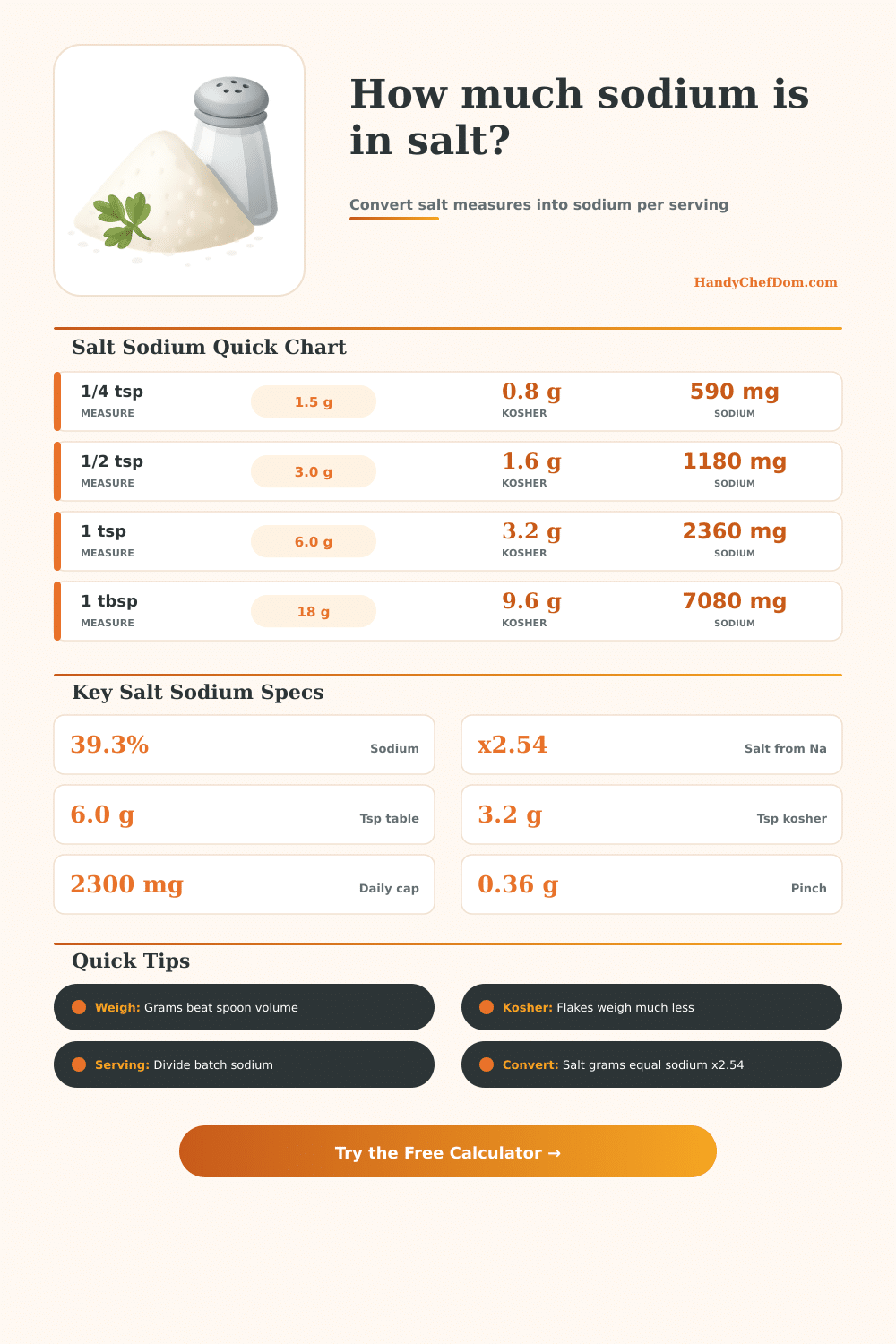
The calculator turns kitchen spoon measures into salt grams by crystal density, then uses sodium as 39.34% of sodium chloride. Use the gram mode when your scale reading is available.
Salt sodium result
Enter salt and serving details, then calculate.
3Live Salt Density Snapshot
4Salt Type and Measure Grid
5Salt Type, Measure, and Sodium Grid
| Salt type | Crystal density | 1 teaspoon salt | Sodium per teaspoon |
|---|---|---|---|
| Table salt, fine crystals | Dense and uniform | About 6.0 g | About 2360 mg sodium |
| Kosher salt, airy flakes | Very light flakes | About 3.2 g | About 1260 mg sodium |
| Kosher salt, dense flakes | Moderately dense | About 4.8 g | About 1890 mg sodium |
| Fine sea salt | Fine mineral crystals | About 5.0 g | About 1970 mg sodium |
| Coarse sea salt | Coarse uneven crystals | About 4.6 g | About 1810 mg sodium |
| Flake sea salt | Broad flakes | About 2.8 g | About 1100 mg sodium |
| Pickling salt | Fine dissolving crystals | About 6.2 g | About 2440 mg sodium |
| Fine pink salt | Fine mineral crystals | About 5.8 g | About 2280 mg sodium |
6Common Kitchen Measure Conversion Table
| Measure | Teaspoon volume | Table salt sodium | Kosher flake sodium |
|---|---|---|---|
| Small pinch | 1/32 tsp | About 74 mg | About 39 mg |
| Standard pinch | 1/16 tsp | About 148 mg | About 79 mg |
| Large pinch | 1/8 tsp | About 295 mg | About 157 mg |
| Quarter teaspoon | 1/4 tsp | About 590 mg | About 315 mg |
| Half teaspoon | 1/2 tsp | About 1180 mg | About 630 mg |
| One teaspoon | 1 tsp | About 2360 mg | About 1260 mg |
| One tablespoon | 3 tsp | About 7080 mg | About 3780 mg |
7Sodium-to-Salt Conversion Table
| Sodium amount | Salt equivalent | Table salt volume | Common reading |
|---|---|---|---|
| 500 mg sodium | 1.27 g salt | About 0.21 tsp | Light per-serving target |
| 1000 mg sodium | 2.54 g salt | About 0.42 tsp | Moderate recipe sodium |
| 1500 mg sodium | 3.81 g salt | About 0.64 tsp | Lower daily target |
| 2000 mg sodium | 5.08 g salt | About 0.85 tsp | Moderate daily target |
| 2300 mg sodium | 5.85 g salt | About 0.98 tsp | Common daily limit |
| 5000 mg sodium | 12.71 g salt | About 2.12 tsp | Large batch reference |
8Serving and Daily Limit Table
| Recipe salt | Servings | Sodium per serving | Percent of 2300 mg |
|---|---|---|---|
| 1/4 tsp table salt | 4 servings | About 148 mg | About 6% |
| 1/2 tsp table salt | 4 servings | About 295 mg | About 13% |
| 1 tsp table salt | 6 servings | About 393 mg | About 17% |
| 1 tbsp table salt | 12 servings | About 590 mg | About 26% |
| 2 tsp kosher flake salt | 8 servings | About 315 mg | About 14% |
| 12 g salt by scale | 10 servings | About 472 mg | About 21% |
9Calculator Mode Comparison
Best when a recipe says teaspoons, tablespoons, dashes, or pinches. Density changes by salt style.
Best for repeatable cooking because salt weight skips the crystal-size problem entirely.
Best when a nutrition label gives sodium mg and you need the equivalent salt amount.
Best when you want to find the batch salt that fits a sodium limit per serving.
10Two Practical Salt Sodium Tips
Don’t take it for granted that one teaspoon of salt equals another teaspoon of salt. When packed tightly into a spoon, salt crystals forms dense solids. But the flaky, airy structures of kosher or other coarse grained salts contain huge gaps between each crystal, trapping a lot of air. So while six grams may be weight of a leveled teaspoon of fine table salt, that volume of flaky kosher salt might only weigh half as much.
Swapping salts without changing the measuring utensil, say you grab some sea salt instead of table salt. Result in you unknowingly adding hugely different quantities of sodium. The calculator above does the math to convert. After choosing the sort of salt you’ve used, just choose your method of input and it’ll do the work for you.
Why Measuring Salt by Weight Is Better Than By Volume
This spares you from wondering if your soup is too salty or not salty enough. Knowing the chemistry clarifies the numerology, which is part that’s been a mystery. About 39% of pure NaCl are sodium by weight. That doesn’t depend on the origin: Whether you mine it out of a rock or scrape it up off the beach somewhere, there will be about 390 milligrams of sodium in each gram of salt.
So if a recipe says “half a teaspoon,” what you’re getting is a certain amount of volume, not necessarily a certain mass, right? Because crystals come in different sizes and shapes, varying amounts of same material can fit into that space, so the measure of volume is unstable, and thus unsuitable for any kind of tracking for nutrients. If you take your salt and weigh it on a digital scale, then you remove crystal-structure variation completely and force yourself into some accuracy where you would of previously only had guesswork.
For those on special diets (or cooking with health in mind), “sodium per serving” is better than “total sodium in the pot.” You can make thousands of milligrams of sodium worth of chili, but if you divide it among eight portion, each gets only a fraction of that load. And yes, you can enter the number of servings you want to eat and have it take into account any salty additional ingredients like cured meats, or broth.
So this helps tie together raw ingredient data with what’s actualy going to get put in our mouths when we eat something. It turns abstract numbers of milligrams into percentages of how much of your day’s limits they represent. One serving? For example, knowing that one serving represents 15 percent of your daily recommended intake is much easier to work with. That’s 15 percent of your daily recommended allowance. Much easier to work with.
Home cooks use volume (it’s convenient), and pros tend to cook by weight (because it’s repeatable). Neither are better than the other, although the two are separated by a knowledge gap. Becoming more precise doesn’t require ditching your spoons; all it requires is knowing what those spoons measure. If you’re curious about how much sodium’s in a dash versus a pinch of a particular kind of salt, there are handy reference tables in the calculator to give you a quick lookup. And remember: a pinch is generally considered to be one-sixteenth of a teaspoon, though different cookbooks’ definitions can range wildly. Having a consistent definition avoids small errors that adds up with multiple additions.
I’m not saying avoid salt in cooking; I’m saying learn about it instead. Salt makes things taste better, keeps them from spoiling, and does some other stuff that’s hard to get out of ingredients just by using herbs. But too much salt (uncontrolled salt) will make your dishes feel flat and heavy (from water retention), and cause you to feel bloated afterward.
Making this switch, from volume to weight to sodium amount, puts the control back into the seasoning process different than how you react to it. That is: Guesswork becomes strategy. You begin to view salt less as something to add at the end and more as a deliberate part of the recipe’s balance. At the end of the day, knowing what’s in your pantry makes you cook better.
Knowing why you use flaky sea salt helps. It adds bursts of flavor and texture rather than acting as bulk seasoning. This means you’ll never attempt to swap it 1:1 for table salt in stews or soup. You’ll tweak your measures, and your expectations, accordingly. These little, precise tweaks can make all the difference between a salty dish and a well-seasoned one.
To measure with intent alters the result. It’s the difference between seasoning by design versus salting by habit.