🍕 Semolina in Pizza Dough Calculator
Calculate semolina grams, remaining bread or 00 flour, water, dough ball weight, dusting semolina, and style fit from baker's percentages.
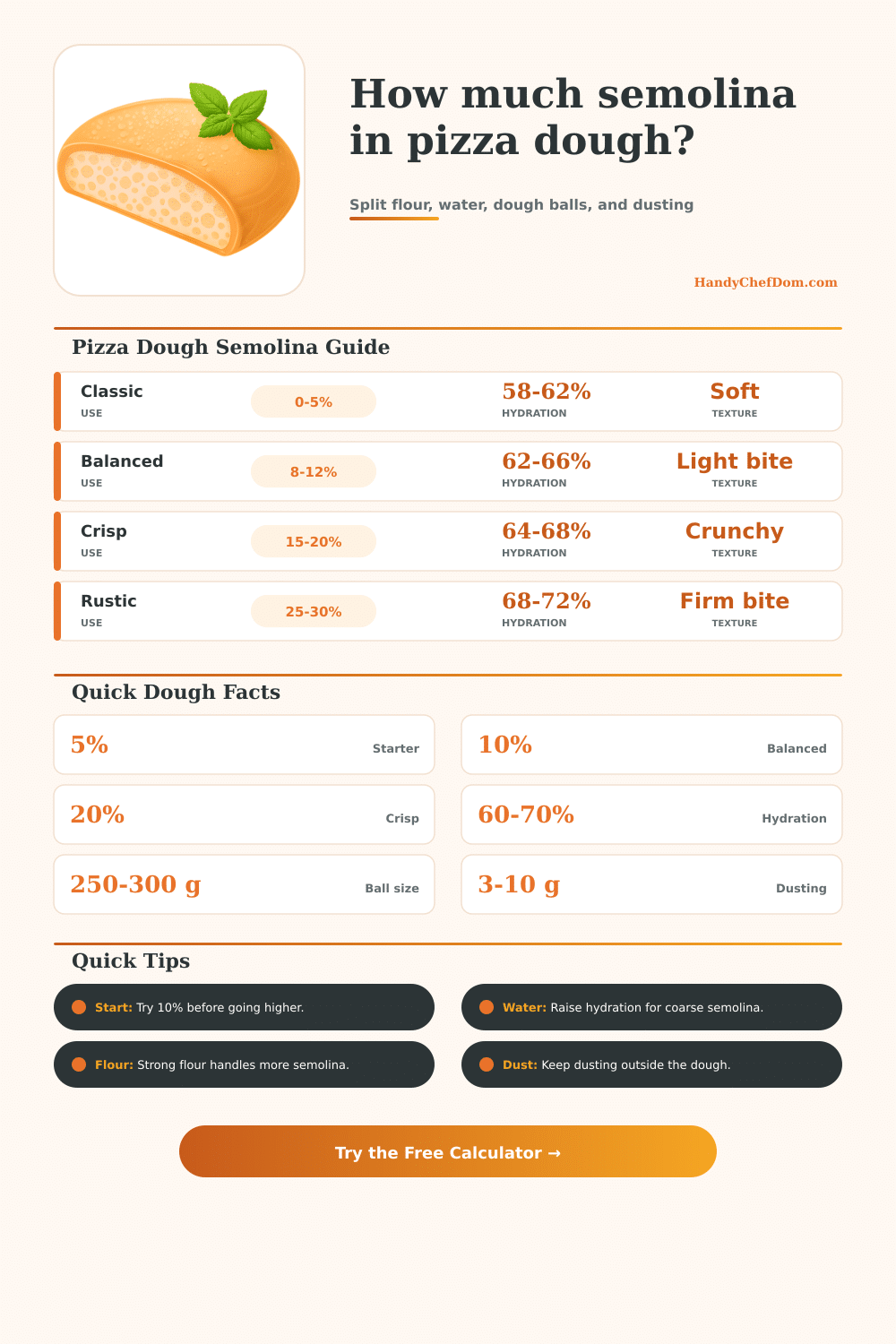
Semolina percentage is calculated from total flour weight. For example, 1000 g total flour at 10% semolina means 100 g semolina and 900 g bread or 00 flour.
Mostly bread or 00 flour. Soft handling, light color, and minimal grainy bite.
Easy starting range for golden color, gentle chew, and a little extra crispness.
Stronger texture with more snap. Hydration and flour strength matter more here.
Coarser bite and firm chew. Best with strong flour, enough water, and patient mixing.
| Semolina share | Best use | Texture effect | Adjustment cue |
|---|---|---|---|
| 0% to 5% | Classic 00 or bread flour dough | Softest stretch with mild color and minimal crunch | Use standard hydration for the dough style. |
| 8% to 12% | Balanced home pizza dough | Light golden color, gentle bite, and easy handling | Good first test range for most styles. |
| 15% to 20% | Crunchier crust or pan pizza | More crispness, more chew, and a slightly firmer dough | Add water if the dough feels tight. |
| 25% to 30% | Rustic, coarse, or very crisp crusts | Distinct semolina texture and stronger wheat flavor | Use strong flour and avoid under-hydrating. |
| 35% to 50% | Experimental dough only | Can become dense, sandy, or hard to stretch | Expect recipe testing and higher hydration. |
| Dough style | Typical hydration | Semolina range | Ball or pan cue |
|---|---|---|---|
| Neapolitan round pizza | 58% to 65% | 0% to 10% | Often 240 g to 280 g per dough ball. |
| New York style pizza | 60% to 65% | 5% to 15% | Often 280 g to 360 g for larger round pies. |
| Sicilian sheet pizza | 65% to 72% | 10% to 20% | Pan dough can carry more water and semolina. |
| Detroit pan pizza | 68% to 75% | 10% to 20% | Higher hydration helps the dough spread in the pan. |
| Roman slab pizza | 70% to 80% | 10% to 25% | Strong flour helps support airy slab dough. |
| Thin crust pizza | 55% to 62% | 5% to 15% | Lower water and modest semolina keep it crisp. |
| Hydration | Dough feel | Semolina note | Handling cue |
|---|---|---|---|
| 55% to 60% | Firm and easy to shape | Best with low to moderate semolina | Good for thin crust, but can feel tight. |
| 61% to 65% | Balanced and versatile | Works well around 5% to 15% semolina | Common range for round home pizza. |
| 66% to 70% | Softer and more extensible | Helpful when semolina is 15% or higher | Use folds or a short rest if sticky. |
| 71% to 78% | Wet pan or slab dough | Can support crisp edges with semolina | Best for oiled pans, not tight hand tossing. |
| 79% to 85% | Very wet specialty dough | Requires strong flour and careful handling | Expect advanced mixing and folding. |
| Flour strength | Typical cue | Semolina tolerance | Best fit |
|---|---|---|---|
| Soft pizza flour | W 180 to 220, lower protein | Keep semolina modest, often under 10% | Shorter ferments and tender round pizzas. |
| Medium 00 or bread flour | W 240 to 280, balanced protein | Comfortable around 5% to 18% | General home pizza dough and cold ferments. |
| Strong bread flour | W 300 to 340, stronger gluten | Handles 10% to 25% with enough water | Pan pizza, long ferment, and higher hydration. |
| Very strong flour | W 360 plus, high protein | Best support for 20% to 30% semolina | Roman slab, airy pan dough, and long fermentation. |
| Mixed pantry blend | Unknown strength or mixed brands | Start near 5% to 10% first | Small test batches before scaling up. |
Semolina is a types of flour that alters the characteristics of pizza dough. Specifically, semolina change the texture of the crust. Adding a small amount of semolina to pizza dough will give the crust a golden color and a snap at an edge of the crust.
Increasing the percentage of semolina in the pizza dough will make it harder to stretch and result in a crust that is more crisper after baking. The amount of semolina that are added to the pizza dough can greatly affect the texture of the pizza dough, as using a small amount of semolina will result in a soft crust, but using a larger amount will result in a crust that crack when it is bitten into. The calculator will allow you to determine the amount of flour and water that you will need to incorporate into your pizza dough.
How Semolina Changes Pizza Dough and How the Calculator Helps
First, you will need to decide the total amount of flour that you will use in your pizza dough. Then, you will need to select the percentage of the total flour that will be semolina. The percentage of semolina will impact the amount of bread flour (or 00 flour) that you will need to use in your pizza dough, as well as the amount of water that are needed.
The amount of semolina will also impact the size of the ball of dough that you will make. The calculator will consider the style of the pizza that you will make, as the Neapolitan style of pizza dough react differently to semolina than the Detroit pan dough. The reference table can help you to ensure that the percentage of semolina that you select for your pizza dough is within the standards for the style of pizza that you are making.
Many people believe that semolina and regular flour are the same. However, semolina and regular flour has different reactions to water. Semolina absorbs water more slowly than regular flour and holds onto the water more tight.
Because of this, pizza dough that contains semolina may seem dry to the touch due to the holding power of the semolina. Additionally, if you add semolina to the dough without adding water to the dough, the dough may tear when it is being stretch. The calculator will help you to avoid this by automatically adjusting the amount of water that you are to use in your dough if the amount of semina that you choose to use change.
Therefore, the calculator will help you to decide the amount of semolina that you will use so that your dough will either be easy to stretch or will require more resting time before being oven baked. The strength of the flour that you use will also factor into the creation of pizza dough that contain semolina. Soft flour have lower protein content than strong flours, making them more difficult to use with higher percentages of semolina.
Additionally, if you use too much semolina with a soft flour, the crust will end up being quite dense. The strong flours will create a better network of gluten within the dough, allowing the crust to contain more semolina without the dough fail to create the desired structure within the crust. The calculator will factor the strength of the flour into the calculation to ensure that the hydration level of the pizza dough and the limits of the semolina are appropriate for the type of flour that is being used.
Lastly, it is important to distinguish between the semolina that is contained within the pizza dough and that which will be used for dusting the dough balls. You will apply the semolina for dusting to the work surface or the peel that is used to launch the dough balls onto the pizza cooking surface. The semolina for dusting is not used within the formula for the pizza dough.
Therefore, the amount of semolina that is used for dusting will not impact the hydration levels of the pizza dough, but it can impact the shaping of the dough ball. However, the calculator will separately track the amount of semolina that you are to use for dusting to show the total amount of semolina that will be used in the pizza making process. When choosing a percentage of semolina to use in your pizza dough, you must consider the texture that you would like your pizza to have and the amount of work that you would like to put into preparing your pizza dough.
Using a lower percentage of semolina will make your pizza dough more easy to manage and more forgiving during the process of stretching the pizza. Using a higher percentage of semolina will result in a crust that is crisp for a longer period of time and has a deeper flavor of wheat. However, using a higher percentage of semolina will require that you pay more attention to your pizza dough during the mixing and stretching stage.
The calculator will help you to avoid guesswork in the recipe for pizza dough containing semolina.