Soy Sauce Sodium Calculator
Estimate sodium from soy sauce by teaspoons, tablespoons, cups, or milliliters. Compare regular soy sauce, low sodium soy sauce, tamari, coconut aminos, recipe servings, marinade retention, stir-fry capture, dip use, daily sodium limit, and dilution factor.
1Soy Sauce Presets
2Soy Sauce Amount, Type, Use, and Dilution Inputs
Enter the soy sauce amount, pick the closest bottle type, choose whether it is used as a marinade, stir-fry sauce, dip, dressing, glaze, or sauce base, then add servings and any sodium-free dilution liquid. Use the label override when your bottle lists a different sodium amount per tablespoon.
Soy sauce sodium result
Choose sauce details, then calculate.
3Live Soy Sauce Measure Snapshot
4Soy Sauce Type, Measure, and Sodium Grid
| Soy sauce type | Sodium per teaspoon | Sodium per tablespoon | Sodium per 1/4 cup | Best calculator use |
|---|---|---|---|---|
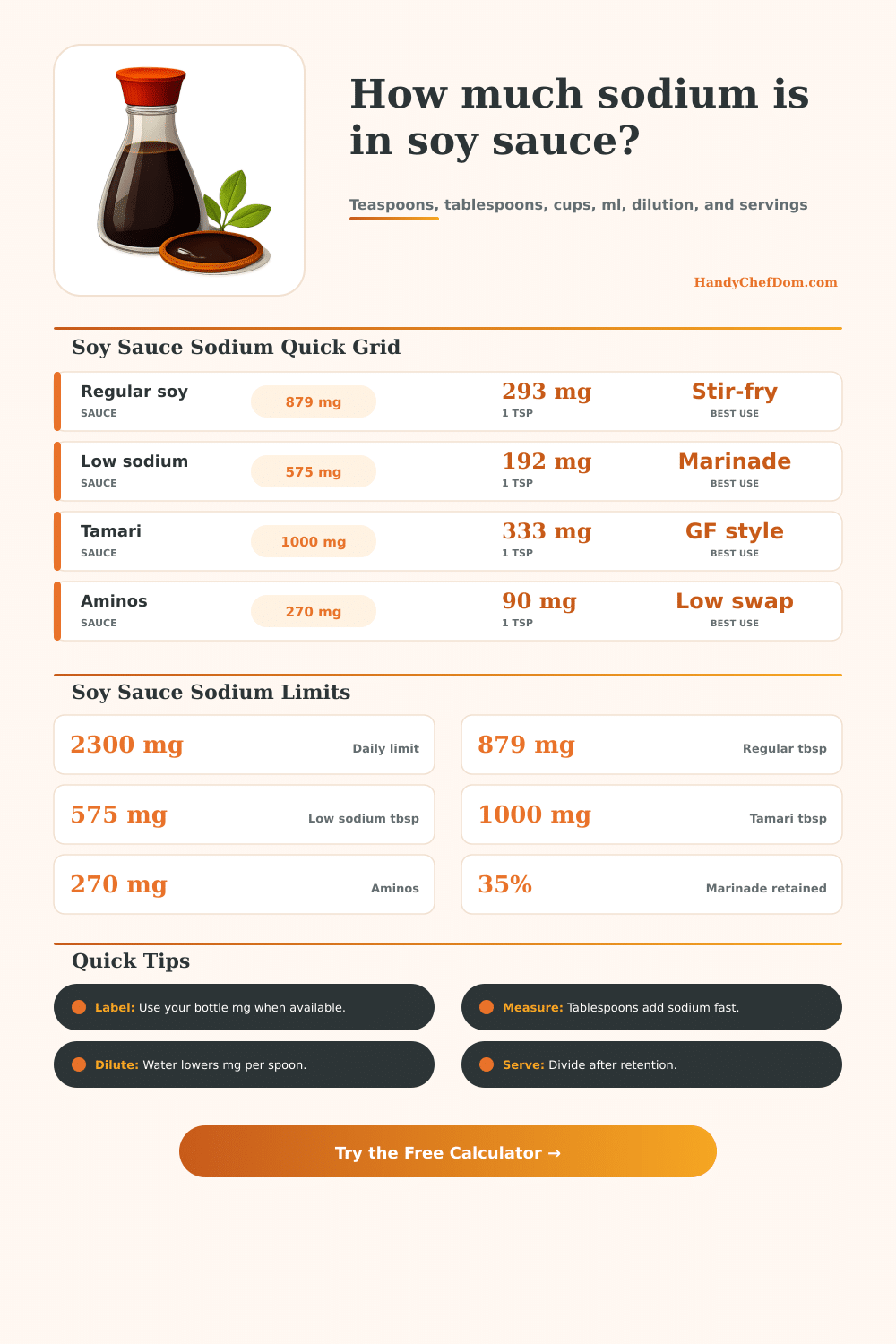
| Regular soy sauce | About 293 mg | About 879 mg | About 3516 mg | Default stir-fries, marinades, dipping sauces, and pantry soy sauce. |
| Low sodium soy sauce | About 192 mg | About 575 mg | About 2300 mg | Better when sodium budget is tight but soy flavor is still needed. |
| Reduced sodium soy sauce | About 197 mg | About 590 mg | About 2360 mg | Use when the bottle says reduced sodium but not necessarily low sodium. |
| Tamari | About 333 mg | About 1000 mg | About 4000 mg | Rich, often wheat-free style sauces that can be high in sodium. |
| Low sodium tamari | About 233 mg | About 700 mg | About 2800 mg | Gluten-free style cooking with a lower sodium target. |
| Coconut aminos | About 90 mg | About 270 mg | About 1080 mg | A sweeter lower-sodium swap, depending on bottle brand. |
| Light soy sauce | About 320 mg | About 960 mg | About 3840 mg | Chinese-style seasoning soy sauce where saltiness is prominent. |
| Dark soy sauce | About 307 mg | About 920 mg | About 3680 mg | Coloring, braising, and glaze recipes where a little goes a long way. |
| Shoyu-style soy sauce | About 300 mg | About 900 mg | About 3600 mg | Japanese-style dipping, noodles, and marinades. |
5Teaspoon, Tablespoon, Cup, and Milliliter Conversion Table
| Measure | Milliliters | Tablespoons | Regular soy sodium | Low sodium soy sodium | Coconut aminos sodium |
|---|---|---|---|---|---|
| 1 teaspoon | 5 ml | 0.33 tbsp | About 293 mg | About 192 mg | About 90 mg |
| 2 teaspoons | 10 ml | 0.67 tbsp | About 586 mg | About 383 mg | About 180 mg |
| 1 tablespoon | 15 ml | 1 tbsp | About 879 mg | About 575 mg | About 270 mg |
| 2 tablespoons | 30 ml | 2 tbsp | About 1758 mg | About 1150 mg | About 540 mg |
| 1/4 cup | 60 ml | 4 tbsp | About 3516 mg | About 2300 mg | About 1080 mg |
| 1/2 cup | 120 ml | 8 tbsp | About 7032 mg | About 4600 mg | About 2160 mg |
| 1 cup | 240 ml | 16 tbsp | About 14064 mg | About 9200 mg | About 4320 mg |
6Marinade, Stir-Fry, Dip, and Dilution Table
| Use type | Default sodium retention | Typical dilution | Calculator interpretation | Practical note |
|---|---|---|---|---|
| Marinade, drained | 35% | Often mixed with vinegar, citrus, oil, or water | Only part of the soy sodium is assigned to the served food. | Discarded marinade can leave a lot of sodium behind. |
| Stir-fry or skillet sauce | 85% | Often diluted by vegetables, stock, or cornstarch slurry | Most sauce is eaten, with a little left in the pan. | Per-serving sodium can climb quickly in small portions. |
| Dip or table condiment | 100% | Often undiluted unless mixed with vinegar or citrus | The full amount poured is counted unless you enter dilution. | Small dishes can still contain several teaspoons. |
| Dressing or cold sauce | 100% | Usually diluted by oil, vinegar, lime, or sweetener | Full sodium is counted but mg per tablespoon of dressing falls. | Dilution changes strength, not total sodium. |
| Glaze reduced on food | 75% | May concentrate as water evaporates | A high share sticks to food, but not always all of it. | Reduction can make each spoon taste saltier. |
| Soup, broth, or sauce base | 90% | Usually heavily diluted by liquid volume | Most sodium remains in the pot and is divided by servings. | Use other sodium for broth or packaged ingredients. |
7Common Soy Sauce Sodium Scenarios
| Scenario | Sauce amount | Type | Use and servings | Estimated per serving |
|---|---|---|---|---|
| Two-tablespoon stir-fry | 2 tbsp | Regular soy sauce | 85% retained across 4 servings | About 374 mg |
| One-tablespoon sushi dip | 1 tbsp | Regular soy sauce | 100% counted for 1 serving | About 879 mg |
| Low sodium marinade | 3 tbsp | Low sodium soy sauce | 35% retained across 4 servings | About 151 mg |
| Tamari noodle bowl | 1.5 tbsp | Tamari | 85% retained across 2 servings | About 638 mg |
| Coconut aminos bowl | 2 tbsp | Coconut aminos | 100% counted across 2 servings | About 270 mg |
| Quarter-cup teriyaki base | 1/4 cup | Regular soy sauce | 75% retained across 8 servings | About 330 mg |
8Two Practical Soy Sauce Sodium Tips
You make a stir fry, and think you’ve added maybe a small pinch of flavor to the dish by pouring in two tablespoons of soy sauce. Except, those two tablespoons holds almost 1800 milligrams of sodium. That is almost eighty percent of what’s recommended for most adult diet in a single day. And before you know it, you’re there.
This is especially true if you make recipe as you go, adjust things here and there, or taste as you cook. Most home cooks believe that soy sauce, being liquid, can’t possibly pack much flavor, so it must be relatively mild compared to sprinkling straight salt over their food. But don’t let its dark color fool you: the concentration is deceptive.
Why Soy Sauce Has So Much Salt
After plugging in your bottle type/amount into calculator above, it does math for you, no need to guess at coefficients or retention rate. To begin with, it will ask you what type of soy sauce you’re working with. Why? Because coconut aminos, tamari, low sodium varieties, and regular soy sauces is all vastly different in their salt content. Coconut aminos provide a much lighter alternative in terms of sodium but still deliver on the umami front without heavy mineral load. Know which bottle is in your cabinet, because it changes everything if you’re tracking intake strictly. What may seem like half a serving of sodium might actualy be double if you’ve replaced your regular soy with tamari but haven’t adjusted volume.
It also takes into account usage, since that’s where most of us fail. Did you marinade some chicken? Then you throw away the marinade when it’s time to cook? You didn’t eat all that sodium. The calculator has retention factors built-in to determine how many grams of sodium actualy stick to whatever it’s applied to and end up in your belly vs. It goes down the sink. With dipping sauces or stir fries, almost none will go down the sink. This prevents you from overestimating the sodium in something like a marinated dish if you threw out the marinade. At the same time, it won’t cause you to underestimate it with something like soup or a glaze. These small details improves accuracy.
People also don’t understand dilution. When you add something like vinegar or water or citrus juice to your soy sauce, you’re reducing the sodium concentration of any given tablespoon of whatever’s left in the mix. But unless you pour out some of that liquid, you haven’t reduced total number of sodium molecules in the pot. With this calculator, you can see more clearly exactly how much sodium is in every spoonful of final sauce… And that’s helpful if you’re creating a sauce or dressing that you’d prefer not to spike with too much salt. It makes the flavor spread across a greater volume and therefore easier to manage.
As a base ingredient, soy sauce adds something that just plain salt doesn’t: depth. It’s made through a fermentation process, which builds many amino acids that increases the savory flavors of meats and vegetables. You’ll be able to get away with using less (and getting a stronger flavor), so when do you cut back? When should you opt for a reduced-sodium version? Knowing this will help inform your decision making. Often, however, the problem isn’t the soy sauce itself, it’s how much you think you need to add in order to achieve good flavor. Adding layers via aromatic ingredients such as ginger, garlic, and chili can lessen your dependence on those salty condiments.
To give you an idea of what the scale looks like, here’s a snapshot of the reference table from the page: See that? One tablespoon of standard soy sauce has almost nine hundred milligrams of sodium. Yikes, that’s a lot of sodium to take in with just one mouthful, particularly if you’re dunking your dumpling or sushi directly into the bowl. Knowing this will make you carefully measure out your portions. Perhaps you’d consider offering soy sauce on the side (in smaller servings) instead of dousing everyone’s food in a big pool. That way, everyone can decide exactly how much they want to really eat.
At the end of the day, mastering soy sauce sodium boils down to two things: measure and be aware. Mindlessly pouring until the bottle’s empty will put you over the limit faster then you realize. But if you have some sort of device to help measure, you add accuracy to what is traditionally a guessing game. You can eat the delicious savory flavor you crave, all while staying mindful of those health goals. As it happens, a little goes an extremely long way…of both flavor and total sodium content. Measure twice, taste once. Let salt enhance the food instead of overpowering it.