🥚 Sour Cream in Scrambled Eggs Calculator
Estimate sour cream teaspoons, tablespoons, grams, tang level, curd texture, servings, cheese balance, herbs, pan heat, and moisture for scrambled eggs.
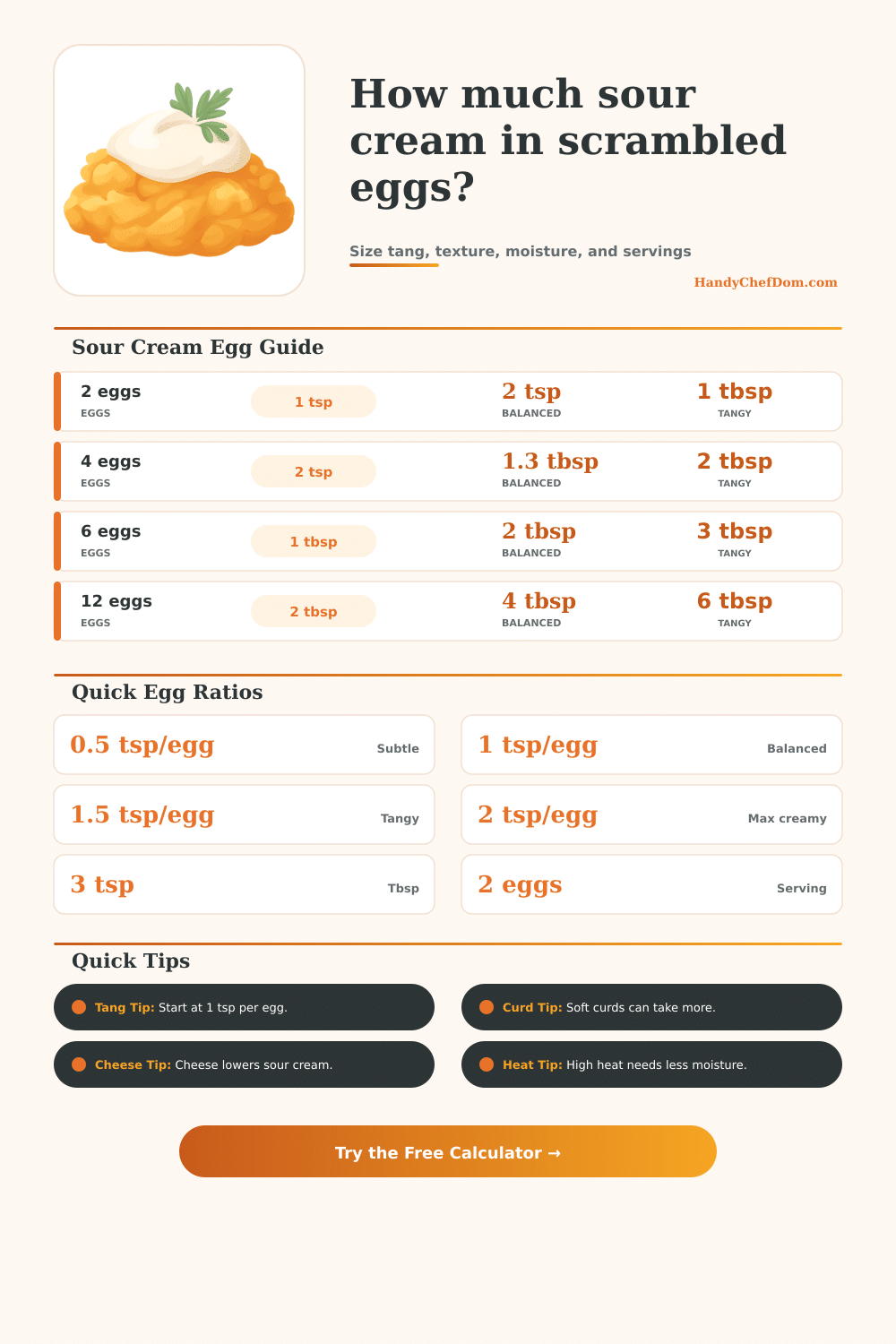
A balanced starting point is about 1 teaspoon sour cream per large egg. The calculator adjusts that ratio for tang, curd size, sour cream thickness, pan heat, moisture target, cheese, herbs, salt, and servings.
Tang Target by Egg Count
| Egg count | Subtle 0.5 tsp/egg | Balanced 1 tsp/egg | Tangy 1.5 tsp/egg |
|---|---|---|---|
| 2 eggs | 1 tsp | 2 tsp | 1 tbsp |
| 3 eggs | 1.5 tsp | 1 tbsp | 1.5 tbsp |
| 4 eggs | 2 tsp | 1 tbsp plus 1 tsp | 2 tbsp |
| 6 eggs | 1 tbsp | 2 tbsp | 3 tbsp |
| 8 eggs | 1 tbsp plus 1 tsp | 2 tbsp plus 2 tsp | 4 tbsp |
| 12 eggs | 2 tbsp | 4 tbsp | 6 tbsp |
Curd Texture Adjustments
| Curd goal | Adjustment | Moisture effect | Best with |
|---|---|---|---|
| Small soft curds | +0.20 tsp/egg | Softest | Low heat |
| Creamy medium curds | +0.10 tsp/egg | Balanced | Medium-low |
| Large folded curds | -0.05 tsp/egg | Set edges | Medium-low |
| Firm diner-style curds | -0.25 tsp/egg | Less loose | Medium |
| Custardy finish | +0.35 tsp/egg | Extra silky | Gentle pan |
| Cheese-heavy curds | -0.15 tsp/egg | Rich but firm | Low salt |
Sour Cream Type Conversion
| Sour cream type | Factor | 1 tbsp weighs | Calculator meaning |
|---|---|---|---|
| Regular full-fat | 1.00 x | 15 g | Default spoon ratio |
| Light sour cream | 0.92 x | 15 g | Use slightly less |
| Creme fraiche style | 1.08 x | 15 g | Richer, less sharp |
| Greek-style thick | 0.86 x | 16 g | Thicker spoonful |
| Loose cultured cream | 1.16 x | 14 g | More volume, softer |
| Lactose-free sour cream | 0.98 x | 15 g | Near regular |
Add-In Balance
| Add-in pattern | Sour cream change | Tang effect | Texture effect |
|---|---|---|---|
| No cheese, no herbs | No change | Clean dairy tang | Direct creaminess |
| Cheese 0.5 tbsp/egg | -0.08 tsp/egg | Softer tang | Richer curds |
| Cheese 1 tbsp/egg | -0.16 tsp/egg | Milder tang | Heavier curds |
| Herbs 0.5 tsp/egg | +0.04 tsp/egg | Brighter finish | Same moisture |
| Herbs 1 tsp/egg | +0.08 tsp/egg | Fresh and sharp | Same moisture |
| Salt over 1 pinch/egg | -0.07 tsp/egg | Tang reads higher | Less slack needed |
Sour cream makes scrambled eggs richer, but it doesn’t turn them into a sauce. The fat in sour cream holds moisture in protein and carries flavor so you end up with a better texture (not just dry curds). It works like butter or cheese does; people do that with their eggs to keep them from releasing too much water while cooking.
It is about deciding how much sour cream you will include and what that dose to the rest of the ingredients. Tang comes from acidity in the sour cream itself. Its texture depend on rate at which the eggs set. This balance is also affected by moisture. If there isn’t enough moisture, the eggs will be tight on your plate. If there’s too much moisture, they won’t hold their form and will slide all over the place.
How to Use the Sour Cream Calculator
Salt, herbs, and cheese all shift this balance by adding fat and seasoning, with salt and herbs specificy making the tang read stronger. Cheese increase both seasoning and fat, while herbs and salt just add seasoning. Pan heat will matter as well. A warmer pan removes water more quickly. Because of this, the sour cream will act different than it would on low heat.
With that information. Including eggs, tang, desired consistency of curd, type of sour cream, moisture level, and add-ins… The calculator above does the math for you. It begins by using a base ratio, then adjusts accordingly in tiny increments for each variable (which is important, since you use more or less sour cream depending on whether you want a soft, creamy curd versus a firmer diner-style variety, how hot it cooks, and what add-ins you use). Milk is used).
It calculates how much sour cream will be necessary, how many grams per egg, and even the breakdown per serving so you can scale from one plate to a brunch tray. Scroll down to see recipe. One starts at a teaspoon per egg, but many will adjust up or down from that point. With the calculator, they don’t have to rely on trial and error to make those tweaks.
One teaspoon of light sour cream has less weight than an equal amount of full-fat, so a given volume provide less richness. Thicker Greek-style sour cream means fewer teaspoons for same effect. With loose cultured cream, you need a little more to get the same result. This wouldn’t of been apparent unless you cooked twice with two different items in the same batch.
People make common errors with the sour cream (straight cream, or milk). Straight cream has no acid, which makes the eggs taste flat. Milk has too much water, and too little fat, the eggs loosen up but don’t feel luxurius at all. If there’s a lot of herbs & salt, the tang reads as stronger, so the calculator backs off on amount of sour cream accordingly. It is the same with cheese, the combination of salt and fat makes it taste like more then just fat.
You’re going for eggs that still taste like eggs, but also carry some added depth. Maximum dairy isn’t your goal here. If you want to double check, you’ll see those relationships expressed in another way as reference tables on the page. After you play with it a couple of times, though, you begin to get the hang of logic.
Use less sour cream for higher cooking temperatures and more dairy for softer curds, because part of the richness you’re looking for is already provided by cheese itself. That’s how those patterns transform a one-off helper app into a sort of brain shortcut, where you’ll continue to employ even after you close the tool. But they don’t end up tasting like science projects. Eggs made this way don’t. They taste like somebody cared about the details that actualy make a difference on your plate.